Breaking News


Popular News


Enter your email address below and subscribe to our newsletter

 ByAiden
The 401(k) vs pension debate isn’t really a debate — it’s a postmortem. American workers who entered the workforce before the 1980s received defined benefit pensions: guaranteed lifetime income, employer-funded, zero market risk. Workers who came after — Millennials, Gen Z, and most of Gen X — got a defined contribution 401(k): a tax-advantaged account where they bear all the risk, the employer contributes as little as legally possible, and retirement security depends entirely on personal savings discipline plus stock market luck. The switch wasn’t inevitable. It was engineered — by corporations looking to cut costs, lobbyists who wrote the tax code, and a generation of lawmakers who had already secured their own pensions.

Key Takeaways: In 1980, 38% of private-sector workers had a defined benefit pension. By 2008, that had fallen to 20% — while 401(k) participation rose from 8% to 31%. The median 401(k) balance today is $38,176 — roughly enough to cover 18 months of average American expenses. Boomers who entered the workforce in the 1960s and 1970s largely missed the gutting of pensions; Millennials and Gen Z walked into a system that had already been stripped. The retirement gap between generations isn’t a matter of individual savings discipline — it’s the result of a deliberate policy shift that transferred all retirement risk from employers to workers.
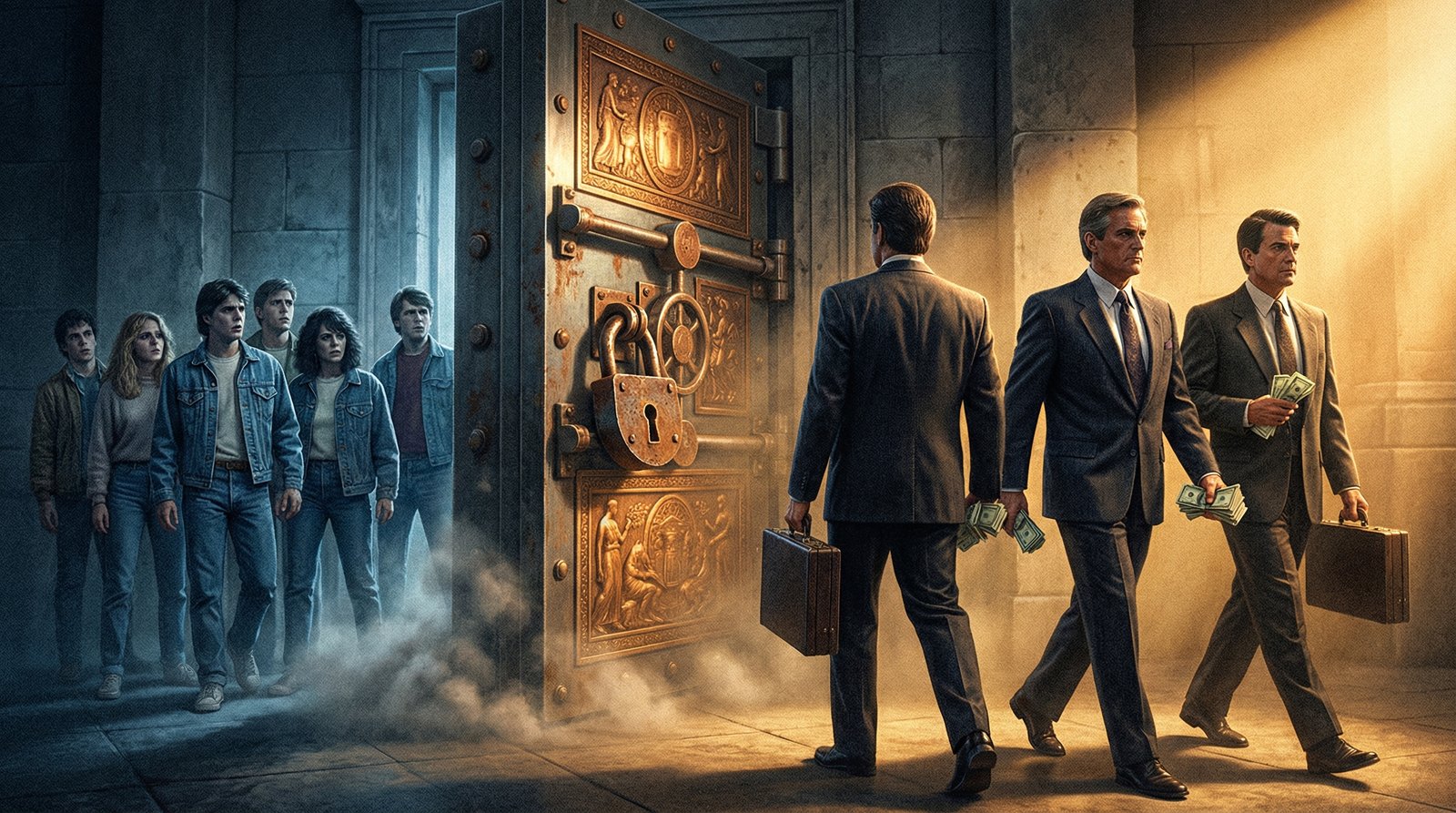
The defined benefit pension wasn’t a gift — it was a hard-fought labor victory. The post-World War II economic boom, combined with strong union density (peaking at 35% of the private workforce in the mid-1950s), produced a labor market where employers competed for workers partly on the basis of retirement security. Companies that wanted to attract and retain skilled workers offered defined benefit plans: the employer promised a specific monthly payment for life after retirement, calculated based on years of service and final salary. The investment risk lived entirely on the employer’s balance sheet.
By 1980, 38% of private-sector wage and salary workers participated in defined benefit pension plans, according to Social Security Administration research. In industries like steel, auto, and manufacturing — dominated by Boomer-era workers — pension coverage was even higher. A factory worker who spent 30 years at GM or Bethlehem Steel could retire at 62 with a guaranteed monthly check for the rest of their life, regardless of what happened to the stock market in 1987, 2001, or 2008.
This wasn’t just security — it was intergenerational wealth accumulation. Workers who didn’t have to save aggressively for retirement could build equity in homes, fund their children’s education, and leave inheritances. The cost of living in the pension era was also dramatically lower — median home prices were 3–4x annual income, not 7–10x as they are today. Boomers didn’t just get pensions. They got pensions while housing, healthcare, and education were still affordable. That combination — guaranteed retirement income plus affordable living costs — is precisely what made middle-class wealth accumulation possible for that generation.

The 401(k) was born in 1978 — almost by accident. The Revenue Act of 1978 inserted Section 401(k) into the tax code, originally to address the tax treatment of profit-sharing programs, not to create a universal retirement system. A benefits consultant named Ted Benna spotted the provision in 1980 and realized it could be used to let employees defer pre-tax salary into investment accounts. He called it a “simple” solution to retirement savings. What followed was one of the most consequential bait-and-switches in American economic history.
The dismantling of the pension system accelerated through the 1980s and 1990s via three mechanisms. First, the Tax Equity and Fiscal Responsibility Act of 1982 and the Tax Reform Act of 1986 reduced the tax advantages of maintaining defined benefit plans, making 401(k)s comparatively cheaper for employers. Second, ERISA regulations — ironically designed to protect workers — increased the administrative and funding burden on pension plans to the point where one study found that increased regulation was the primary factor in 44% of DB plan terminations in the late 1980s. Third, and most bluntly: corporations discovered they could eliminate billions in long-term pension liabilities by switching to 401(k)s and contributing as little as 3–4% of salary instead of the 10–15% required to fully fund a pension.
The great pension freeze came in waves. By December 2006, major American corporations — IBM, Motorola, Verizon, HP — had begun freezing their defined benefit plans. A 2007 survey found that over one-third of remaining DB plan sponsors had recently frozen their plans, with another third expecting to follow within two years. By 2008, private-sector pension participation had collapsed to 20%, while 401(k)-only participation rose to 31%. The wealth generated by those eliminated pension obligations didn’t disappear — it migrated from worker retirement accounts to corporate earnings and executive compensation.

The numbers are staggering — and the averages lie. The average 401(k) balance across all ages in 2024 is $148,153, according to Vanguard data. That sounds almost reassuring until you learn the median balance is $38,176. The median is the number that actually reflects what a typical American has saved — the average is inflated by the relatively small number of high earners with $500,000+ accounts. The typical American worker approaching retirement has $38,176 in their 401(k). The average monthly Social Security payment in 2026 is approximately $1,900. Financial planners consistently recommend replacing 70–90% of pre-retirement income. Social Security covers roughly 40% for average earners. The math doesn’t work.
For Millennials specifically, the picture is grim given their context. The Millennial homeownership collapse means many in this generation won’t have home equity to fall back on in retirement. Student debt has consumed the savings window of their 20s and early 30s — the highest-return years for compounding. Median Millennial household retirement savings sits at approximately $65,000 across all retirement accounts, according to 401k Specialist Magazine. Meanwhile, the Social Security trust fund is projected to be depleted by 2033–2035, at which point benefits could be cut by 20–25% — right when the oldest Millennials are nearing retirement age. And proposed Medicaid cuts could strip healthcare coverage from millions before Medicare eligibility kicks in at 65.
The generational contrast is stark. Boomers who had pensions didn’t need to think about asset allocation, contribution rates, or market timing. Their retirement was defined — a guaranteed number, for life, starting at a set age. Today’s workers spend enormous cognitive and financial resources trying to optimize a system that was never designed to replace pensions — it was designed to supplement them. The financial services industry that administers 401(k)s collects an estimated $30 billion in annual fees from these accounts, a wealth transfer from workers’ retirement savings to Wall Street that has no equivalent in the pension era.

This is the counter-argument most often deployed by financial advisors, libertarian commentators, and people who’ve never had to choose between their 401(k) contribution and a car repair. The argument goes: 401(k)s are portable, you control the investments, and if you’re disciplined and lucky, you can build more wealth than a pension would have provided. There’s a narrow technical truth here. A high-earner who maxes their 401(k) contribution every year for 40 years, in a low-fee index fund, starting at 22, can accumulate more in nominal dollars than a typical pension would have paid. Congratulations to that person.
The problem is that this argument describes almost no one. To build adequate retirement wealth through a 401(k), a worker needs: (1) consistent employment with an employer who offers a 401(k) — 33% of private-sector workers have no access to a workplace retirement plan; (2) sufficient income to contribute meaningfully after housing, healthcare, student debt, and childcare; (3) financial literacy to avoid high-fee funds; (4) 40 years of consistent contributions without a single major disruption — job loss, medical crisis, recession — that forces early withdrawal; and (5) the good fortune not to retire into a market crash that cuts their balance by 30–40% in year one. The pension required none of these conditions. You worked, the employer funded the pension, and you received checks for life. The 401(k) shift didn’t give workers more control. It gave them more risk while stripping away the safety net — and called it freedom.
Meanwhile, the workers who would most benefit from guaranteed retirement income — low-wage workers, those with interrupted careers (disproportionately women), workers in gig or contract arrangements — are precisely the ones least equipped to optimize a 401(k). The pension system, for all its flaws, delivered retirement security to workers who weren’t financial experts. The 401(k) system delivers retirement security primarily to people who were already wealthy enough to save aggressively. That’s not an accident. It’s the design.
Did Boomers all have pensions?
Not universally — pension coverage was concentrated in manufacturing, government, and unionized industries. But in 1980, 38% of private-sector workers had a defined benefit pension, compared to roughly 4% of private-sector workers today. Boomers who entered those industries in the 1960s and early 1970s largely secured pension benefits before the mass freezes of the 1990s and 2000s.
Why did companies stop offering pensions?
Cost and risk transfer. Defined benefit pensions require employers to fund guaranteed future obligations — when markets underperform, companies have to top up the pension fund. 401(k)s shifted all investment risk to employees. They also dramatically reduced employer obligations: instead of funding a guaranteed benefit, companies contribute a fixed 3–6% of salary and their liability ends there.
What is the average 401(k) balance for someone near retirement?
The average 401(k) balance for workers in their 50s is approximately $558,740–$629,000 in 2024, according to Empower and Vanguard data. The median, however, is far lower — the average is skewed by a small number of high-balance accounts. Most workers in their 50s have far less than $500,000 saved, which financial planners generally consider the minimum for a modest retirement supplemented by Social Security.
Can Millennials and Gen Z still retire comfortably with a 401(k)?
In theory, yes — with consistent contributions starting early, low-fee index funds, and no major interruptions to savings. In practice, the combination of student debt, housing costs, stagnant wages, and intermittent employment makes this extremely difficult for the median worker. Studies consistently show Millennials are behind on retirement savings benchmarks, and projected Social Security cuts will compound the shortfall.
Pension participation statistics (1980–2008 decline from 38% to 20%) sourced from the Social Security Administration’s research on the disappearing defined benefit pension. 401(k) balance data (average $148,153, median $38,176) from Vanguard’s 2024 How America Saves report via Yahoo Finance. Age-segmented balance data from Empower and Kiplinger. Millennial median household retirement savings ($65,000) from 401k Specialist Magazine citing ASPPA data. History of the 401(k)’s legislative origins from Morningstar and Georgetown Law’s Timeline of Retirement in the United States. Pension freeze data from ICI and SSA research. All statistics reflect the most recent available data as of February 2026.