
 ByAiden
Section 8 Housing Voucher Waitlist: Why 10 Million Eligible Families Are Left Behind
Share your love
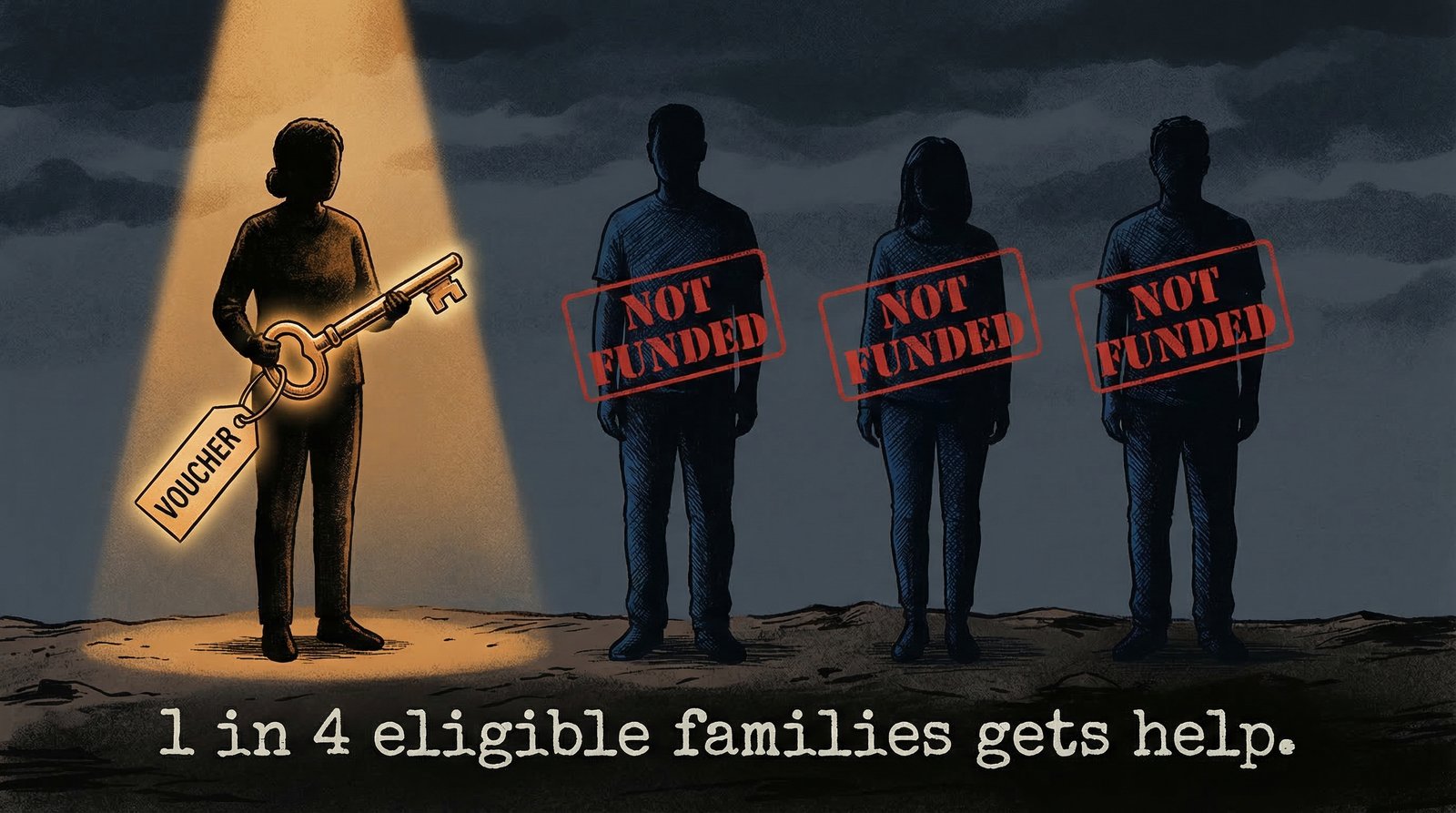
The Section 8 housing voucher waitlist is so long that most eligible families will never reach the top — and in dozens of cities, the list has been closed for a decade or more. Only 1 in 4 households eligible for federal rental assistance actually receives it, leaving an estimated 10 million households who qualify locked out by a congressional funding gap that has persisted for 50 years. The program works — it reduces homelessness, improves children’s outcomes, and costs less than the emergency services it prevents — but Congress has never chosen to fund it for everyone it was designed to help.

Key Takeaways:
- Only 1 in 4 households eligible for federal rental assistance receives it — the other 3 are left out by funding limits, not eligibility.
- Nationally, families that received vouchers in 2024 waited an average of 2 years and 3 months before getting one — and that’s only counting those who eventually got through.
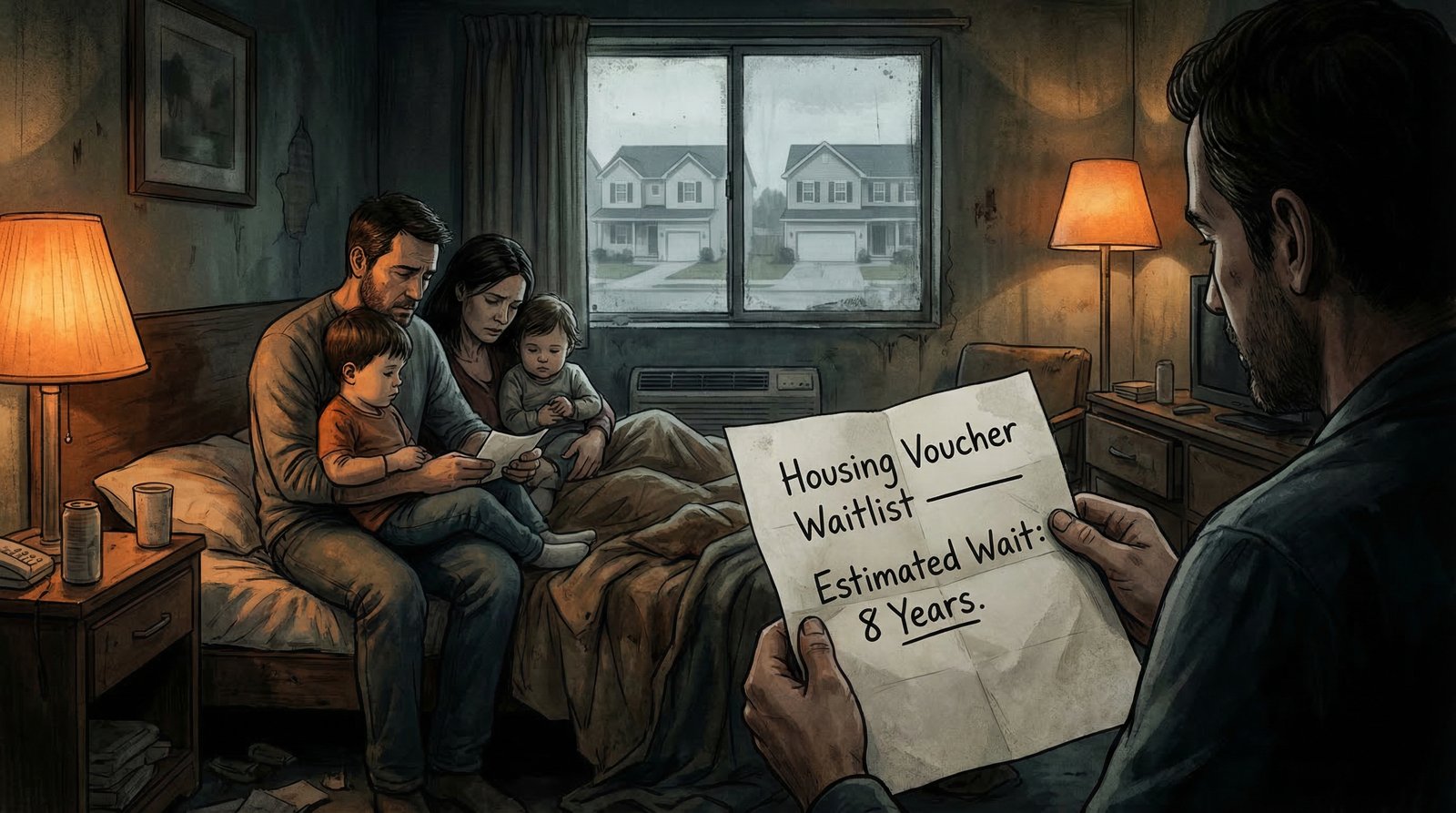
- Among the 50 largest housing agencies, the longest waitlists average up to 8 years. In 2019, 53% of agencies had closed their waitlists entirely.
- When NYC’s NYCHA reopened its Section 8 waitlist in 2024 — closed for nearly 15 years — over 400,000 people applied for 200,000 lottery spots in a single week.
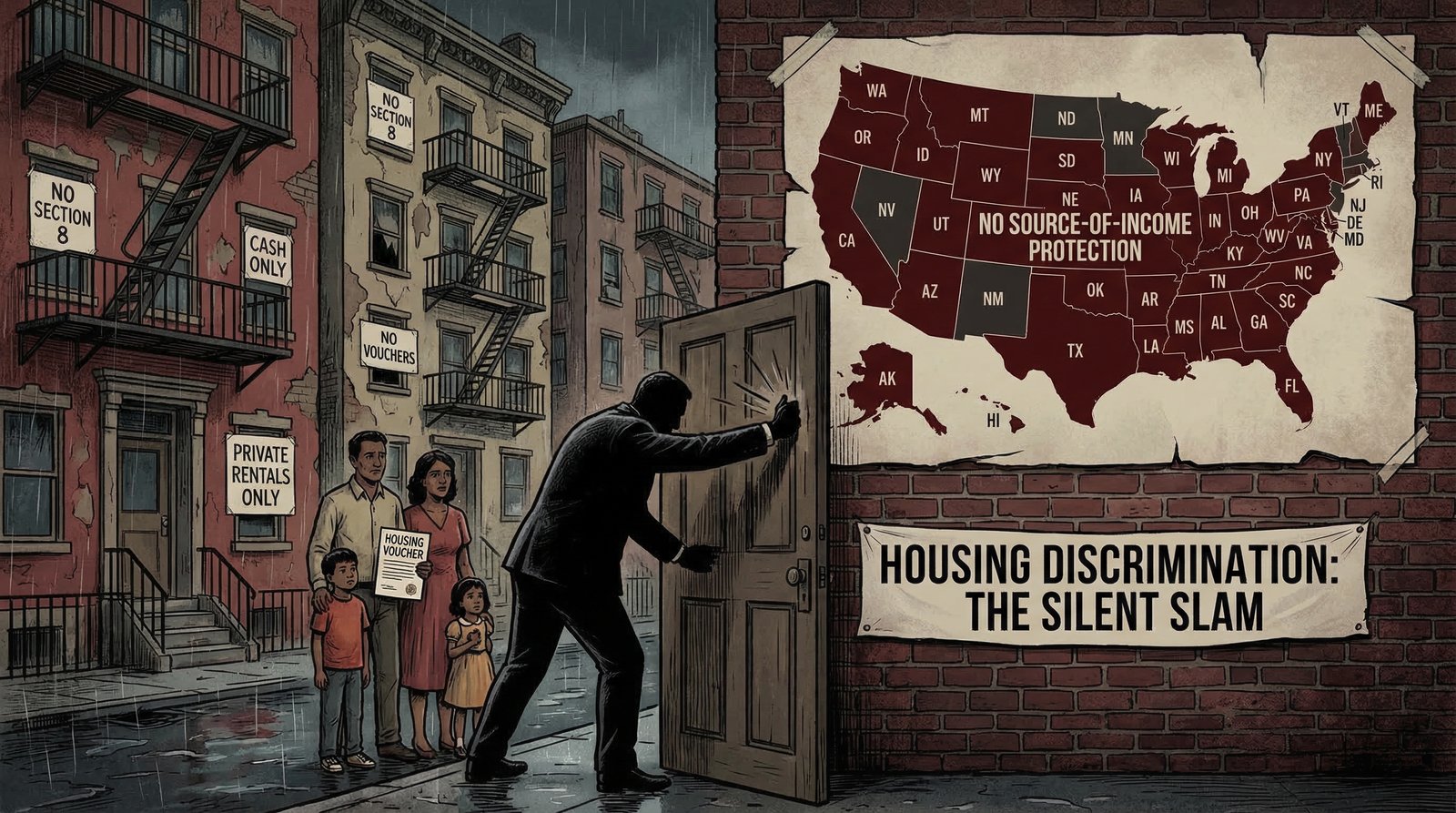
- In 33 states, landlords can legally refuse to rent to voucher holders, turning the voucher into a theoretical benefit with no practical guarantee.
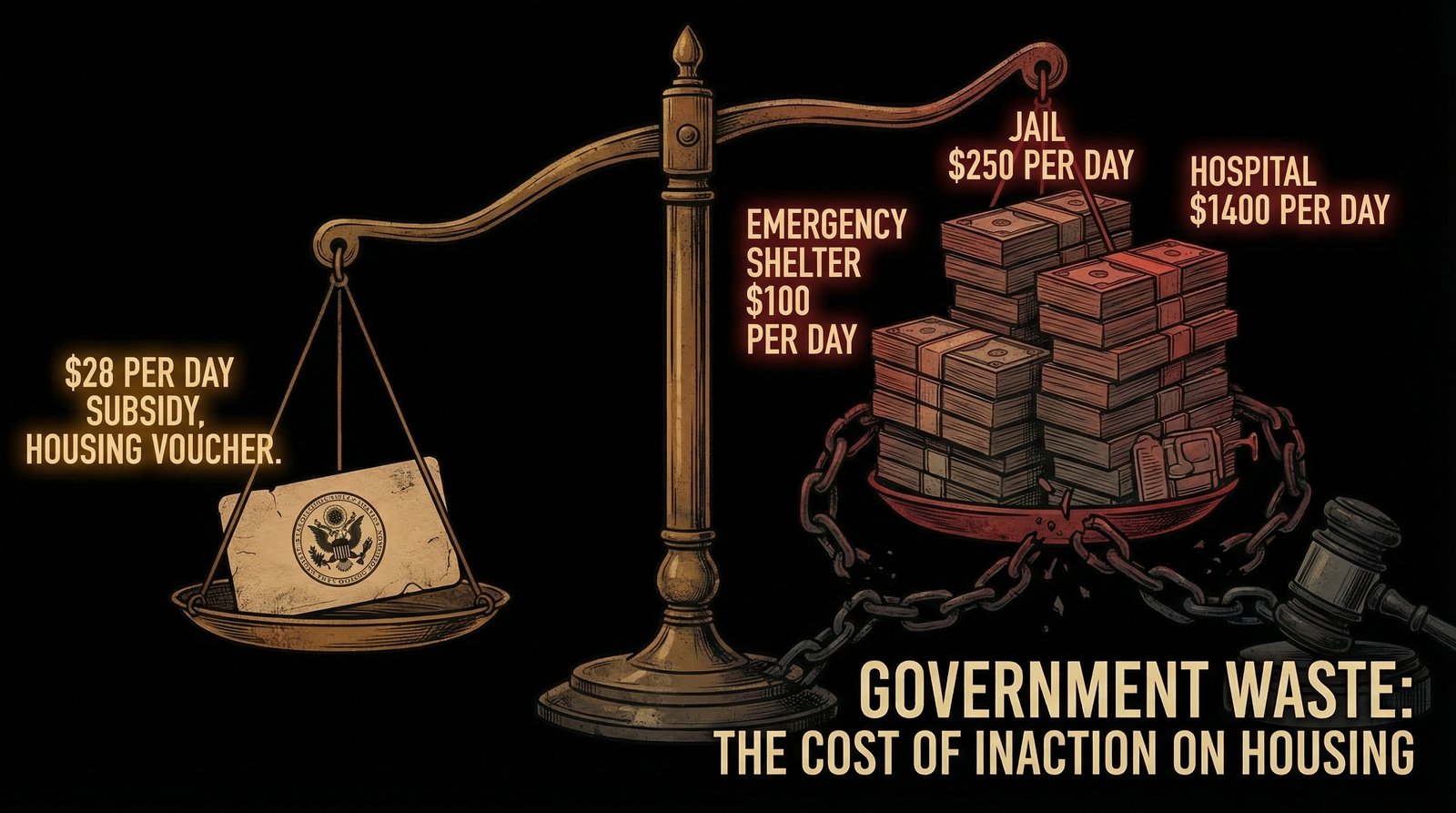
- A housing voucher costs the federal government roughly $28/day per household. Emergency shelter costs $100+/day. Incarceration: $250+/day.
- The Trump administration’s proposed FY2026 budget would slash HUD rental assistance by roughly 40%, including potentially eliminating or curtailing vouchers for hundreds of thousands of households.
- The voucher program serves approximately 2.3 million households today — a fraction of those who need it, with a 7-million-household shortfall compared to the eligible population.
What Is the Section 8 Housing Choice Voucher Program?
The Section 8 Housing Choice Voucher program is the largest federal rental assistance program in the United States. Authorized under Section 8 of the Housing Act of 1937 and substantially reformed by the Housing and Community Development Act of 1974 under the Nixon-Ford administration, it provides rental subsidies to low-income households who use them to rent private-market housing of their choosing — unlike public housing, where the government owns the unit.
The mechanics are straightforward: a voucher holder finds a rental unit, and the federal government — through local Public Housing Authorities (PHAs) — pays the landlord the difference between 30% of the tenant’s income and the fair market rent for the area. The tenant pays no more than 30% of their gross income toward rent and utilities. The federal government covers the rest, up to a payment standard set by HUD.
To qualify, households must earn below 50% of the area median income (AMI), though PHAs are required to prioritize extremely low-income households (below 30% AMI) for 75% of new vouchers. In practice, vouchers predominantly serve the very poor: the average voucher household earns around $15,000–$17,000 per year.
The program is widely regarded — across ideological lines — as one of the most effective federal housing interventions. Rigorous research, including the landmark Moving to Opportunity experiment, has shown that housing vouchers reduce homelessness, lower rates of food insecurity, improve children’s long-term educational and earnings outcomes, and reduce emergency room visits and hospitalizations. They are portable — holders can use them in any jurisdiction that has adopted the program — which gives low-income families access to neighborhoods with better schools and job markets, an opportunity denied to previous generations stuck in concentrated-poverty public housing projects.
Related reading: Wall Street buying homes, the NIMBY zoning machine, the eviction crisis, and why rent is so high.
How Many People Are Waiting for a Section 8 Voucher — and How Long?
The waitlist numbers are staggering — but the real numbers are even worse than the official figures suggest, because they only count people agencies are currently tracking. Millions more never make it onto a list at all.
According to CBPP analysis of HUD data, among families that actually received vouchers in recent years:
- National average wait: 2 years and 3 months as of 2024, per USAFacts — an 8% increase from 2023’s average of 2 years and 1 month.
- Among the 50 largest housing agencies, only two had average wait times under one year. The longest averaged up to 8 years.
- In Chicago, the CHA has waitlists ranging from 6 months to 25 years depending on the type of assistance requested.
- In Los Angeles, the Housing Authority (HACLA) holds periodic lotteries when it briefly opens its waitlist — drawing tens of thousands of applicants for a small number of spots.
- In 2019, CBPP found that 53% of agencies had closed their waitlists entirely to new applicants — meaning millions of eligible families couldn’t even get in line.
The wait-time figures also dramatically understate the actual scope of the problem. These averages cover only people who eventually received vouchers — not the much larger universe of people who applied, waited years, then moved, died, gave up, or were removed from the list for missing a recertification deadline. According to CBPP, the real wait for the average person who puts their name on a list — accounting for all the ways people fall off before receiving help — is significantly longer than the reported average.
“Millions of other families eligible for rental assistance never receive it because their names never rise to the top of the waiting list or they live in communities where the housing agency has closed or doesn’t keep a waiting list.” — Center on Budget and Policy Priorities
The scale of unmet need is not a recent phenomenon. In 2019, roughly 2 million households used vouchers to rent housing. But more than 16 million unassisted renter households paid more than 30% of their income for housing or lived in substandard or overcrowded homes — the federal definition of housing cost burden. The program currently serves approximately 2.3 million households; the eligible-but-unserved population is estimated in the range of 7–10 million additional households.
Why Does Only 1 in 4 Eligible Families Get a Voucher? The Deliberate Underfunding, Explained
The voucher shortage isn’t an accident. It’s a 50-year policy choice by Congress — one made more palatable by the political invisibility of the people it affects and the deep cultural stigma attached to the words “Section 8.”
Unlike Medicaid, Social Security, Medicare, or SNAP — which are entitlement programs that fund everyone who qualifies — the Housing Choice Voucher program is a discretionary appropriation. Congress decides each year how many vouchers to fund. Not how many eligible households to serve. How many vouchers to fund. The number is always lower than the eligible population, and it has always been lower.
The consequences of this distinction are enormous. When the economy tanks and more families fall below the income threshold for eligibility, the voucher pool doesn’t automatically expand. When rents rise faster than voucher payment standards, families with vouchers can’t find units they can afford. When a household loses its voucher because it missed a recertification or moved out of the PHA’s jurisdiction without proper notice, that voucher doesn’t automatically get redistributed — it often gets absorbed by the PHA’s reserve or returned to HUD.
The history of underfunding traces through every administration:
- 1974–1994: Congress funded new incremental vouchers each year, gradually building the program. But it never committed to full funding of the eligible population — always keeping new issuances below demand.
- 1995–2003: A shift from certificates to vouchers brought greater housing choice, but budget constraints forced many PHAs to reduce their portfolios below funded levels.
- 2003: HUD shifted to a unit-cost funding model (rather than per-PHA allocations), which in practice gave PHAs less flexibility and created perverse incentives to serve fewer, more expensive households rather than more, lower-cost ones.
- 2013: Budget sequestration cut HCV funding by approximately $1.7 billion, causing PHAs across the country to issue fewer vouchers and some to cancel assistance for existing holders.
- 2024: The final FY2024 spending bill funded $565 million for 50,000 additional incremental vouchers — a meaningful step, but against a backdrop of 7+ million unserved eligible households, it barely moved the needle.
The political economy of voucher underfunding is also tied to the same NIMBY forces that resist affordable housing construction: property owners and suburban homeowners who don’t want low-income renters in their neighborhoods use political influence to keep payment standards low enough that vouchers don’t work in their ZIP codes, or oppose source-of-income protection laws that would force landlords to accept them. The result is a program that helps a fraction of who it should, channeled disproportionately into already-poor neighborhoods — reinforcing the very residential segregation it was designed to overcome.
The Double Trap: Getting a Voucher Doesn’t Mean You Get Housing
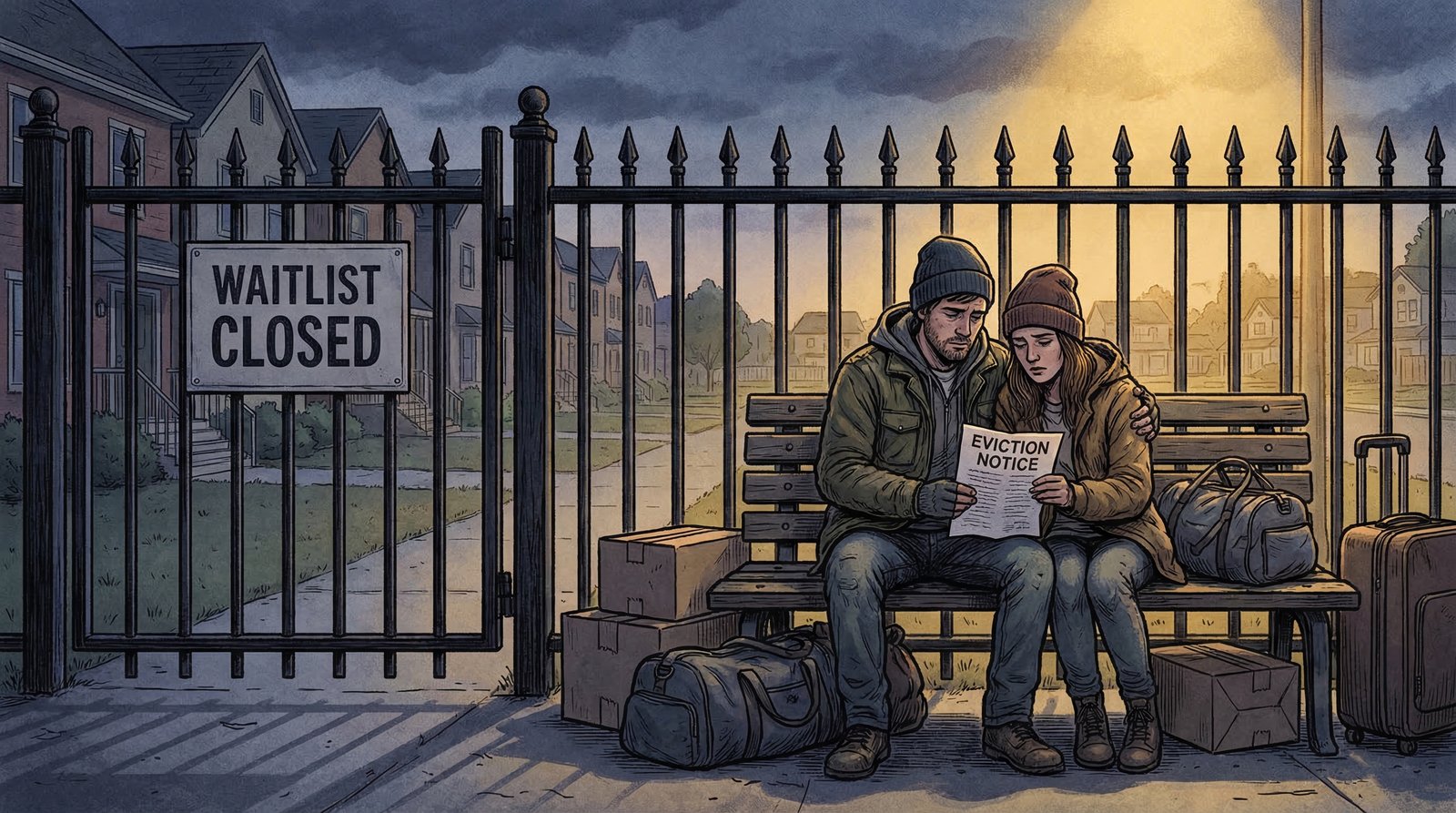
After waiting years for a voucher — surviving homelessness, overcrowding, or severe rent burden in the meantime — many families discover a cruel second barrier: landlords who won’t accept them.
In 33 states, there is no state law prohibiting landlords from refusing to rent to housing voucher holders. This is known as source-of-income (SOI) discrimination, and it is perfectly legal in most of the country. As of 2022, according to the Alliance for Children and Families, only 17 states, 21 counties, and 85 cities had enacted SOI protections. The coverage is wildly uneven — New York City has protections, but large swaths of New York State do not; California has a statewide SOI law, but enforcement is weak.
Research consistently shows that voucher rejection rates by landlords are extremely high, particularly in low-poverty, high-opportunity neighborhoods — precisely the areas where living with a voucher would have the greatest benefit for children’s outcomes. A 2025 WBEZ investigation documented systematic patterns of landlord refusal in Chicago despite local protections on paper. Studies in Dallas, Baltimore, and other cities have found landlord rejection rates of 60–80% of voucher-holding applicants in higher-income ZIP codes.
When landlords do accept vouchers, they often concentrate them in neighborhoods that are already high-poverty — not because that’s where voucher holders prefer to live, but because those are the only landlords who will take them. The result is that the program theoretically offers housing choice but practically delivers housing concentration in the same disinvested areas that low-income families have always been steered toward.
Beyond landlord refusal, voucher holders face a time trap: most PHAs give families 60–120 days to find a unit after receiving a voucher before it expires. In tight rental markets — Los Angeles, New York, Seattle, Denver, Boston — finding an affordable unit that meets HUD quality standards, is in a landlord willing to participate, and falls within the payment standard is nearly impossible in that window. CBPP research found that about 25% of families who receive vouchers fail to use them because they can’t find a unit in time, particularly in high-cost metros. They go back to the bottom of the waitlist.

Vouchers Are Cheaper Than Homelessness — So Why Doesn’t Congress Fund Them?
The economic case for expanding the voucher program is not subtle. It is one of the clearest cost-benefit cases in American social policy, and Congress has ignored it for 50 years.
The federal government spends an average of roughly $10,000–$12,000 per year per voucher household — around $28–33 per day — in net subsidy (the difference between 30% of the household’s income and fair market rent). This is a bargain compared to the alternatives:
- Emergency homeless shelter: $35–$100+ per person per night in most major cities, with some family shelter placements exceeding $200/night in high-cost markets like New York.
- Jail or prison: Average $250–$350 per day per incarcerated person nationally; in states like California, $150,000+ per year.
- Hospital emergency department visit triggered by housing instability: $1,400–$2,700 per visit, with frequent recurrence among chronically homeless individuals.
- Foster care: $25,000–$50,000 per child per year — a system that housing instability disproportionately feeds.
Multiple rigorous studies have quantified the downstream savings from stable housing. The HUD-sponsored Family Options Study found that long-term rental subsidies — essentially vouchers — produced significantly better housing stability outcomes than emergency shelter or transitional housing at lower total system cost. Research from the Urban Institute found that expanding vouchers to all eligible households would cost approximately $22.5 billion per year in new federal spending but would generate substantial offsets in reduced emergency shelter, Medicaid, and criminal justice costs.
The reason Congress doesn’t act isn’t ignorance of these facts — it’s political economy. The people who benefit from vouchers are among the least politically powerful constituencies in America: very poor renters, disproportionately women, disproportionately people of color, with low voter turnout, no major lobby, and no organized campaign infrastructure. The people who would pay for expanded vouchers through taxes — or who fear voucher holders moving into their neighborhoods — are organized, vote consistently, and have contributed generously to the revolving-door lobbying machine that keeps federal housing policy frozen.
A housing voucher costs $28/day. An emergency shelter bed costs $100+. A jail cell costs $250+. Congress has defunded the cheap option for 50 years and then complained about the expensive ones.
The NYC Lottery That Exposed the Crisis: 400,000 Applied for 200,000 Spots in One Week
In June 2024, the New York City Housing Authority (NYCHA) reopened its Section 8 Housing Choice Voucher waitlist for the first time in nearly 15 years. The waitlist had been closed since approximately 2009 — meaning that for a decade and a half, low-income New Yorkers who needed rental assistance couldn’t even get in line.
NYCHA announced it would accept 200,000 new applicants via lottery to be added to its existing waitlist. The application window was open for one week: June 3–9, 2024. In that single week, more than 400,000 people applied — more than twice the available spots — according to amNY reporting. These were not random applicants; they were households with income low enough to qualify for a federal rental subsidy, living in one of the most expensive rental markets in the world, desperate enough to navigate the application process when the window briefly cracked open.
The NYC story is extreme in scale but not unusual in kind. The same dynamic plays out whenever a major city PHA opens its waitlist:
- The Los Angeles Housing Authority (HACLA) runs periodic lotteries with similarly overwhelming demand. In Michigan, 85,000+ residents are on the statewide waitlist — and growing.
- Chicago’s waitlist — for units that may take 6 months to 25 years to arrive — has remained perpetually oversubscribed.
- In many smaller cities and rural areas, the waitlist was never opened in the first place, or was closed in the early 2010s during sequestration and never reopened.
The NY Times’ reporting on the NYCHA reopening noted the tragic mathematics: the 200,000 people who “won” the lottery to be placed on the waitlist were not guaranteed vouchers. They were placed on a list for vouchers that would be distributed over the following years as existing holders leave the program and funding allows new ones to be issued. Receiving a spot in the lottery meant you might receive housing assistance — in a few years, if the program remained funded, if your circumstances still qualified.
The demographic profile of those 400,000 applicants reflects what national data consistently shows: approximately 44–46% of Housing Choice Voucher households are Black, around 20% are Hispanic, and the vast majority are headed by women. The waiting list is not abstract. It is a list of specific people — many of them children — who qualify for federal help that was authorized in 1937, reformed in 1974, and still not funded for all of them in 2025.
Now They Want to Cut It Further: How the Trump HUD Budget Makes a Crisis Into a Catastrophe
The Housing Choice Voucher program was already serving a fraction of the eligible population. The Trump administration’s 2026 budget proposal, if enacted, would take a broken program and break it further.
According to NPR reporting on the White House FY2026 budget proposal, the administration is considering slashing federal rental assistance by approximately 40%. The proposal includes:
- Capping rental subsidies at two years for able-bodied adults — regardless of the rental market they live in or the availability of housing they can afford without assistance.
- Converting housing vouchers to a block grant model, which would give states fixed sums and allow them to design their own programs — and in practice, would allow Republican-controlled states to gut or eliminate rental assistance entirely.
- Potential elimination of the Emergency Housing Voucher (EHV) program, which serves 50,000+ households including domestic violence survivors, people experiencing homelessness, and those aging out of foster care.
- Deeper cuts in the House FY2026 appropriations bill: $2.2 billion less than FY2025 in overall HUD funding, per NLIHC.
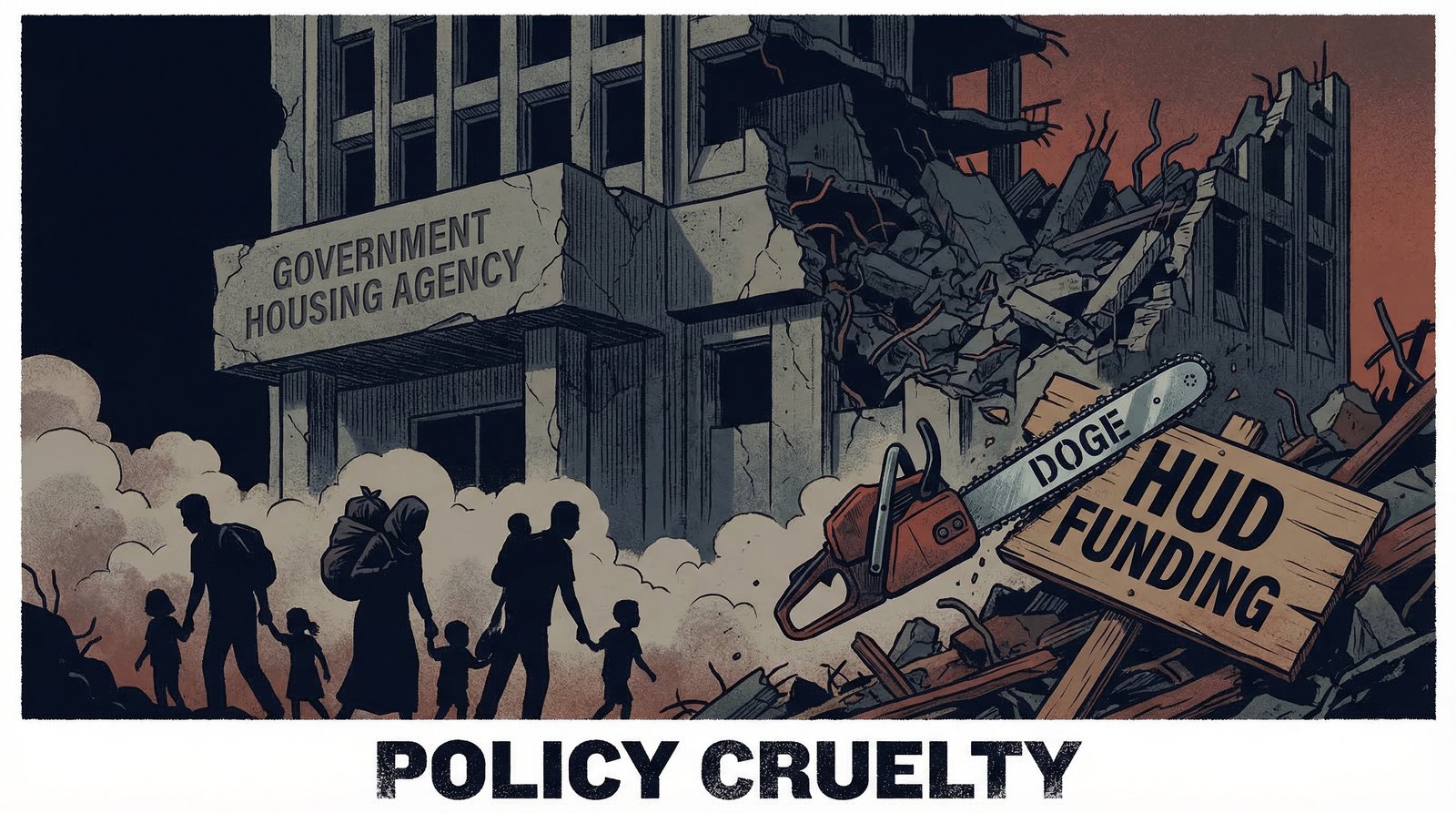
The National Alliance to End Homelessness estimates that at least 170,000 people are expected to lose their supportive housing from HUD’s policy shifts already in motion, separate from the proposed budget cuts. DOGE-directed staff reductions at HUD have eliminated institutional capacity that processes voucher renewals, inspects units, and manages PHA compliance — meaning the administrative capacity to even distribute existing vouchers is shrinking.
The proposed cuts come at a moment when homelessness is already at a record high. The 2024 Annual Homeless Assessment Report found 771,480 people experiencing homelessness on a single night in January 2024 — the highest count in the report’s history. Cutting rental assistance will directly increase that number, channel more families into emergency shelters and hospitals, and cost the federal government more in emergency services than it saves in voucher expenditure. The math has been done. It doesn’t support the cuts on any terms other than ideological ones.
The Counter-Argument: Vouchers Aren’t the Only Answer (And Sometimes Make Things Worse)
The case for vouchers is strong, but critics from both left and right have legitimate objections worth engaging.
The supply problem: A voucher is only as useful as the rental housing available to use it in. In markets where vacancy rates are 1–3% and rents have risen 30–50% since 2019, vouchers can chase housing without creating it — and in extreme cases, can contribute to bidding up rents in the remaining affordable-rate units that landlords will accept. Critics from the supply-side school argue that vouchers are a demand-side fix to a supply-side problem: the real solution is building more housing, particularly the “missing middle” density (duplexes, triplexes, small apartments) that was zoned out of existence by Boomer-era land-use policies. The NIMBY zoning machine created the shortage; vouchers can’t unbuild it. Both things need to happen.
Neighborhood concentration: Despite the program’s intent to promote housing mobility, the practical barriers — landlord refusal, tight search windows, payment standards that don’t reflect opportunity-neighborhood rents — mean voucher holders often end up concentrated in the same neighborhoods that public housing always concentrated them in. Critics argue the program’s design reinforces residential segregation more than it overcomes it, and that without mandatory source-of-income protections and realistic payment standards for opportunity neighborhoods, the mobility promise is largely theoretical.
Administrative complexity: The program’s inspection requirements, payment standards, and recertification processes create real burden for both landlords and tenants. Some smaller landlords decline vouchers not out of animus but because HUD inspections and paperwork overhead are genuinely inconvenient for a four-unit building owner who isn’t a property management company. Reforms that streamline landlord participation could meaningfully improve utilization rates without increasing costs.
None of these criticisms argue for cutting the program. They argue for fixing it — expanding supply alongside demand, strengthening source-of-income protections, raising payment standards to reflect actual opportunity-area rents, and streamlining participation. The critics who use these limitations as justification for the Trump-style 40% cut are not engaged in good-faith policy reform. They are using legitimate design critiques as cover for a political goal of eliminating federal housing assistance.
FAQ: Section 8 Housing Voucher Waitlist
How long is the Section 8 housing voucher waitlist?
Nationally, families that received vouchers in 2024 had waited an average of 2 years and 3 months. But this figure only covers people who eventually got a voucher — not the much larger population who applied and never made it through. Among the 50 largest housing agencies, the longest waitlists average up to 8 years. In many cities including New York, Los Angeles, and Chicago, the wait is measured in years to decades. In 2019, 53% of agencies had closed their waitlists entirely — meaning millions of eligible families couldn’t even start the clock.
Why do only 1 in 4 eligible households get housing vouchers?
Because Congress has never chosen to fund the program for all eligible households. Unlike Medicare, Medicaid, and SNAP — entitlement programs that fund every qualifying person — the Housing Choice Voucher program is a discretionary appropriation. Each year Congress decides how many vouchers to fund, and for 50 years that number has been far below the eligible population. There is no legal requirement to serve everyone who qualifies; it’s a policy choice to leave 3 in 4 eligible households without help.
Can landlords refuse to accept Section 8 vouchers?
In 33 states, yes — landlords can legally refuse to rent to voucher holders with no legal consequence. This is called source-of-income discrimination, and it is only prohibited in 17 states plus Washington DC and roughly 100 counties and cities. In states with protections, enforcement is often weak. Research consistently shows that landlord rejection rates are highest in precisely the higher-opportunity neighborhoods where vouchers would do the most good for families and children. About 25% of families who receive vouchers fail to use them because they can’t find a willing landlord within the search window.
How much does the Section 8 program cost and is it worth it?
The federal government spends approximately $10,000–$12,000 per year per voucher household — roughly $28–33/day. This compares to $100+/day for emergency shelter, $250+/day for incarceration, and $1,400+/visit for emergency room care — all expenses that housing instability directly drives. Multiple studies have found that the downstream savings in reduced emergency services, Medicaid, foster care, and criminal justice costs offset a significant portion of voucher expenditure. Fully funding the program for all eligible households would cost approximately $22.5 billion per year in new spending — less than what the federal government spends annually on mortgage interest deductions that primarily benefit upper-income homeowners.
Sources & Methodology
Data sources used in this article:
- Center on Budget and Policy Priorities — “Families Wait Years for Housing Vouchers Due to Inadequate Funding” — average wait times by PHA, 53% agency waitlist closure rate (2019 survey), 1-in-4 eligible households served, 16 million unassisted cost-burdened renter households (2019)
- USAFacts — “How long do people wait for subsidized housing in the United States?” — 2 years 3 months national average wait time 2024 (8% increase from 2023)
- amNY — NYC Section 8 waitlist reopening June 2024 — 200,000 lottery spots, 400,000+ applications
- New York Times — “Waiting List for Section 8 Housing Vouchers” (June 2024) — NYCHA waitlist closed ~15 years, reopened details
- ABC7 Chicago — CHA waitlist 6 months to 25 years
- Alliance for Children and Families — Source-of-income discrimination: 17 states, 21 counties, 85 cities (2022)
- WBEZ — “Section 8 renters say landlords routinely reject their housing choice vouchers” (2025)
- Housing Assistance Council — FY2024 HUD voucher funding: $565 million for 50,000 incremental vouchers
- NPR — “Trump budget would slash federal rental aid by 40%”
- National Low Income Housing Coalition — FY2026 HUD spending bill comparison: House $2.2B cut vs Senate $3.3B increase
- National Alliance to End Homelessness — 170,000 expected to lose supportive housing from HUD policy shifts
- HUD 2024 Annual Homelessness Assessment Report (AHAR) — 771,480 people experiencing homelessness single-night count January 2024 (record high)
- Congressional Research Service — Section 8 Housing Choice Voucher Program overview
- New York State Comptroller — HPD HCV program: 36,000 households, $1,408/month average cost (November 2024)
Methodology: Wait-time figures from CBPP and USAFacts reflect average time from waitlist entry to voucher receipt among households that successfully obtained vouchers — not the median or mean experience for all applicants, which includes those who never receive assistance. The “1 in 4” figure is CBPP’s calculation comparing active voucher households (~2 million in 2019, ~2.3 million 2024) to estimated eligible households based on HUD income limits applied to ACS renter data. Cost-per-day voucher comparison uses HUD’s average federal subsidy per household year divided by 365; emergency service comparisons use published government and NLIHC cost data. Demographics figures use HUD PIH Resident Characteristics Report data (FY2022), the most recent comprehensive breakdown available.