The United States is the world’s largest oil producer — pumping more than 13 million barrels per day — and yet Americans are paying $3.25 a gallon at the pump while diesel sits at $4.16, the highest since 2023, because a war in the Middle East choked a shipping lane half a world away. The American energy independence myth is one of the most expensive lies in modern political history: a story sold by Boomer-era politicians and oil executives that conflated record production with actual price protection for American consumers — two things that have almost nothing to do with each other.

What ‘Energy Independence’ Actually Means (And Doesn’t)
The phrase “energy independence” has been a staple of American political speeches since Nixon coined it after the 1973 Arab oil embargo. Every president since has promised it. Trump ran on it in both 2016 and 2024. The shale revolution of the 2010s finally let politicians declare victory — the US hit 13+ million barrels per day in 2024, surpassing Saudi Arabia and Russia, and became a net total petroleum exporter for the first time since 1949. Cue the ticker-tape parade.
Here’s what “energy independence” actually means in practice: the US imports roughly 6.28 million barrels per day of crude oil while exporting about 4.1 million barrels per day. On a net basis, yes, exports exceed imports when you count refined products. But those aren’t the same barrels — and that distinction is the entire ballgame. Americans who think energy independence means they’re insulated from a Hormuz closure or a Saudi production cut have been sold a story that’s true in a technical accounting sense and completely false in the sense that matters at the pump.
Key Takeaways
• The US produces 13+ million barrels/day — the world’s largest producer — yet still imports 6.28M bpd
• 70% of US refinery capacity was built for heavy crude; US shale produces light crude — they don’t match
• Oil is a fungible global commodity: when Brent spikes due to Iran, US pump prices spike regardless of domestic output
• Congress lifted the 40-year crude export ban in 2015 — locking in US consumer exposure to global prices permanently
• The fracking revolution’s biggest beneficiaries were oil executives, landowners, and energy investors — not the Millennial filling up a tank
• The Jones Act adds an estimated $403M/year in unnecessary US petroleum shipping costs that consumers absorb
• “Energy independence” was always a production story — never a consumer price protection story
The Refinery Trap: Why America Exports Light and Imports Heavy
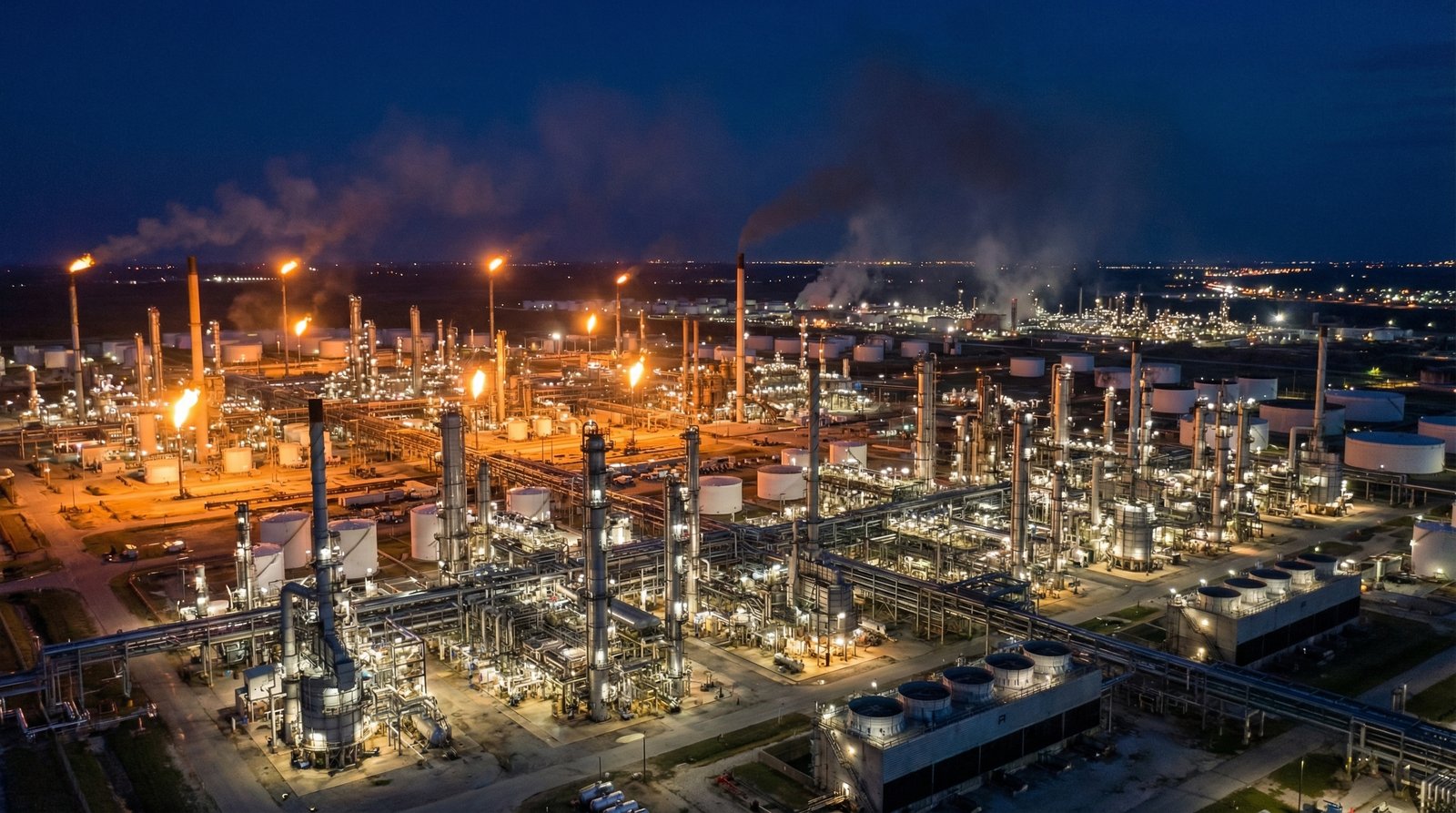
The US shale revolution produced an ocean of light sweet crude — the stuff that flows out of the Permian Basin and Bakken formation in North Dakota. Light crude is excellent for gasoline. The problem is that roughly 70% of US refinery capacity was built and optimized decades ago — specifically for heavy crude, the thick, dense oil that historically flowed from Venezuela, Mexico, and the Middle East. Heavy crude refineries are engineering marvels calibrated to squeeze maximum diesel and jet fuel yield from sludge that light crude refineries can’t efficiently process.
The result is a structurally absurd trade: the US exports light crude (much of it to Europe and Asia) and simultaneously imports heavy crude (mostly from Canada at 60%, plus Mexico and elsewhere) to run its own refineries. About 90% of all US crude imports are heavy crude. Upgrading a single major refinery from heavy to light crude processing costs upward of several billion dollars and takes years to permit and build. Nobody has done it at scale because the economics never justified it — until now, when the Iran war energy shock is making everyone reconsider the entire architecture of American energy infrastructure.
This wasn’t an accident. It was a decades-long series of investment decisions — made during the exact era of Boomer political dominance — that prioritized short-term cost efficiency over strategic resilience. The refinery infrastructure that locks America into global heavy crude markets was built and locked in during the 1970s through 1990s. The same generation that couldn’t fix bridges, roads, and broadband also couldn’t be bothered to futureproof the oil system they were supposedly making independent.
Oil Fungibility: The Mechanism That Kills the Myth
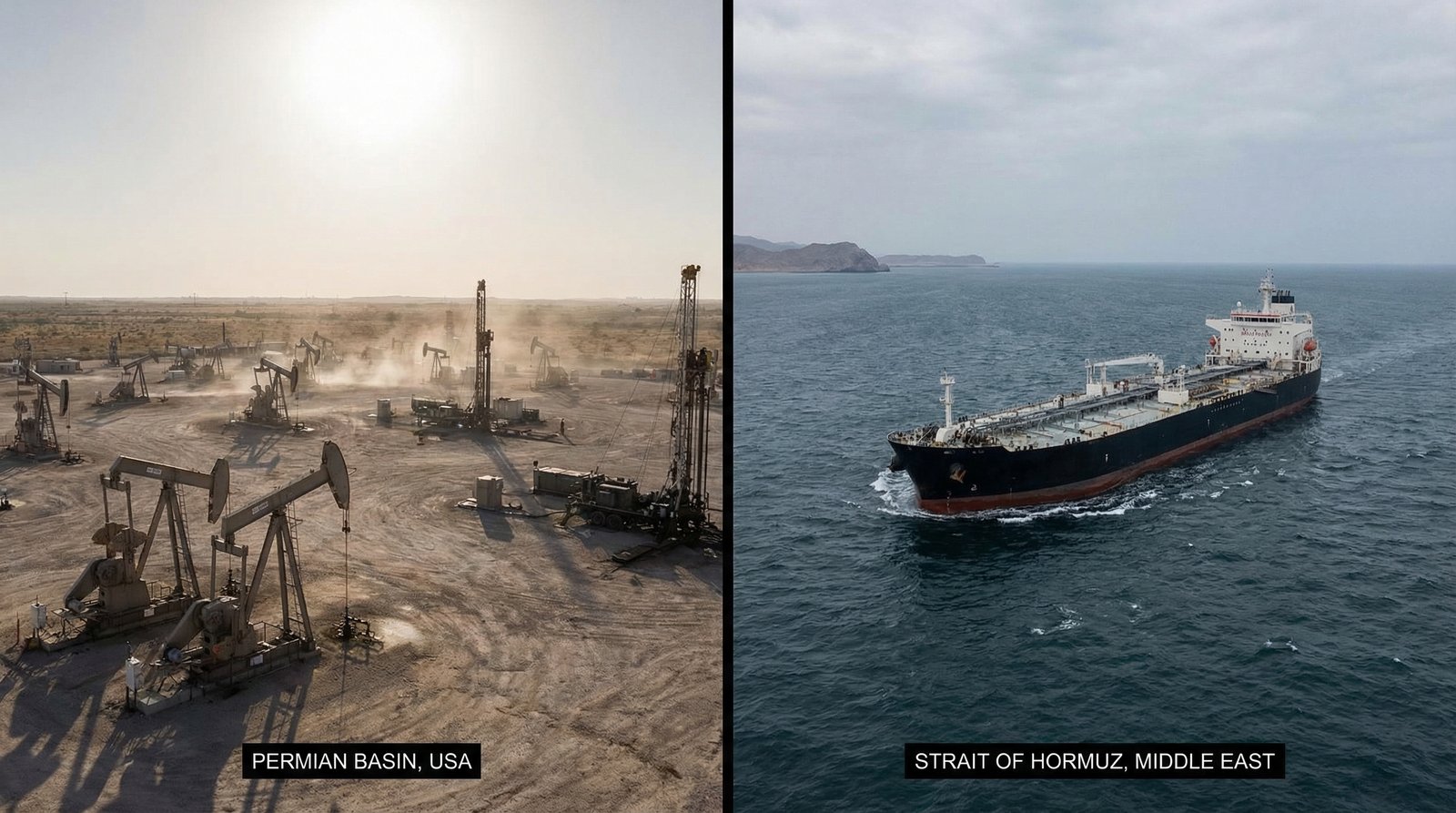
Even if the refinery mismatch were fixed tomorrow, Americans would still pay global prices. Oil is a fungible commodity — meaning one barrel is interchangeable with another, and the entire global market prices off unified benchmarks: Brent Crude for international prices, WTI (West Texas Intermediate) for US domestic prices. The two benchmarks trade within a few dollars of each other almost all the time.
Here’s the mechanism that makes “energy independence” a consumer fiction: if US domestic oil prices fell significantly below global Brent prices, refiners and traders would simply export more US crude until the price equalized. The arbitrage is automatic and instant. This is not a conspiracy — it’s just how commodity markets work. As the American Fuel & Petrochemical Manufacturers put it plainly: “Our gasoline prices are linked to the global crude oil price benchmark (Brent).” When the Iran war sent Brent up 7% on day one, US retail gas prices followed within days. Domestic production level was irrelevant.
The Council on Foreign Relations framed it exactly right: “Oil is a fungible commodity, and it is a global commodity. Thus, oil has a global price susceptible to fluctuations in the global market.” Every barrel of American shale oil produced in the Permian Basin trades against every barrel of Saudi crude on the same global exchange. There is no American price. There is only the price.
How the 2015 Export Ban Repeal Made It Worse for Consumers
Here’s where the story takes a turn that most people don’t know about. Before December 2015, the US had a 40-year-old ban on exporting crude oil — enacted after the 1973 oil embargo specifically to protect American consumers from global price volatility. Because US crude couldn’t leave the country, it built up domestically, and WTI prices traded at a meaningful discount to Brent. American refiners were buying cheaper oil than their global competitors. US consumers were partially insulated from global shocks by the sheer trap of domestic crude that couldn’t go anywhere else.
In December 2015, Congress lifted the ban as part of a $1.1 trillion spending bill — one of those omnibus packages nobody reads. The oil industry had lobbied hard for it. The fracking boom had created a domestic light crude glut that was depressing WTI prices, which was great for consumers but terrible for producer margins. Lifting the ban let producers export their product at global Brent prices. WTI converged toward Brent. The consumer discount evaporated. According to the Federal Reserve Bank of Kansas City, after the ban was lifted, US crude exports rose sharply even as the WTI-Brent spread narrowed — exactly as critics had warned. The industry won. Consumers lost. And the revolving door between oil industry lobbyists and energy policy staff ensured nobody in power was particularly bothered by the outcome.
Who Actually Won the Fracking Revolution
The fracking revolution was real. It genuinely transformed US oil and gas production and did provide some consumer benefit — the Trump White House estimated it saved US consumers approximately $203 billion annually, or $2,500 per household of four, compared to pre-fracking price baselines. Brookings calculated that fracking caused natural gas prices to drop 47% compared to what they would have been. Those aren’t nothing numbers.
But the distribution of those gains tells a very different story. The biggest financial winners of the fracking revolution were: energy company shareholders (ExxonMobil, Chevron, Pioneer Natural Resources); private equity firms that bought and sold fracking operations; Texas and North Dakota landowners who held mineral rights; and executive compensation packages at the major drillers. The workers who actually operated the rigs — often young men without college degrees from working-class towns — got wages that peaked and then collapsed when oil prices crashed in 2014–2016, and then again in 2020. Many of the boom towns that grew up around shale plays are still recovering from those busts.
For Millennials and Gen Z who don’t own mineral rights, don’t hold energy stocks, and aren’t executives at Chevron, the fracking revolution showed up as: marginally lower natural gas bills in some years, offset by the permanent loss of any domestic crude price discount after the 2015 export ban repeal. The same capital gains tax structure that let energy investors keep most of their fracking windfall tax-advantaged meant younger workers who have no investment portfolio to speak of captured almost none of the upside — while being fully exposed to every downside price shock.
The Jones Act: The Hidden Tax That Jacks Up Your Gas Bill
There’s one more layer to the American energy independence con that rarely gets discussed: the Jones Act of 1920. This century-old law requires that goods shipped between US ports must travel on ships that are US-built, US-owned, US-crewed, and US-flagged. In practice this means that moving crude oil from the Gulf Coast to the East Coast — a route that’s entirely domestic — costs dramatically more than shipping the same crude from a foreign port to the East Coast on an international tanker.
The result: East Coast refineries often import crude from overseas rather than pay the Jones Act premium to ship American crude from the Gulf. A 2025 MIT CEEPR working paper and NBER analysis by economists at the University of Chicago’s EPIC found that Jones Act restrictions cost the US petroleum market approximately $403 million per year in unnecessary inefficiency — costs that ultimately land on consumers as higher prices. Repealing the Jones Act for domestic petroleum shipping would nearly eliminate East Coast imports of jet fuel and ultra-low-sulfur diesel, lowering East Coast prices. The law has survived intact for over a century because the US maritime industry lobby — a classic example of regulatory capture protecting entrenched incumbent industries — has blocked every reform attempt. It’s a Boomer-era policy architecture operating on a Progressive-era law, costing American consumers hundreds of millions annually, with zero constituency for fixing it.
But Wait — Doesn’t More Production Lower Prices?
The counter-argument to all of this is straightforward: more domestic production adds supply to the global market, and more supply does lower global prices at the margin. That’s true. The shale boom of the 2010s, combined with weakening OPEC discipline, contributed to the oil price collapse of 2014–2016 that briefly brought US gas prices below $2/gallon. More US production does mean Brent prices are somewhat lower than they’d otherwise be.
But “somewhat lower than they’d otherwise be” is not what politicians promised when they said “energy independence.” What they promised was insulation — the ability to tell OPEC and the Middle East to go pound sand. What they delivered was a production achievement that still leaves American consumers paying Brent-linked prices, still leaves 70% of US refinery capacity dependent on imported heavy crude, still leaves American LNG exports exposed to Hormuz disruption pricing, and still delivers the majority of its financial benefits to the top of the wealth distribution. Fortune reported in March 2026 that while US oil and gas exporters are benefiting from the Iran war price spike, they “can’t fill the Middle East supply gap” — meaning the Hormuz closure is a net price negative for American consumers even as it’s a windfall for domestic energy producers. The same Iran war inflation dynamic that’s crushing working-class household budgets is fattening the balance sheets of ExxonMobil and Chevron. That’s not energy independence. That’s energy financialization — and it’s been running since the day the export ban was lifted.
FAQ
Why does the US import oil if it’s the world’s largest producer?
The US imports approximately 6.28 million barrels per day of crude oil because roughly 70% of US refinery capacity is configured for heavy crude oil, while US domestic shale production is predominantly light crude. The two types don’t match without expensive retrofits. The US exports light crude while importing heavy crude to run its own refineries — a structural mismatch built up over decades of investment decisions.
Why do US gas prices rise when there’s a war in the Middle East if the US produces its own oil?
Oil is a fungible global commodity that trades at unified benchmarks (Brent Crude internationally, WTI domestically). Because US crude can be exported, domestic prices track global prices — if US prices fell too far below Brent, traders would export until they equalized. There is no separate “American price” for oil. When Brent rises due to a Middle East disruption, US pump prices rise within days regardless of how many barrels American companies are producing.
Did lifting the crude oil export ban in 2015 hurt American consumers?
Yes, materially. Before 2015, the 40-year-old export ban caused WTI to trade at a significant discount to Brent, partially shielding US consumers from global price volatility. After Congress lifted the ban, WTI converged toward Brent, eliminating that consumer discount. The ban repeal was a victory for US oil producers who could now sell at global prices — and a loss for consumers who lost their domestic price insulation.
What is the Jones Act and how does it affect gas prices?
The Jones Act of 1920 requires goods shipped between US ports to travel on US-built, US-owned, US-crewed ships. This makes domestic petroleum shipping significantly more expensive than international alternatives, costing the US petroleum market an estimated $403 million per year in unnecessary inefficiency. East Coast refineries often import crude from overseas rather than pay Jones Act premiums to receive Gulf Coast crude domestically — adding to consumer costs.
Sources & Methodology
US Energy Information Administration — Oil Imports and Exports | American Fuel & Petrochemical Manufacturers — Why Does the US Import Oil? | Federal Reserve Bank of Kansas City — Effects of Lifting the Crude Oil Export Ban | University of Chicago EPIC / NBER — Jones Act Petroleum Market Impacts | Brookings Institution — Economic Benefits of Fracking | Fortune — US Oil Exporters Can’t Fill Middle East Gap | BBC — US Spending Bill Lifts 40-Year Ban on Crude Oil Exports | Council on Foreign Relations — Why Is the Free Flow of Oil Important?