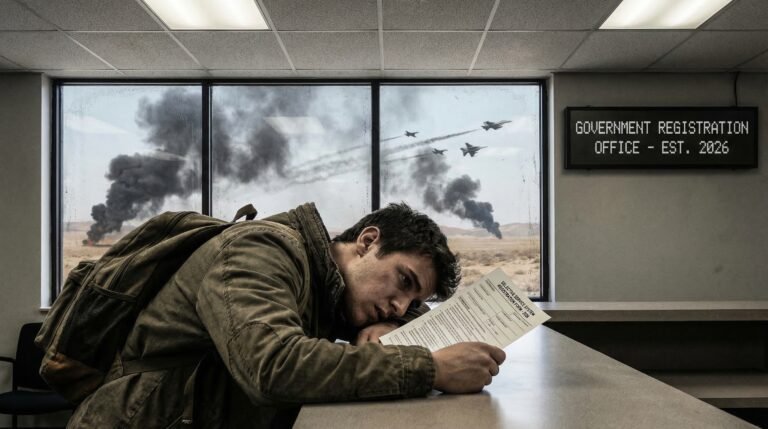
The U.S. economy shed 92,000 jobs in February 2026 — an unexpected and broad-based collapse that pushed unemployment to 4.4% and sent recession alarm bells ringing across Wall Street, the Fed, and whatever’s left of Washington’s economic credibility. The February 2026 jobs report is the worst monthly labor market reading since October, and comes sandwiched between an Iran war-fueled gas price spike and a tariff regime that economists warned would do exactly this.

Key Takeaways: The U.S. lost 92,000 jobs in February 2026, the worst month since October. Unemployment rose to 4.4%. Job losses were broad-based across manufacturing (-12K), construction (-11K), and healthcare (-19K). College-educated unemployment hit its highest point since 2014. Gas prices jumped 30+ cents due to the Iran war. The Fed is now trapped between a weakening labor market and rising inflation — classic stagflation. JPMorgan had already put recession odds at 33% before this report.
What the February 2026 Jobs Report Actually Says
The Bureau of Labor Statistics released the February 2026 jobs report on Friday morning, and it was, in the words of one labor economist, “terrible.” Employers cut a net 92,000 positions — against a consensus forecast of +50,000. That’s a 142,000-job swing in the wrong direction.
To make it worse: December was revised down to -17,000 jobs (it had been reported as a small gain), and January’s figures were nudged lower too. Add those revisions up and the last three months of Trump’s “Golden Age” economy have produced essentially zero net job growth.
“This is a rough report,” said Cory Stahle, economist at the Indeed Hiring Lab. “You might even say this is a bad report.” Senate Minority Leader Chuck Schumer called it “a blaring alarm” that the economy is “teetering on the edge of recession.” JPMorgan, which had already put recession odds at 33% before Friday, is expected to revise that estimate upward.

Who Got Hit Hardest
Here’s where the generational math gets brutal. The February 2026 jobs report didn’t hit evenly — it hit young and working-class people hardest, while the political class that engineered this moment mostly watches from the sidelines.
Young workers: The unemployment rate for workers aged 16–24 sits at 9.5%. While that’s off last year’s high, it remains catastrophically elevated. The Fed’s own governor, Stephen Miran, noted on Friday that “younger workers are feeling the brunt of the pain.” The student loan debt those workers took on — on the promise of a knowledge economy that would reward their credentials — is looking like an increasingly bad trade.
College-educated workers: The unemployment rate for bachelor’s degree holders hit 3.0% in February — the highest since 2014, excluding the pandemic. For years, “get a degree” was the economic insurance policy sold to every Millennial and Gen Z kid. That policy is now paying out less and less.
Black unemployment: Rose to 7.7% after briefly dipping to 7.3% in January. It had reached 8.2% in November 2025. The trend line is not moving in the right direction.
Blue-collar workers: Manufacturing lost 12,000 jobs. Construction lost 11,000. Mining and logging (which includes oil and gas) cut 2,000. These are the exact industries Trump promised to revive with tariffs and trade wars. The tariffs are real. The revival isn’t.
Healthcare: Shed 19,000 jobs in February, dragged down by a California nurses’ strike involving 31,000 workers. Healthcare has been the single sector keeping the job market afloat — powered almost entirely by the aging Boomer population’s medical needs. When even healthcare stumbles, there’s no backstop left.

The Iran War Gas Price Gut Punch
The February 2026 jobs report doesn’t exist in a vacuum. It landed on the same Friday that the Iran war hit its one-week mark — and the economic collateral damage is already showing up at the pump.
The national average for a gallon of gasoline hit $3.32 on Friday, according to AAA — up from $2.98 just a week ago. That’s a 34-cent jump in seven days. In states like Maine, the increase was closer to 30 cents per gallon in a single week. For Millennials and Gen Z already stretched thin on cost of living, this is another direct tax on driving to work, picking up groceries, and existing in a car-dependent country that the generation that built it never planned to make walkable.
Qatar’s energy minister has warned oil prices could reach $150 per barrel within weeks if the Strait of Hormuz — through which roughly one-fifth of global seaborne crude passes — remains effectively closed. Brent crude was already testing $80+ by Friday afternoon. UBS has warned Brent could top $120 in a sustained disruption scenario.
Trump’s go-to talking point for months was low gas prices. That talking point is now gone. His response on Friday was essentially: “It’ll drop when the war ends.” That’s not an economic policy. That’s a hope.
The Fed’s Stagflation Nightmare
The Federal Reserve meets March 17–18, and after Friday’s report, it walks in holding two grenades pointed in opposite directions.
A weakening labor market normally calls for rate cuts to stimulate growth and hiring. But surging oil prices from the Iran war are pushing inflation back up — and inflation has already been above the Fed’s 2% target for roughly five years. The Fed’s interest rate decisions have disproportionately crushed younger would-be homebuyers and borrowers while protecting Boomer asset-holders. Now the central bank faces a scenario with no clean play.
“Stagflationary-direction shocks are the hardest thing that the central bank has to deal with, because there’s not an obvious playbook,” Chicago Fed President Austan Goolsbee said Friday. “If the job market is getting worse and inflation is getting worse at the same time, it’s not obvious to me what the immediate response should be.”
Morgan Stanley’s chief economic strategist Ellen Zentner put it plainly: “Today’s numbers may have put the Fed between a rock and a hard place.” Markets are now pricing a rate cut as early as July — pulled forward from September — but Cleveland Fed President Beth Hammack said the Fed “could be on hold for quite some time,” and hasn’t ruled out rate increases if inflation resurges.
The S&P 500 dropped 1.3–1.5% in early trading Friday. Gold futures rose 2%. The dollar softened. These are textbook stagflation market signals.
What the White House Is Saying (And Why It’s Spin)
White House National Economic Council Director Kevin Hassett appeared on CNBC Friday morning and said — with a straight face — “I think it’s consistent with everything else we’re seeing, which is the economy is really strong.”
He attributed the -92,000 to: bad weather, a California nurses’ strike, and “methodological changes” at the BLS. He then said the economy was experiencing a “productivity boom.” He added that the “pessimists really need to understand that, as the U.S. gets richer, and richer and richer, that it creates more jobs for folks.”
Here’s what that spin leaves out: The weather effect analysis doesn’t hold up. About 267,000 people reported being unable to work due to bad weather in February — actually down from a year earlier and below the typical February figure. The losses were broad-based, not concentrated in weather-sensitive sectors. And the three-month trend — effectively zero net job growth — predates both the weather event and the Iran war. This has been building for months.
As Oxford Economics put it: “We’ve just gotten gut punch after gut punch.” Recession odds are going up. The war hasn’t ended. The tariffs are still in place. And the Americans who were told the economy was “strong” are filling up their tanks for $3.32 a gallon on their way to a job market that just shed 92,000 positions in a single month.
For a generation that was told to do everything right — get the degree, work the entry-level jobs, wait for the economy to open up — the February 2026 jobs report is one more data point confirming what they already know in their bones: the system wasn’t built for them, and the people running it aren’t losing sleep over it.
FAQ
How many jobs did the U.S. lose in February 2026?
The U.S. lost 92,000 jobs in February 2026, according to the Bureau of Labor Statistics. This was a significant miss versus analyst expectations of +50,000 jobs. The unemployment rate rose to 4.4%.
Why did the February 2026 jobs report miss so badly?
Economists cite several factors: a California nurses’ strike involving 31,000 workers that dragged down healthcare hiring, continued weakness from tariff uncertainty, immigration-driven labor supply changes, and a broader hiring freeze as businesses wait out economic volatility. The White House also blamed bad weather, though the data doesn’t fully support that explanation.
How does the Iran war affect the jobs report?
Directly, the Iran war contributed to a sharp spike in gas prices (+30¢/gallon in a week), which increases inflation pressure — complicating the Fed’s ability to cut rates to support the labor market. Indirectly, war-related economic uncertainty further freezes business investment and hiring. Qatar’s energy minister warned oil could hit $150/barrel if the Strait of Hormuz stays disrupted.
Is the U.S. heading into a recession in 2026?
Recession odds are rising. JPMorgan placed the probability at 33% before the February report — analysts expect that to move higher. The combination of job losses, elevated inflation, an Iran war-driven energy shock, and a Fed with limited room to act is creating conditions economists describe as a potential stagflation trap.
Sources
New York Times — Live Jobs Report Coverage, March 6, 2026 | Wall Street Journal — U.S. Loses 92,000 Jobs in Widespread and Unexpected Downturn | Washington Post — U.S. Labor Market Lost 92,000 Jobs in February | NPR — U.S. Unexpectedly Loses 92,000 Jobs | Barchart — Jobs Report and Iran War Economic Uncertainty