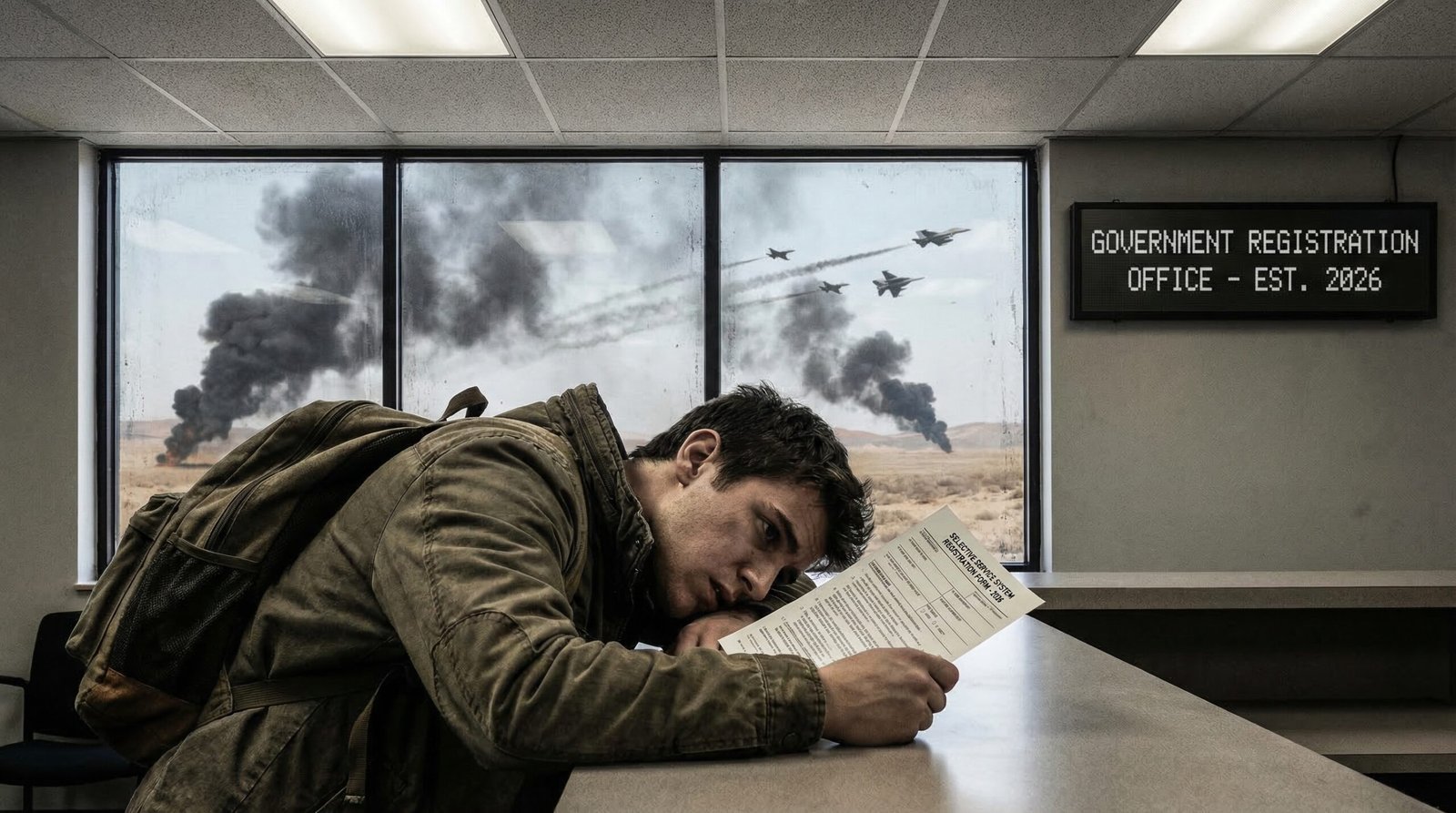
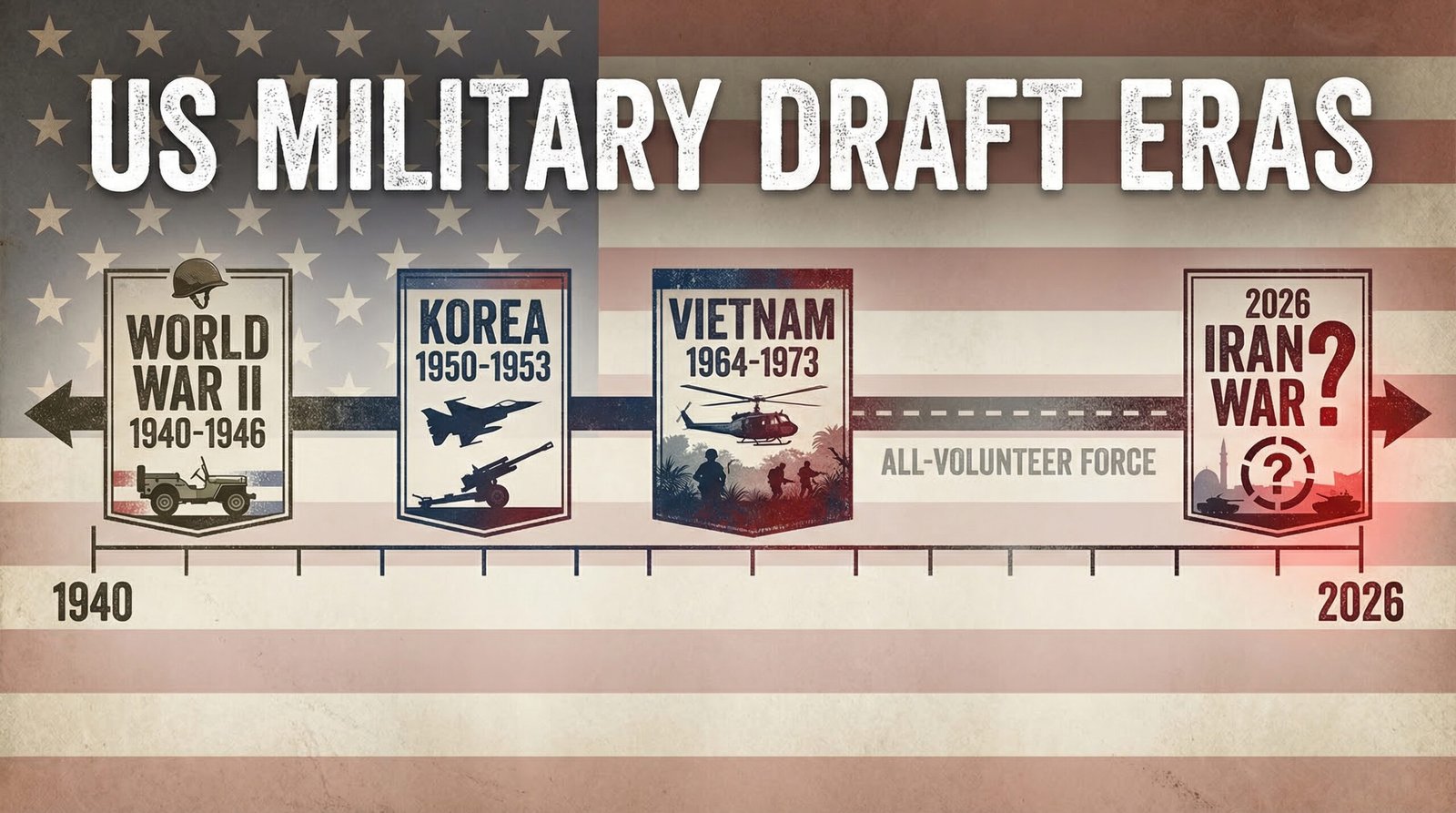
The Iran war draft 2026 is not currently planned — but the Trump administration has explicitly refused to rule it out. On March 8, 2026, White House Press Secretary Karoline Leavitt told Fox News that Trump “wisely keeps his options on the table,” and Defense Secretary Pete Hegseth echoed on 60 Minutes that the U.S. “reserves the right” to deploy ground troops. If a draft were reinstated, Congress would need to pass legislation authorizing it, and Selective Service would conduct a random lottery targeting men aged 21 to 25. You are already registered — you just don’t know it yet.
Key Takeaways
- Trump’s White House and Pentagon have both declined to rule out an Iran war draft 2026 — calling it “on the table.”
- Any reinstatement of the draft requires an act of Congress plus presidential approval — it cannot happen unilaterally.
- Selective Service already has 16.7 million men ages 18–25 registered. A lottery would target men aged 21–25 first.
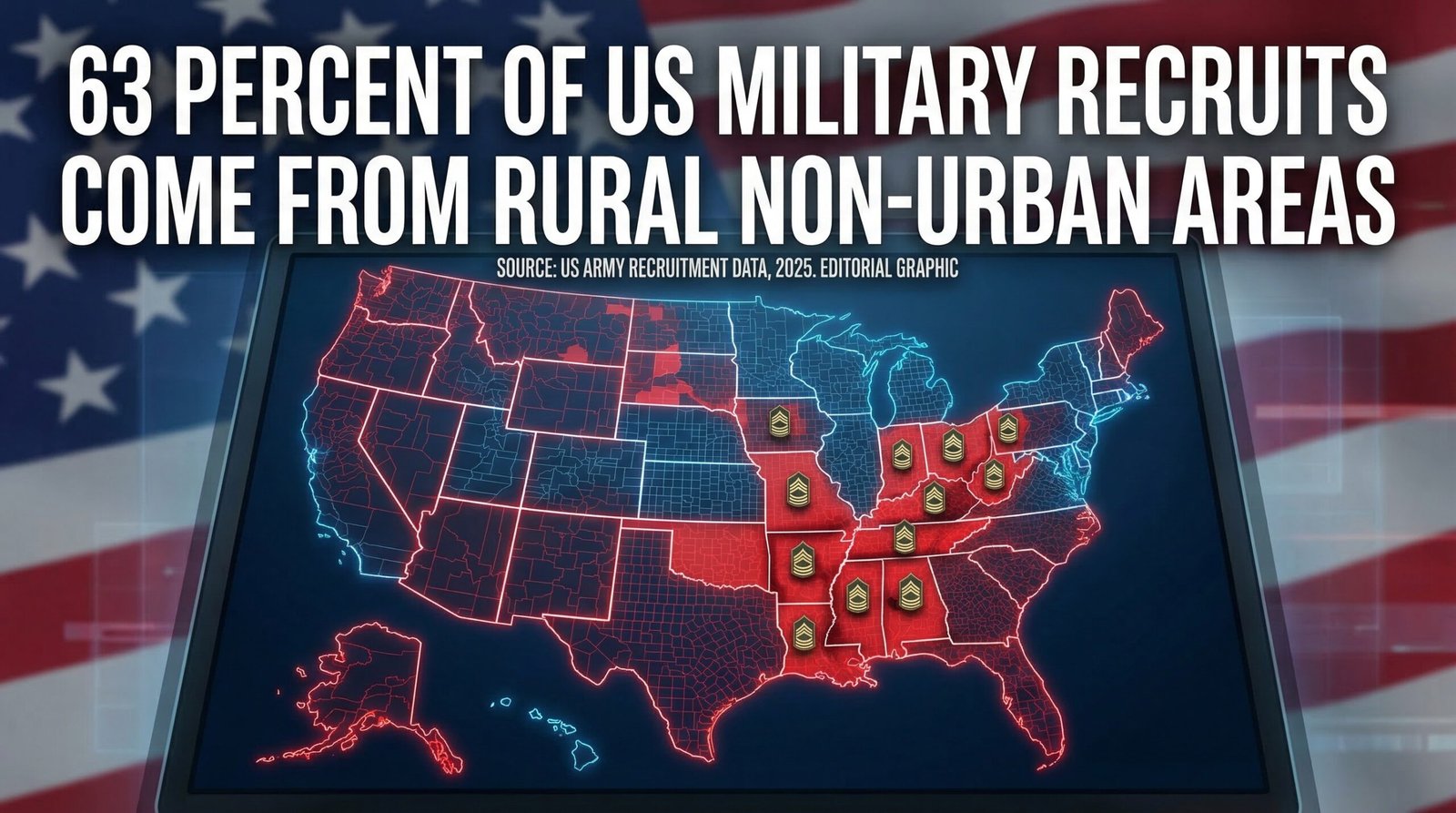
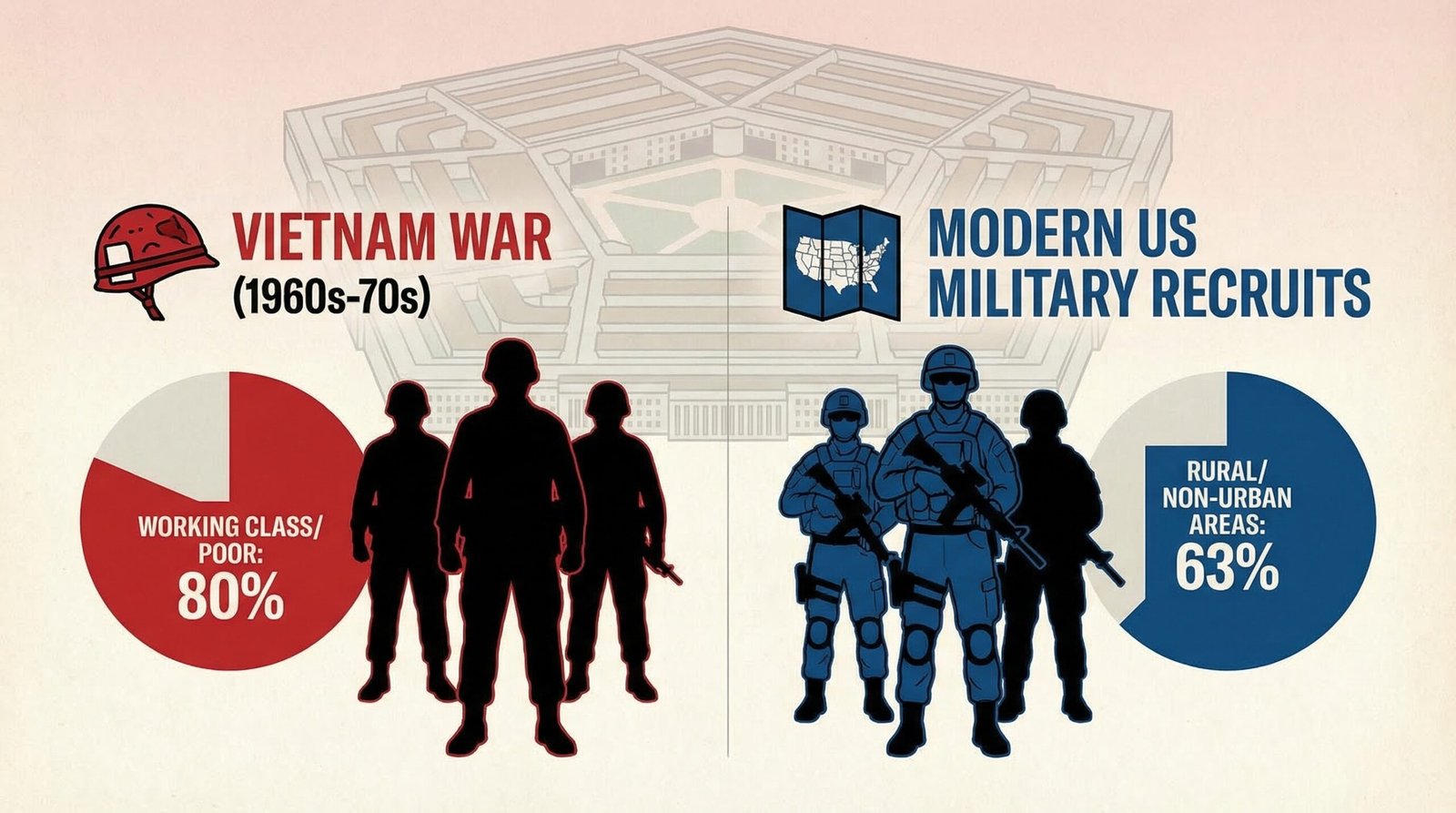
- 63% of current US military recruits come from rural, non-urban areas — the same working-class communities that always bear the sacrifice.
- During Vietnam, 80% of soldiers were working class. College deferments shielded the wealthy — including Donald Trump himself (five deferments).
- The Army lowered its recruiting goals to claim success after missing targets by 6,000 soldiers in fiscal year 2023.
- Senate Democrats have launched a sustained War Powers campaign to force Hegseth and Rubio to testify about the Iran war — and a draft would supercharge that fight.

What Did Karoline Leavitt and Pete Hegseth Actually Say?
On March 8, 2026 — Day 9 of Operation Epic Fury — Fox Business anchor Maria Bartiromo asked Press Secretary Karoline Leavitt point-blank whether American mothers should worry about a draft for the Iran war. Leavitt did not say no.
“President Trump wisely does not remove options off of the table… It’s not part of the current plan right now, but the president, again, wisely keeps his options on the table.”
— White House Press Secretary Karoline Leavitt, Sunday Morning Futures, March 8, 2026
Hours later, Defense Secretary Pete Hegseth appeared on 60 Minutes. CBS News correspondent Major Garrett asked whether U.S. forces were currently on the ground in Iran. Hegseth said no — then immediately said he wouldn’t tell anyone if they were. On the broader question of troop deployment or a draft:
“We would be completely unwise if we did not reserve the right to take any particular option, whether it included boots on the ground or no boots on the ground.”
— Defense Secretary Pete Hegseth, 60 Minutes, March 8, 2026
This is the language of deliberate ambiguity — a classic military communications strategy designed to keep adversaries guessing. The problem is it’s also keeping 16.7 million registered American men guessing. And on the same day, the war had already killed seven Americans — including Army Sgt. Benjamin Pennington, 26, of Glendale, Kentucky, who died March 9 of wounds sustained in Saudi Arabia. Pennington is the seventh KIA. He was assigned to the 1st Space Battalion.
That ambiguity landed. By March 9, draft speculation had gone mainstream enough that PolitiFact published a full explainer titled “Is a new military draft coming?” The answer was “considered unlikely” — but notable enough to warrant the piece. That’s where we are.
Who Would Actually Get Drafted?
If the Iran war draft 2026 became reality, the Selective Service lottery would work like this: men aged 21 are called first, then 22, 23, 24, and finally 25. Men who are 18, 19, and 20 would be registered but not the initial target pool. Within each age group, birthdates are selected by random lottery — the same system used during Vietnam.
Women are currently not eligible to be drafted. The House passed a measure in 2024 to automatically register men for Selective Service — but the broader effort to require women to register stalled in the Senate, where it always does. So the draft pool is exclusively male, aged 18–25, approximately 16.7 million registered individuals.
Who gets exemptions? The current framework allows deferments for:
- Sole surviving sons of families where other members died in military service
- Conscientious objectors (must prove sincerely held religious or moral belief)
- Ministers and divinity students
- Non-immigrant visa holders (student, tourist, diplomatic)
- Active-duty military members
- Those deemed physically or mentally unfit
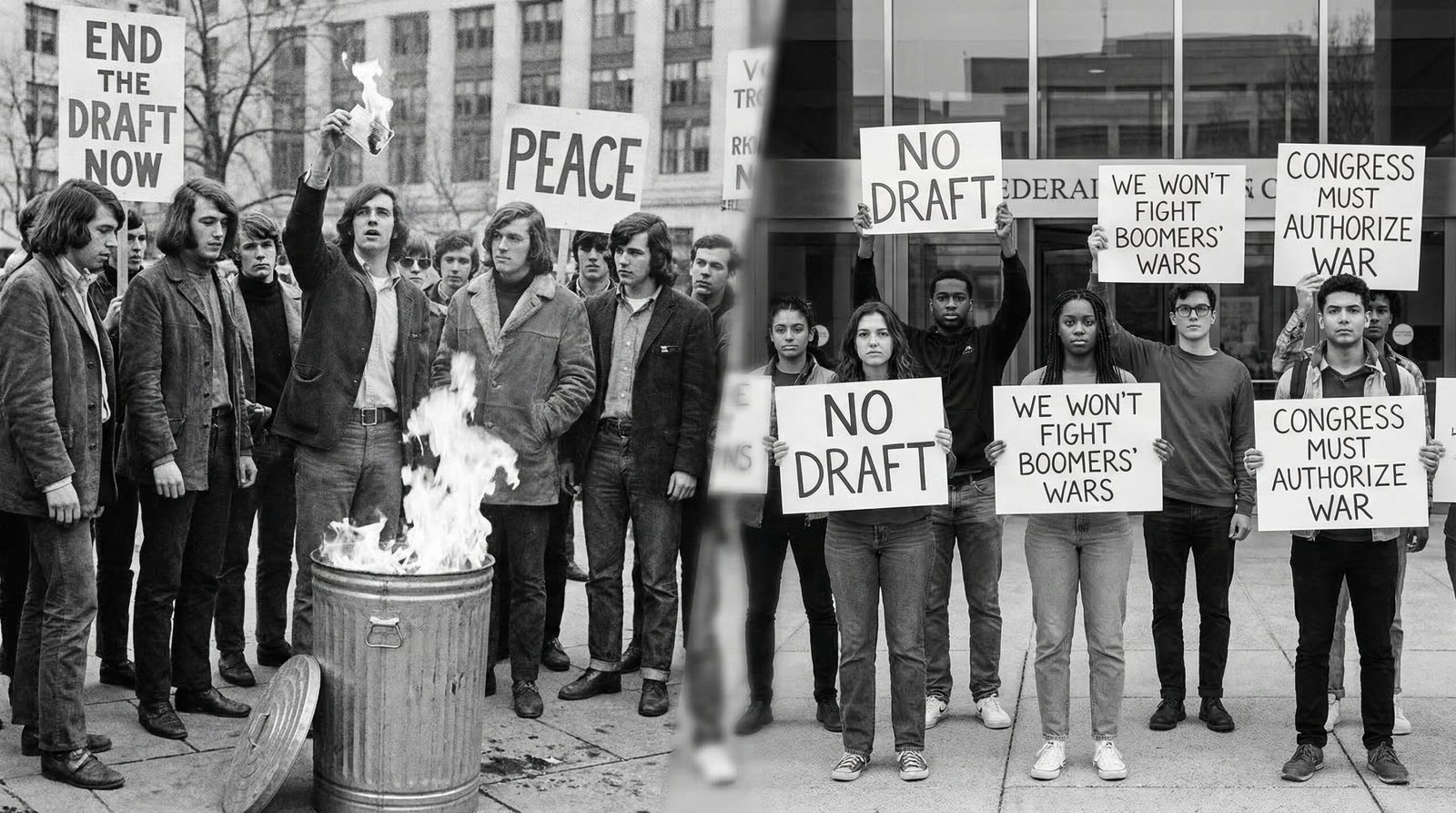
Notice what’s not on that list: college enrollment. Student deferments — the mechanism that allowed wealthy Boomers and their sons to sit out Vietnam — were officially eliminated after 1971. Trump himself received five draft deferments during Vietnam: four for being a student and one for “bone spurs.” In 2026, that specific escape hatch is closed. The students, baristas, Amazon warehouse workers, and software engineers in your zip code are in the same lottery.
Practically speaking, the Mirror UK published the full exemption list amid draft fears, which tells you everything about the public mood right now.
How Does Selective Service Work in 2026?
Here’s the part most people don’t know: you’re probably already in the system. Under current law, nearly all male U.S. citizens and male immigrants aged 18–25 are automatically registered when they apply for federal student aid, a driver’s license in most states, or certain federal jobs. You didn’t sign a form acknowledging you were registering for potential conscription. You applied for FAFSA.
The House went further in 2024, passing a measure to make automatic Selective Service registration universal and mandatory — set to take effect December 18, 2026. The system’s reach is expanding, not contracting, even as the Iran war raises the stakes of what that registration actually means.
How would a draft actually be activated? The process requires:
- Congressional authorization — Congress must pass legislation amending the Military Selective Service Act to authorize the president to induct personnel
- Presidential proclamation — The president must issue a proclamation ordering registration (already done) and then a second proclamation initiating the draft
- Lottery — Selective Service conducts a random lottery by birthdate, starting with 21-year-olds
- Processing — Draftees undergo physical, mental, and administrative screening; requests for deferment or conscientious objector status are evaluated at this stage
Failure to register carries penalties that include fines up to $250,000, up to five years in prison, loss of eligibility for federal student aid, and exclusion from certain federal jobs and state benefits. Prosecutions are rare but legally available. More practically: if a draft lottery selects your birthdate and you’re not registered, you have no standing to apply for deferments or exemptions.
The Iran war’s cost is already running at an estimated $891 million per day. If the air campaign cannot complete the objective — and CNN reported March 9 that seven current and former US officials believe the HEU uranium stockpile deep underground cannot be secured without ground troops — the political and military math gets worse fast.
The Class Divide: Who Dies in America’s Wars?
This is the part of the draft conversation that doesn’t get nearly enough attention: even without a formal draft, the Iran war draft 2026 debate is already revealing who carries the weight of American military decisions made by people who never carried a rifle.
The data on the all-volunteer force is damning in its own right. According to Pentagon recruitment data, 63% of new active-duty recruits in 2023 came from non-urban areas — the highest share since at least 2010. Southern states account for roughly 40% of US military personnel, well above their population share. The median military recruit in 2026 is working class, from a rural county, and joined partly because the civilian job market — particularly post-Iran war with 92,000 jobs lost in February 2026 — offers fewer alternatives.
This is not an accident. Economic conscription — where military service is disproportionately chosen by people with fewer civilian options — is the functional equivalent of a class-based draft. The uniform changes. The inequality doesn’t.
The historical pattern is stark. During Vietnam:
- 80% of American soldiers were from working-class or low-income backgrounds
- Only 20% came from white-collar or affluent families
- College deferments, medical deferments, and National Guard assignments — all heavily utilized by the wealthy — kept the privileged out of the lottery
- An estimated 15 to 16 million men used deferments, exemptions, or disqualifications to avoid Vietnam service
The seven Americans killed so far in Operation Epic Fury are: working-class soldiers from Kentucky, California, and other states where military service is one of the more accessible economic ladders. The class divide in who dies in America’s wars is as old as the Republic and as current as Sgt. Benjamin Pennington’s flag-draped casket arriving at Dover Air Force Base on March 9, 2026.
Meanwhile, the generation that voted most heavily for the politicians who launched this war — Boomers, who gave Trump his largest margin of any age cohort — are the generation least likely to have anyone in the draft pool. Their children are in their 40s and 50s. Their grandchildren are 18.
Could Congress Actually Pass a Draft?
The short answer is: not easily, and not quickly. But “quickly” may not be the operative word if the Iran war drags into weeks seven, eight, and nine.
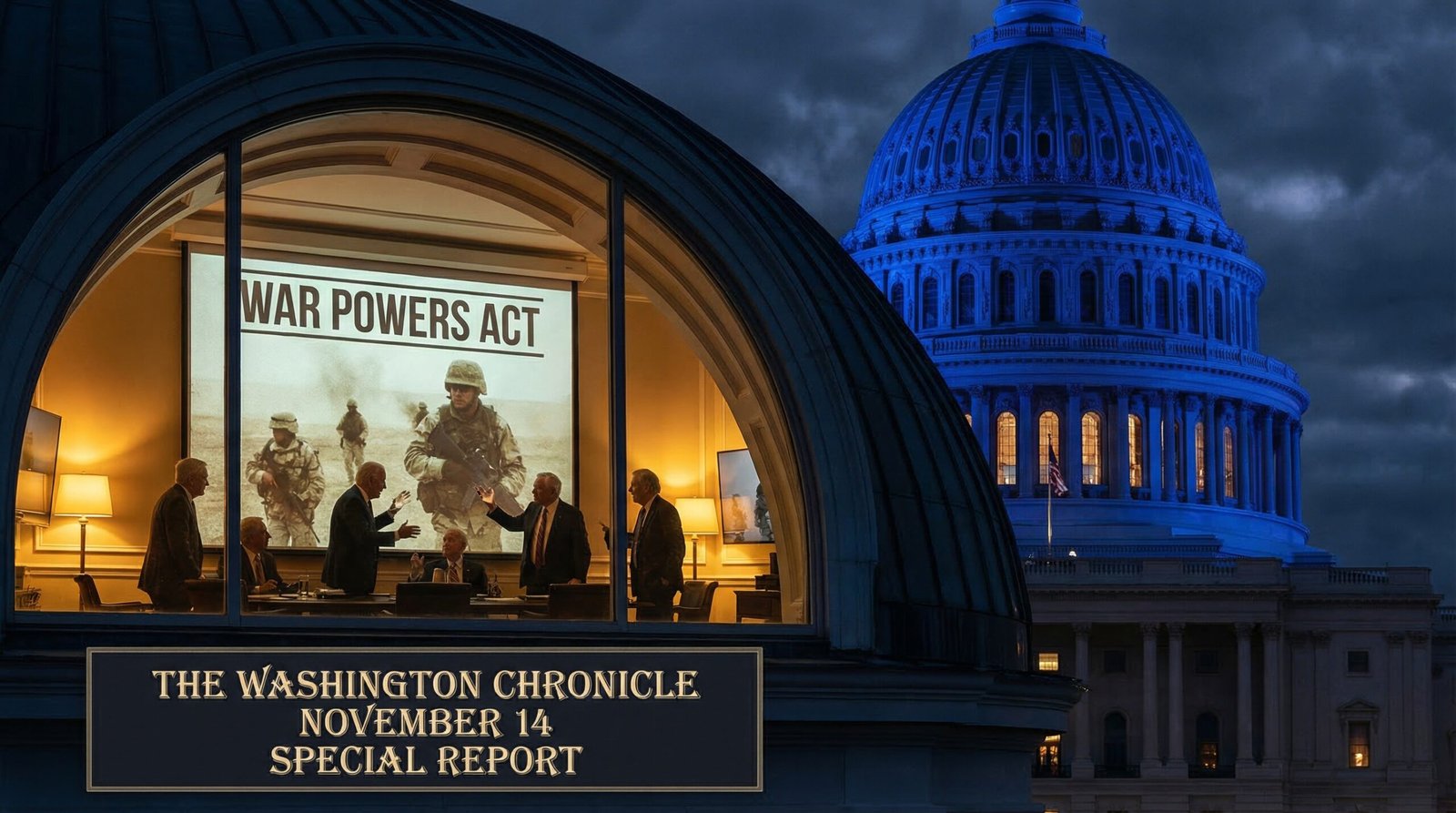
To reinstate the draft, Congress would need to pass legislation amending the Military Selective Service Act — a statute last meaningfully invoked in 1973. That means committee hearings, floor votes in both chambers, a reconciliation process, and a presidential signature. Any one of those steps could be a political grenade. MTG — Marjorie Taylor Greene, a Trump ally — already publicly criticized the administration for not ruling out a draft, calling it a betrayal of the anti-foreign-war campaign promises Trump ran on.
On the Senate side, Democrats are already making their move. Senators Chris Murphy and Tim Kaine announced March 9 they will force repeated War Powers votes unless Secretary Hegseth and Secretary Rubio testify publicly about the Iran war. Murphy’s framing: “This is not a one and done. This is the start of something, not the end.” A draft authorization vote in this environment would be the largest war powers confrontation since Vietnam.
There’s also the structural reality that the Iran war is, as of March 9, approximately 10 days old. Trump told House Republicans on Monday that the US has struck “5,000+ targets” but is “saving the most important targets for later.” That is not the language of a campaign winding down. Iran’s senior officials are telling CNN from Tehran they see “no room for diplomacy” and are “prepared for a long war.” The IRGC announced it will only fire missiles with warheads over one ton going forward.
The financial markets have already priced in prolonged conflict. The question of ground troops — and with it, whether the all-volunteer force has sufficient manpower for a sustained Iranian theater — is not hypothetical. It’s a logistics problem being worked in real time at the Pentagon.
The Counter-Argument: The All-Volunteer Force Is Fine
Here’s the strongest case against draft panic: the Trump administration did actually fix the Biden-era military recruiting crisis. The Army reached its 2025 recruiting goal months early. The National Guard exceeded its 2025 targets. All branches — Air Force, Marine Corps, Space Force — hit their numbers. The Heritage Foundation called it a turnaround, and by the available data, they’re not wrong about the raw intake numbers.
PolitiFact’s March 9 analysis rated the draft as “considered unlikely” — noting it would require a prolonged ground war that no official has confirmed is coming. The administration’s stated goal is an air-only campaign to eliminate nuclear capacity; ground troops are a last resort, not the plan. Trump’s own framing at Doral was “pretty well complete.”
A Pew Research poll found 74% of Americans support maintaining the all-volunteer military — making any draft a political catastrophe for whoever signs it. Even in the middle of active conflict, that number is politically prohibitive. No senator facing reelection in 2026 is voting for a draft unless the alternative is visible military collapse.
Where the counter-argument breaks down: “Hitting recruiting goals” is less impressive when you learn the Army lowered those goals after missing the FY2023 target by approximately 6,000 soldiers. You can always meet the goal if you move the goalpost. More pointedly: even hitting the adjusted targets, the Army is still losing experienced personnel at nearly 15,000 per year through attrition, low morale, and inadequate housing. Intake and retention are separate problems, and the Pentagon is papering over one while the other bleeds out. An air campaign that transitions to ground operations is a retention problem, not just a recruitment problem — and retention doesn’t improve during wartime if the mission starts to look unwinnable.
FAQ: Iran War Draft 2026
Is there currently a military draft in 2026?
No. As of March 9, 2026, there is no active military draft. The Trump administration has declined to rule one out, but it has not been authorized or initiated. Any draft would require Congressional legislation plus a presidential proclamation.
Am I already registered for the draft?
If you are a male US citizen or male immigrant between the ages of 18 and 25, you are almost certainly already registered with Selective Service — likely automatically through a FAFSA application, a driver’s license in most states, or another federal process. Failure to register is technically a federal crime, though prosecutions are rare.
What ages would be drafted first in the Iran war?
Under current Selective Service law, a draft lottery would begin with men who are 21 years old, then 22, 23, 24, and finally 25. Men aged 18, 19, and 20 would be in the registered pool but would not be called first. A random birthdate lottery determines order within each age group.
Can women be drafted in 2026?
No. Women are not currently required to register for Selective Service and cannot be drafted under existing law. Congressional efforts to change this — including a bipartisan committee recommendation in 2016 — have repeatedly failed in the Senate. Automatic registration for women was passed by the House in 2024 but did not become law.
What exemptions exist from the draft?
Exemptions include: conscientious objectors (with demonstrated sincerely held belief), ministers and divinity students, sole surviving sons, non-immigrant visa holders, active-duty military, and those physically or mentally unfit for service. College enrollment is not an exemption — student deferments were eliminated after 1971.
Sources & Methodology
This article draws on reporting published March 8–9, 2026. Primary sources include: Military.com’s March 9 draft analysis covering Leavitt and Hegseth statements; PolitiFact’s March 9 Selective Service explainer; Washington Examiner’s legal analysis of how a draft would work; CNN’s live blog coverage of Trump’s Doral press conference including the HEU ground-troops disclosure; Selective Service System official registration requirements; Pentagon FY2023–2025 recruitment data; and historical data on Vietnam-era conscription and class composition from multiple academic and journalistic sources. Recruitment shortfall and goal-lowering data from publicly available Pentagon reporting. Internal links reference previously published boomersbrokeamerica.com analysis of Operation Epic Fury costs, the military class divide, and war powers legal history.