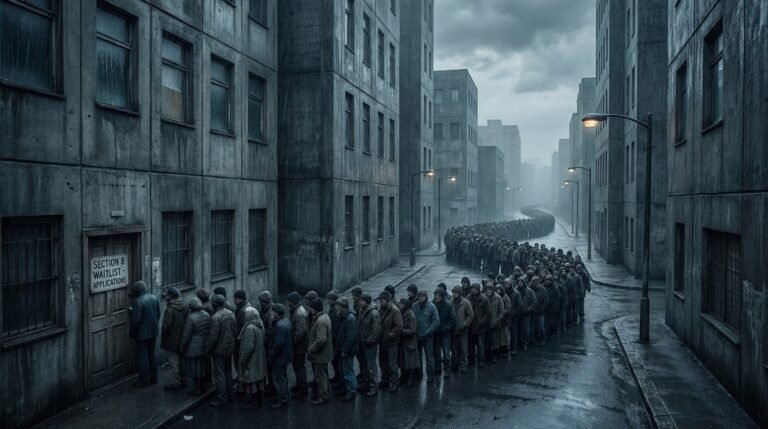
Mass incarceration in America has transformed the United States into the world’s largest jailer — holding nearly 2 million people at a cost of $182 billion per year, a system that grew sixfold under Boomer-era policy decisions between 1980 and 2010 and now extracts a generational tax from every American who isn’t profiting from it. The U.S. incarcerates at five times the rate of comparable wealthy nations, spending more to lock people up than most states spend on their public schools — and the communities bearing the greatest cost are the same ones already squeezed by student debt, housing unaffordability, and wage stagnation.

Key Takeaways
- The U.S. holds nearly 2 million people in prisons, jails, immigration detention, and other confinement — the highest incarceration rate on Earth.
- The system costs $182 billion per year — funded largely by state and local taxes paid disproportionately by working-age Americans with stagnant wages.
- The 1994 Crime Bill — bipartisan legislation written by a Boomer Congress — financially incentivized states to build more prisons and impose longer sentences.
- Private prison companies posted record profits in 2025: GEO Group ($254 million), CoreCivic ($2.2 billion revenue) — both expanding under ICE detention contracts.
- Black Americans are incarcerated at 5 times the rate of white Americans. Native Americans face the highest rate of any group: 763 per 100,000.
- 1.25 million children currently have a parent in prison. Those kids are 3x more likely to face behavioral problems and depression — and statistically more likely to be incarcerated themselves.
- The recidivism rate exceeds 80% over 10 years — meaning the system that costs $182 billion annually fails on its own terms.

How Big Is Mass Incarceration in America, Really?
The United States currently holds approximately 2.1 million people in confinement across 1,566 state prisons, 98 federal facilities, 3,116 local jails, 1,277 juvenile facilities, 133 immigration detention centers, and an assortment of other confinement systems. Together, these facilities cost at least $182 billion per year — roughly equivalent to the entire GDP of Hungary — according to Prison Policy Initiative’s 2025 comprehensive analysis.
That 2 million figure isn’t just a big number in isolation. It’s the product of a deliberate and sustained policy explosion. In 1980, the United States imprisoned approximately 300,000 people. By 2008 — at peak incarceration — that number had surpassed 2.3 million. It has only slightly declined since. The U.S. incarceration rate of roughly 650 per 100,000 people is five to seven times higher than comparable wealthy democracies like Germany (75), France (100), or Canada (114).
To put the fiscal scale in perspective: in New York State, the government spends $69,355 per inmate per year — and $22,366 per student. That’s a $47,000 gap per person, representing a policy choice made by a political class whose own children attended well-funded schools in well-funded zip codes. The same generation that underfunded infrastructure decided that locking people up was worth three times the investment of educating them.

Who Built This System — and When?
Mass incarceration in America didn’t emerge from thin air. It was built, piece by piece, by a Boomer-dominated political class responding to real crime spikes with policies that prioritized punishment over everything else — and then refused to dismantle those policies once the crime wave passed.
The policy architecture spans both parties and several decades:
- 1971: Nixon declares the “War on Drugs” — creating the framework for treating addiction as a criminal matter and seeding mandatory minimum culture.
- 1986: The Anti-Drug Abuse Act establishes the infamous 100:1 crack-to-powder cocaine sentencing disparity — meaning someone caught with 5 grams of crack got the same mandatory 5-year sentence as someone caught with 500 grams of powder cocaine. The communities that used crack were predominantly Black. The communities that used powder cocaine were predominantly white.
- 1994: The Violent Crime Control and Law Enforcement Act — co-written by then-Senator Joe Biden — pumped $9.7 billion in federal incentives to states that built more prisons and passed “truth-in-sentencing” laws requiring prisoners to serve at least 85% of their sentences. States that wanted the federal money had to eliminate parole discretion. The bill also expanded the federal death penalty to 60 new offenses and added 100,000 new police officers.
- 1996: The Prison Litigation Reform Act made it dramatically harder for incarcerated people to challenge their conditions in court, insulating the growing system from legal accountability.
- 1997–2010: States across the country — led by Boomer legislators on both sides of the aisle — passed three-strikes laws, mandatory minimums for drug offenses, and truth-in-sentencing requirements that ballooned prison populations regardless of actual crime trends.
The 2010 Fair Sentencing Act finally reduced the crack-to-powder disparity from 100:1 to 18:1. The First Step Act of 2018 offered modest sentencing reforms. But the foundational architecture — the prison-building incentives, the mandatory minimums, the probation-and-parole system that functions as a re-incarceration pipeline — remains largely intact. What Boomers did to banking regulation, they also did to criminal justice: built up a system that enriched some, hurt many, and then left it for the next generation to fund.

Who Pays for Mass Incarceration in America?
The $182 billion annual cost of the U.S. incarceration system is borne almost entirely by state and local governments — which means it lands on the working-age taxpayers least equipped to absorb it. The federal system accounts for only about 12% of total incarcerated people; the other 88% are in state prisons and local jails, funded by the same property, income, and sales taxes that younger Americans are already being asked to cover for underfunded public pensions.
The hidden costs run even deeper. For every dollar spent directly on prisons, economists estimate an additional $10 in social costs — lost wages, increased foster care placements, higher infant mortality rates in affected communities, reduced tax revenue from people who can’t get jobs with felony records, and the long-term healthcare burden of trauma. A 2023 analysis estimated the full social cost of incarceration at approximately $1 trillion per year when downstream effects are included.
The fiscal picture is made worse by the recidivism trap: the U.S. spends almost nothing on genuine reintegration. Federal reentry programs received just $115 million in 2024 — a rounding error compared to the $182 billion system cost. When more than 600,000 people leave prison each year with no job prospects, housing instability, and felony records that disqualify them from most rental agreements and professional licenses, the system isn’t just expensive — it’s self-perpetuating by design. The same bureaucratic dysfunction that fails disability claimants runs through every stage of the reentry process.

Who Profits From the Prison Industrial Complex?
Private prisons hold approximately 8% of all incarcerated people in the United States — a minority share of bodies, but a majority of the political oxygen in criminal justice debates. The two dominant players are CoreCivic (formerly Corrections Corporation of America) and GEO Group. In 2025, CoreCivic reported $2.2 billion in total revenue — a 13% year-over-year increase — while GEO Group posted a record $254 million net profit.
The boom isn’t coming from traditional state prison contracts. It’s coming from ICE immigration detention, which expanded dramatically under the Trump administration’s enforcement surge. Both companies expect their ICE contracts to generate over $1 billion in revenue each in 2025, according to In These Times. CoreCivic operates at least 10 ICE detention facilities. GEO Group’s ICE revenues are growing faster than any other segment of its business.
But private prisons are only the most visible layer of a much larger profit ecosystem. Prison labor — which pays incarcerated workers an average of $0.13–$0.52 per hour in most states — generates billions in value for corporations that contract with state prison systems. The prison phone industry extracts $1.4 billion per year from incarcerated people and their families through rates that can reach $14 per minute. Commissary monopolies charge three to five times retail price for basic goods. The entire infrastructure is built on a captive population that has no market power, no union, and no recourse — and whose families are simultaneously drowning in their own financial crises.

The Racial Math Doesn’t Add Up
The racial disparities embedded in mass incarceration in America are not incidental. They are the product of deliberate policy choices layered over decades, from targeted drug enforcement to prosecutorial discretion to bail systems that punish poverty.
The numbers, according to the Sentencing Project’s most recent analysis:
- Black Americans comprise 13% of the U.S. population but 37% of incarcerated people
- Black Americans are imprisoned at nearly 5 times the rate of white Americans
- One in 81 Black adults in the United States is currently serving time in a state prison
- For Black men born in 2001, lifetime likelihood of imprisonment remains 4 times higher than for their white counterparts
- Native Americans face the highest incarceration rate of any group: 763 per 100,000, more than twice the national rate of 350
- Hispanic Americans are incarcerated at 1.3 times the rate of white Americans
These disparities exist despite comparable rates of drug use across racial groups. Research from Prison Policy Initiative consistently finds that Black Americans are not more likely to use drugs than white Americans — they are simply more likely to be stopped, searched, charged, and sentenced to longer terms for equivalent behavior. The 1986 crack-cocaine disparity, which sent Black men to prison for years on charges that would have resulted in probation for white powder cocaine users, wasn’t a bug in the system. It was the feature.
The wealth gap between generations and the racial wealth gap are inseparable from the incarceration gap. A felony conviction collapses lifetime earnings by an estimated 40%, eliminates eligibility for federal student loans (partially reformed in 1998), restricts access to public housing, and in many states permanently removes voting rights. It is a debt sentence that never expires.

How Mass Incarceration Punishes Millennials and Gen Z — Twice
The generational injustice of mass incarceration operates on two distinct tracks simultaneously.
Track 1: Direct impact. Millennials and Gen Z are the generations most directly affected by Boomer-era incarceration policies. The Atlantic documented in 2020 that Millennial economic outcomes are directly depressed by incarceration rates in their communities — not just for the incarcerated, but for everyone who grew up in high-incarceration neighborhoods. Children of incarcerated parents are three times more likely to face behavioral problems and depression, twice as likely to suffer anxiety, and statistically more likely to end up incarcerated themselves, perpetuating a generational cycle. Currently, 33% of people in state prisons had an incarcerated parent. 69% are themselves parents, with 1.25 million minor children waiting for them.
Track 2: The tax bill. Even younger Americans with zero personal connection to the criminal justice system are paying for it. State prison costs have grown faster than any other public expenditure in the past four decades — faster than Medicaid, faster than education, faster than transportation. That money comes out of the same tax base that is also supposed to fund Pell Grants, infrastructure repair, and the Social Security trust fund that Boomers are now drawing down. The math doesn’t work — and the political class that built this system is largely done paying into it.
The 2025 federal sentencing guidelines amendments made modest improvements to drug offense calculations, and the Second Chance Act’s reentry programs have reduced 3-year reincarceration rates by 23% nationally since passage. But the structural machine — the private prison contracts, the mandatory minimums, the probation supervision trap that re-incarcerates people for technical violations — remains operating at full capacity, billing the next generation for maintenance.
The Counter-Argument: Doesn’t Incarceration Reduce Crime?
The standard defense of America’s incarceration system is straightforward: crime fell sharply from the early 1990s through the 2010s, and incarceration was part of that story. This argument deserves a serious response rather than dismissal.
There is some truth to it. Criminologists generally agree that incapacitation — physically removing active offenders from communities — does reduce crime, at least in the short term. Studies have estimated that the incarceration buildup from 1980–2010 accounts for somewhere between 10% and 25% of the crime decline during that period.
But three inconvenient facts complicate the simple cause-and-effect story:
- Crime fell in countries that did NOT massively expand incarceration. Canada, the UK, Germany, and France all experienced similar crime declines in the 1990s without building anything close to the U.S. incarceration machine. If incarceration was the primary driver, they should have seen no improvement.
- At scale, incarceration produces diminishing and then negative returns. A 2014 National Academy of Sciences report concluded that beyond a certain saturation point, additional incarceration actually increases crime — by destabilizing communities, eliminating working-age breadwinners, and producing more criminally experienced individuals who return without legitimate employment prospects. A RAND analysis found that $1 million spent on mandatory minimum sentences reduces cocaine consumption less than $1 million spent on treatment.
- The recidivism rate is 80%+. If the system were achieving rehabilitation — its stated secondary goal — this number would be declining. Instead, it has been essentially flat for decades. The system is not rehabilitating people. It is cycling them. That’s not justice. That’s an industry.
Frequently Asked Questions
How many people are incarcerated in the United States in 2025?
Approximately 2.1 million people are incarcerated across all confinement systems in the United States, including state prisons, federal facilities, local jails, juvenile detention, immigration detention, and civil commitment facilities. This makes the U.S. the world’s largest jailer by total population and by rate of incarceration per capita.
What caused mass incarceration in America?
Mass incarceration resulted from a combination of Boomer-era policy decisions: Nixon’s War on Drugs (1971), the 100:1 crack-to-powder cocaine sentencing disparity created by the 1986 Anti-Drug Abuse Act, mandatory minimum sentencing laws passed in the 1980s and 1990s, and the 1994 Crime Bill which gave states financial incentives to build more prisons and eliminate parole discretion. Both major parties contributed to building the system; neither has comprehensively dismantled it.
How much does mass incarceration cost taxpayers?
Direct costs total at least $182 billion per year, according to Prison Policy Initiative’s 2025 analysis. When social costs — lost wages, foster care, healthcare burdens, reduced tax revenue from felony-record holders — are factored in, estimates reach approximately $1 trillion per year. Per-inmate costs vary dramatically by state: New York spends $69,355 per inmate annually; some Southern states spend under $25,000 while providing correspondingly worse conditions and higher recidivism rates.
Are private prisons a major part of the incarceration system?
Private prisons hold approximately 8% of the total incarcerated population — a minority of the overall system, which is primarily publicly operated. However, private prison companies have expanded dramatically through ICE immigration detention contracts. CoreCivic reported $2.2 billion in 2025 revenue; GEO Group posted record profits of $254 million. Both companies are projected to generate over $1 billion each from ICE contracts in 2025 alone, making immigration enforcement the primary growth driver of the private prison industry.
Sources & Methodology
This article draws on data from Prison Policy Initiative’s Mass Incarceration: The Whole Pie 2025, the Sentencing Project’s One in Five: Ending Racial Inequity in Incarceration (2024), Bureau of Justice Statistics recidivism reports, the Council on Criminal Justice’s 2024 National Recidivism Report, Brennan Center for Justice analyses of the 1994 Crime Bill, ACLU reporting on mandatory minimums, U.S. Sentencing Commission 2025 Guidelines amendments, Time and In These Times reporting on CoreCivic and GEO Group 2025 earnings, and the National Academy of Sciences 2014 report The Growth of Incarceration in the United States. Statistics on per-inmate versus per-student spending sourced from Reading Kingdom/New York State budget data and Bureau of Justice Statistics per-inmate expenditure reports.