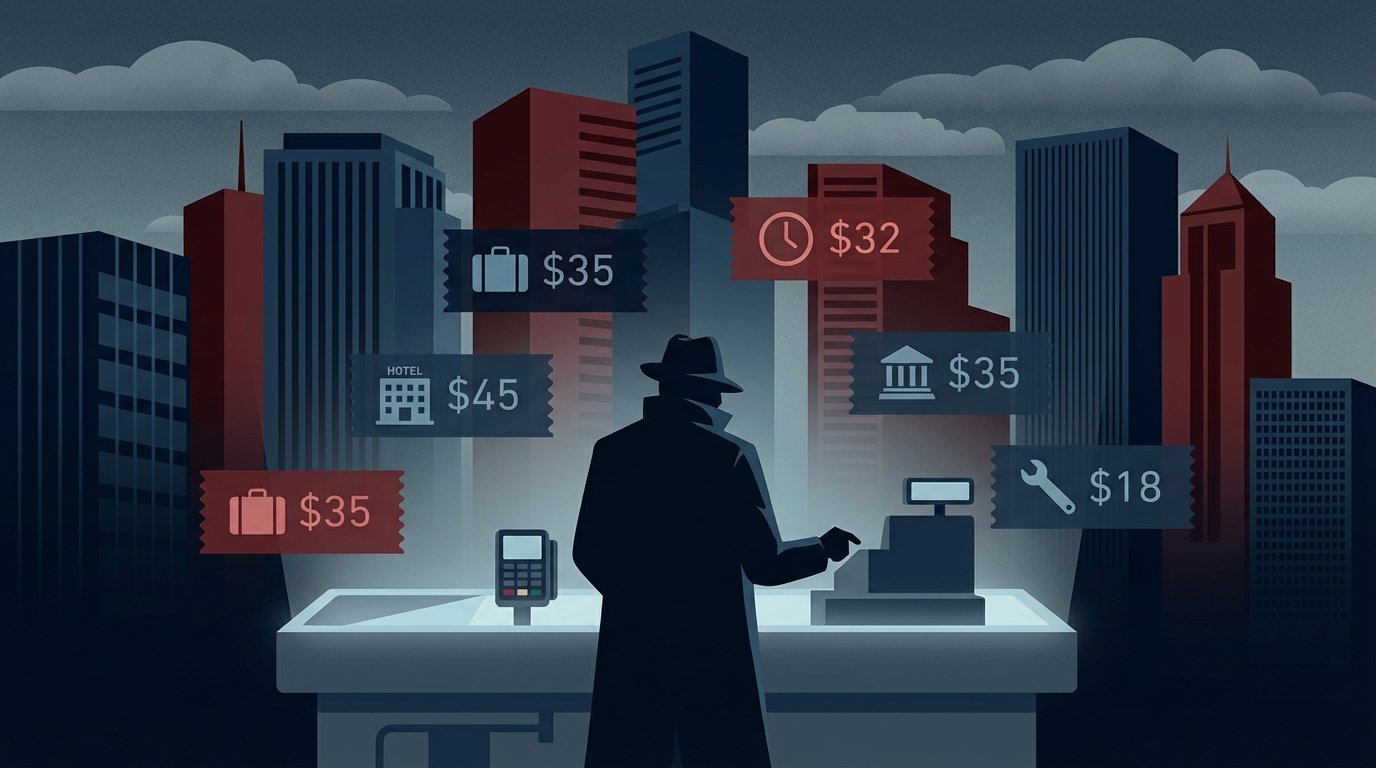

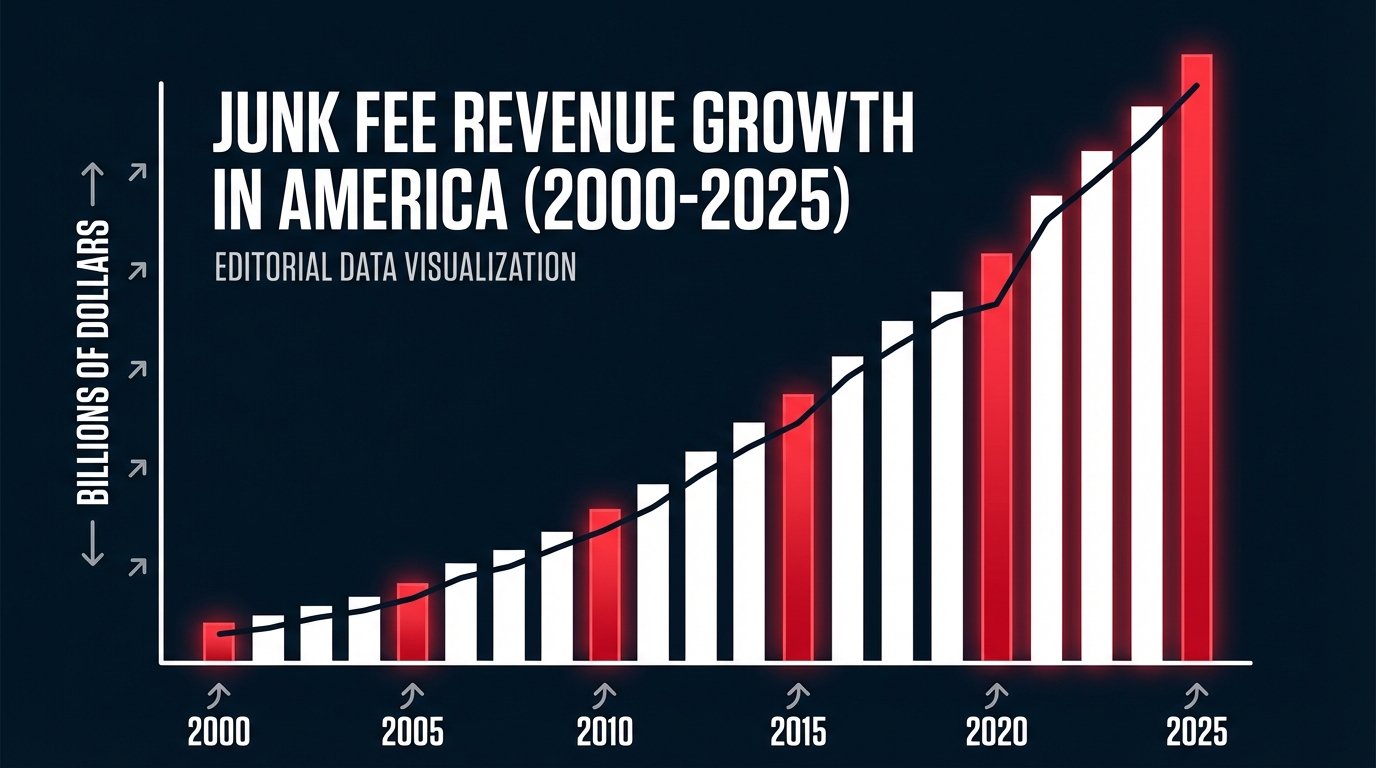
Junk fees — the hidden, mandatory, and often inescapable charges tacked onto the advertised price of nearly everything Americans buy — cost U.S. consumers an estimated $90 billion every year on concert tickets, hotel rooms, and food delivery apps alone, with total fee extraction across all industries running well past $165 billion annually. They didn’t emerge from a free market. They were engineered over decades by industries that discovered it is more profitable to advertise a low number and charge a higher one than to compete on honest pricing — and enabled by regulators who either looked away or, under the current administration, actively handed back the keys.
Key Takeaways
- Junk fees cost Americans an estimated $90–$165 billion annually across banking, airlines, hotels, apartments, and ticketing.
- U.S. airlines collected a record $7.1 billion in checked-baggage fees alone in 2023, plus billions more in seat selection charges never disclosed at booking.
- Banks charged $5.83 billion in overdraft and NSF fees in 2023 — down from a peak of $11.96 billion before public pressure, but rising again after CFPB rule rollback.
- Credit card late fees cost Americans $12 billion per year; the Biden-era CFPB rule capping them at $8 was scrapped by the Trump administration in April 2025.
- The CFPB’s overdraft rule — estimated to save $5 billion annually — was repealed by Congress and signed by Trump in May 2025.
- 58% of renters paid at least one additional fee in 2024; application fees, amenity fees, and “technology fees” have become standard across corporate landlord portfolios.
- Low-income households bear the highest proportional fee burden — overdraft fees disproportionately hit accounts with under $350 balances.
The $90 Billion Junk Fee Problem, Explained
The term “junk fees” sounds trivial — like the annoying $2.99 convenience charge on a movie ticket. It is not trivial. It is a systemic extraction mechanism that quietly inflates the cost of housing, travel, banking, and basic services while the advertised price stays artificially low, and it has become one of the core drivers of financial instability for working- and middle-class Americans.
The Consumer Financial Protection Bureau, White House Council of Economic Advisers, and multiple Senate investigations have all attempted to quantify the total. The Investopedia analysis puts the “annoyance economy” at $165 billion — of which $90 billion is attributable to event ticketing, hotels, and food delivery. That’s before accounting for overdraft fees ($5.8–$13 billion depending on year), credit card late fees ($12 billion), rental application fees ($hundreds of millions), and the labyrinthine add-ons attached to rental cars, internet service, gym memberships, and cable contracts.
The mechanics are almost always the same. A company advertises a price — for a flight, a hotel room, an apartment. That price is real. But it is also deliberately incomplete. The full price — the one you actually pay — is revealed at the end of the checkout process, after you’ve already invested time in the booking and become psychologically committed to completing the transaction. Behavioral economists call this “drip pricing.” Regulators call it deceptive. The industries that profit from it call it “unbundling” or “transparent pricing for consumer choice.”
The industries are lying. But since 2025, they’ve had a lot more room to keep doing it.
“Junk fees pad corporate profits while making it harder for families to budget. When you don’t know the true cost of something, you can’t plan for it. And when you can’t plan, you end up in debt.” — White House Council of Economic Advisers, 2023

Banking’s Hidden Tax: Overdraft Fees and the $32 Late Fee Racket
The financial sector was the original home of the junk fee — and it remains among the most aggressive practitioners. Banks collected $11.96 billion in overdraft and NSF fees in 2019. After years of public pressure, congressional scrutiny, and some voluntary reforms by major banks, that number dropped to $5.83 billion in 2023 — still a staggering sum, but a 51% reduction that proved these fees are not inevitable. Then 2025 happened, and the numbers started climbing again.
The structure of overdraft fees is designed to punish people for being poor. The CFPB’s data shows that overdraft fees disproportionately hit accounts with very low balances — the median overdraft occurs when an account has less than $350 in it. Consumers are charged $35 per overdraft on average. Most overdrafts are for transactions under $24. In economic terms, a $35 fee on a $24 transaction is a 146% APR loan. JPMorgan alone collected $815 million in overdraft-related revenue in the first nine months of 2025 — up $58 million from the same period the previous year, after federal protections were stripped away.
Credit card late fees are the other major vector. The credit industry charges Americans approximately $12 billion per year in late fees, according to CFPB data. In 2024, the Biden-era CFPB finalized a rule that would have capped late fees at $8 for large card issuers — a cap based on the statutory requirement that fees be “reasonable and proportional” to the actual cost incurred. The credit card industry sued. A Texas federal judge blocked the rule. The Trump CFPB then formally abandoned the rule in April 2025, allowing issuers to continue charging the standard $32 late fee — or more. The CFPB estimated the $8 cap would have saved Americans $10 billion per year.
That $10 billion is now going back to the banks. Not because the $8 cap was bad policy — it was consistent with the law and supported by bipartisan consumer advocates. But because the banking lobby spent lavishly to prevent it, and found a receptive administration to finish the job.
The median overdraft: a $35 fee on a transaction under $24, from an account with less than $350 in it. In annualized interest rate terms, that is 146% APR. The payday loan industry charges less.

Airline Junk Fees: How Unbundling Turned a $200 Ticket Into a $350 Experience
The airline industry’s fee apparatus is a masterwork of regulatory arbitrage and consumer manipulation that was, until recently, technically legal precisely because airlines exploited a loophole in price transparency rules. U.S. airlines collected a record $7.1 billion in checked-baggage fees alone in 2023 — a number that doesn’t include seat selection charges, which airlines don’t separately report to the DOT, a fact that a November 2024 Senate Homeland Security and Governmental Affairs Committee investigation found deeply suspicious.
The mechanics of airline unbundling emerged after the mid-2000s fuel crisis, when carriers desperate for margin discovered that consumers comparison-shop on base ticket price, not total price. By stripping amenities out of the base fare and charging for them separately — a checked bag, a seat selection, early boarding, a carry-on on ultra-low-cost carriers — airlines could maintain artificially low advertised prices while capturing significantly more revenue. The airline lobby then spent years ensuring the DOT’s price transparency rules had enough gaps to make full-cost comparison nearly impossible.
The Senate investigation published in November 2024 — titled “The Sky’s the Limit: The Rise of Junk Fees in American Travel” — found that American, Delta, United, and Southwest collectively earned billions in seat fees that consumers couldn’t have known about when comparing fares. The report found that families traveling together were systematically forced to either pay seat selection fees or risk being seated apart, a practice the investigation called coercive. Globally, airline ancillary revenue topped $148 billion worldwide in 2024, up from $117.9 billion in 2023. For many carriers, fees are no longer a supplement to the business model. They are the business model.

Hotel Resort Fees and Rental Car Extras: The Hospitality Industry’s Bait-and-Switch
Hotel resort fees — also called “destination fees,” “amenity fees,” or “facility fees” — are mandatory daily charges, typically ranging from $25 to $100 per night, that appear at the end of the booking process after the base room rate has been displayed. A room advertised at $149 per night may carry a $45 resort fee, making the actual nightly cost $194 — a 30% gap between the price you saw and the price you pay. The fee covers the pool, the gym, and sometimes Wi-Fi that other hotels include for free.
The FTC under the Biden administration finalized a Junk Fees Rule in December 2024 — in a bipartisan 4-1 vote — requiring hotels, short-term rentals, and live-event ticketing companies to disclose total price upfront. As of early 2026, the rule is technically in effect but FTC enforcement has been sparse, and industry compliance has been inconsistent as the current administration has signaled reduced appetite for consumer fee enforcement.
Rental cars are in many ways worse. The advertised daily rate — $39 per day for a compact — almost never reflects what you actually pay. By the time the mandatory airport concession fee (up to 11.1%), the vehicle license fee, the customer facility charge, and the aggressively upsold Loss Damage Waiver are stacked on, the $39 daily rate can exceed $90. Rental car companies have also been caught adding insurance fees for coverage the renter’s own auto policy already provides. This is not creative pricing. It is structural deception enabled by the assumption that most consumers don’t read the fine print at the counter.
Apartment Junk Fees: How Landlords Turned Rent Into a Fee-Stacking Game
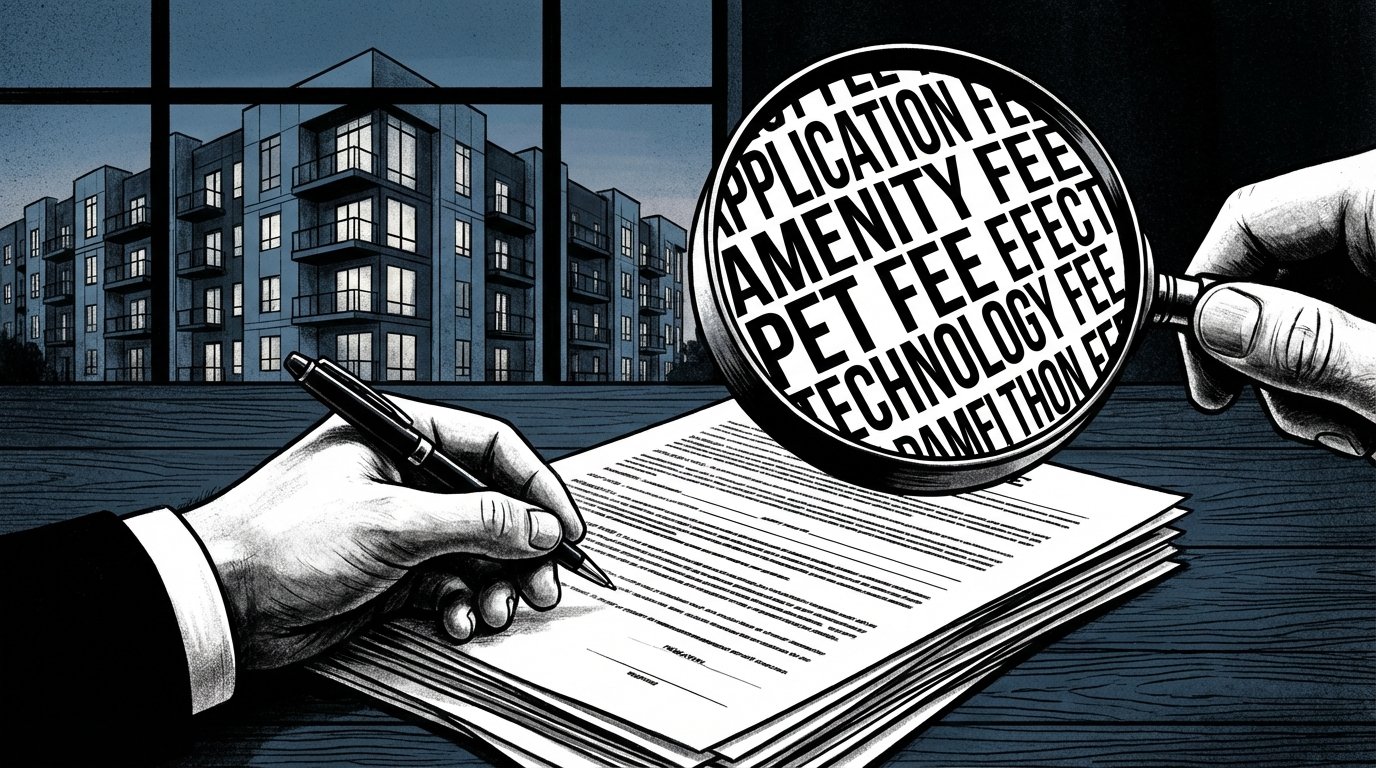
The corporate landlord industry has imported the airline unbundling playbook into housing. A Zillow Consumer Housing Trends Report from 2024 found that 58% of renters reported paying at least one kind of additional fee on their rental — beyond base rent and a security deposit. The most common were utility pass-through fees, but the list has expanded dramatically over the past decade under corporate property management.
The menu now includes: non-refundable application fees ($50–$150, charged to every applicant whether approved or not), administrative fees (charged at lease signing on top of a security deposit), monthly pet rent (on top of a pet deposit that already covers damage), technology fees (for a tenant portal app that costs the landlord perhaps $5 per unit per month), amenity fees (for a gym that was listed as included), package locker fees, undisclosed parking fees, and — in the latest innovation from the corporate landlord sector — monthly “convenience fees” for paying rent online instead of by physical check.
A Business Insider investigation published in 2025 traced this evolution, quoting an internal real estate management industry document that used the phrase “juice this hog” to describe the fee maximization strategy. The National Consumer Law Center found that rental junk fees cost American tenants hundreds of millions of dollars per year. For renters already spending over 30% of income on rent — the majority of U.S. renters — these fees can push them into severe housing cost burden. And unlike hotel resort fees, no federal rule currently requires upfront disclosure of rental fees before a lease is signed.

The Regulators Blinked: How the Trump Administration Handed the Fee Economy Back to Corporations
Between 2021 and 2024, the Biden administration launched the most aggressive junk fee enforcement campaign in U.S. history. The CFPB issued rules capping overdraft fees, capping credit card late fees at $8, and requiring financial institutions to treat overdraft as a loan subject to Truth in Lending Act disclosures. The FTC finalized a bipartisan junk fees rule on hotels and ticketing. The White House created a dedicated “Junk Fee Prevention” task force. Collectively, these actions were estimated to save Americans more than $20 billion annually.
In 2025, Congress and the Trump administration methodically dismantled most of it. The CFPB overdraft rule — which would have saved $5 billion annually, or $225 per affected household — was repealed under the Congressional Review Act and signed by President Trump in May 2025. The $8 credit card late fee cap was abandoned by the Trump CFPB in April 2025 after a Texas federal court blocked it. The CFPB itself was effectively neutered — enforcement staff was gutted, rulemaking was frozen, and acting leadership signaled the bureau’s consumer protection role would shrink dramatically.
The financial industry’s justification for repealing the overdraft rule was that it would “reduce access to credit” for low-income consumers — that the overdraft fee is actually a service vulnerable consumers depend on. This is technically defensible in a narrow sense and deeply dishonest in the broader one. Consumers who pay the most in overdraft fees are not making sophisticated credit decisions; they are being charged $35 for a $15 transaction at 11pm because they had no other option. Framing that as consumer choice is the kind of rhetorical sleight-of-hand that comes pre-packaged from industry lobbyists, which is exactly where it originated.
The net effect: JPMorgan, Bank of America, and Wells Fargo will collectively recapture several billion dollars in annual fee revenue that the Biden-era rules had constrained. The same consumers — the ones without financial cushion, the ones living paycheck to paycheck — will absorb most of it.

Who Gets Crushed: The Generational and Racial Fee Burden
Junk fees are not applied equally. The structure of most fee systems — overdraft fees on low-balance accounts, credit card late fees that compound on minimum-payment cycles, resort fees on budget travel, rental application fees paid repeatedly by people who can’t afford the first-choice unit — means the economic burden falls hardest on people with the least margin to absorb it.
Millennials and Gen Z are disproportionately exposed. Their median savings are low, their housing costs are high, they travel with tighter budgets, and they are more likely to rent from corporate landlord portfolios where fee-stacking has become standard. CFPB data shows that overdraft fees concentrate most heavily on accounts with low average balances — precisely the accounts held by younger workers in early career stages and gig workers with irregular income.
The racial dimensions are significant. Black and Latino households carry higher proportional fee burdens across overdraft, credit card late fees, and rental fees, partly because they are more likely to be asset-poor and income-volatile due to structural factors. The fee economy amplifies existing inequality. It does not create it — but it does not need to.
For a household earning $50,000 a year — a salary in the middle of the American income distribution — the annual fee burden across banking, travel, and housing can easily reach $1,500 to $3,000. That is 3% to 6% of gross income extracted by charges that existed on paper as “choices” but function in practice as unavoidable tolls on participating in the modern economy. There is no fee-free path to banking, renting an apartment, flying, or attending a live event. There is only the advertised price and the real one.
The Counter-Argument: Are Junk Fees Just Transparent Pricing?
The industry position, articulated consistently by airline trade groups, banking lobbies, hotel associations, and their allies in Congress, is that ancillary fee disclosure is not deceptive — it’s choice. If you don’t want to check a bag, you don’t pay the baggage fee. If you don’t want the resort pool, book a different hotel. If you maintain a positive balance, you don’t pay overdraft fees. Unbundling, the argument goes, lets consumers pay only for what they use and keeps base prices lower for price-sensitive consumers.
This argument holds up only in a world with perfect information, zero switching costs, and abundant alternatives. In the real world, it falls apart almost immediately. Families can’t “choose” to avoid seat selection fees unless they accept being separated on a flight. Resort fees are mandatory — there is no option to decline. Overdraft fees hit at the moment of lowest financial awareness, not as a deliberate credit decision. And in concentrated markets — where four airlines control 80%+ of U.S. domestic capacity and consolidation has narrowed alternatives across industries — the “just choose a competitor” option is theoretical.
The counter-argument also cannot explain why the same industries that claim fees represent “consumer choice” spent hundreds of millions of dollars lobbying against rules that would simply require them to disclose the full price upfront. If transparency is consistent with choice-based pricing, there is no reason to fight disclosure. The fight against disclosure rules is the tell.
Frequently Asked Questions About Junk Fees
What are junk fees?
Junk fees are hidden, mandatory, or surprise charges added to the advertised price of a product or service — often disclosed only at the end of a transaction. Examples include hotel resort fees, airline seat selection charges, bank overdraft fees, credit card late fees, rental application fees, and ticketing service charges.
How much do junk fees cost Americans per year?
Estimates range from $90 billion to $165 billion annually, depending on which sectors are included. Banking fees (overdraft, late fees) account for roughly $18 billion; airline ancillary fees add $7+ billion in baggage alone; hotel resort fees, rental car extras, ticketing fees, and rental housing fees account for much of the remainder.
Are junk fees legal?
Most are currently legal in the United States. The FTC’s 2024 Junk Fees Rule requires hotels and ticketing companies to disclose total prices upfront. Overdraft and credit card late fee caps were rolled back by the Trump administration in 2025. Several states — including California, Colorado, and Minnesota — have enacted their own limits on rental and consumer fees.
Why did the CFPB’s overdraft and late fee rules get repealed?
The financial industry lobbied aggressively against both rules, and the Trump administration and Congress used the Congressional Review Act to repeal the overdraft rule in May 2025. The $8 late fee cap was first blocked by a Texas federal judge and then abandoned by the Trump-era CFPB in April 2025. Industry groups argued the rules reduced access to credit; consumer advocates said they eliminated exploitative practices that disproportionately harmed low-income households.
Sources & Methodology
Data on overdraft and NSF fee revenue: CFPB Data Spotlight, 2023. Credit card late fee estimates: CFPB rulemaking record, 2024. Airline ancillary fee data: DOT quarterly reports; Senate HSGAC Majority Staff Report, November 2024. Hotel and ticketing junk fees: FTC Junk Fees Rule announcement, December 2024. Total junk fee estimates: White House Council of Economic Advisers; Investopedia annoyance economy analysis. Rental fee data: Zillow Consumer Housing Trends Report 2024; National Consumer Law Center; Business Insider investigative report, 2025. CFPB overdraft rule repeal: Holland & Knight, May 2025. JPMorgan overdraft revenue increase: American Banker, December 2025. Late fee cap scrapped: CNN / WSFA, April 2025. Rental fee statistics: Newsweek / National Consumer Law Center.