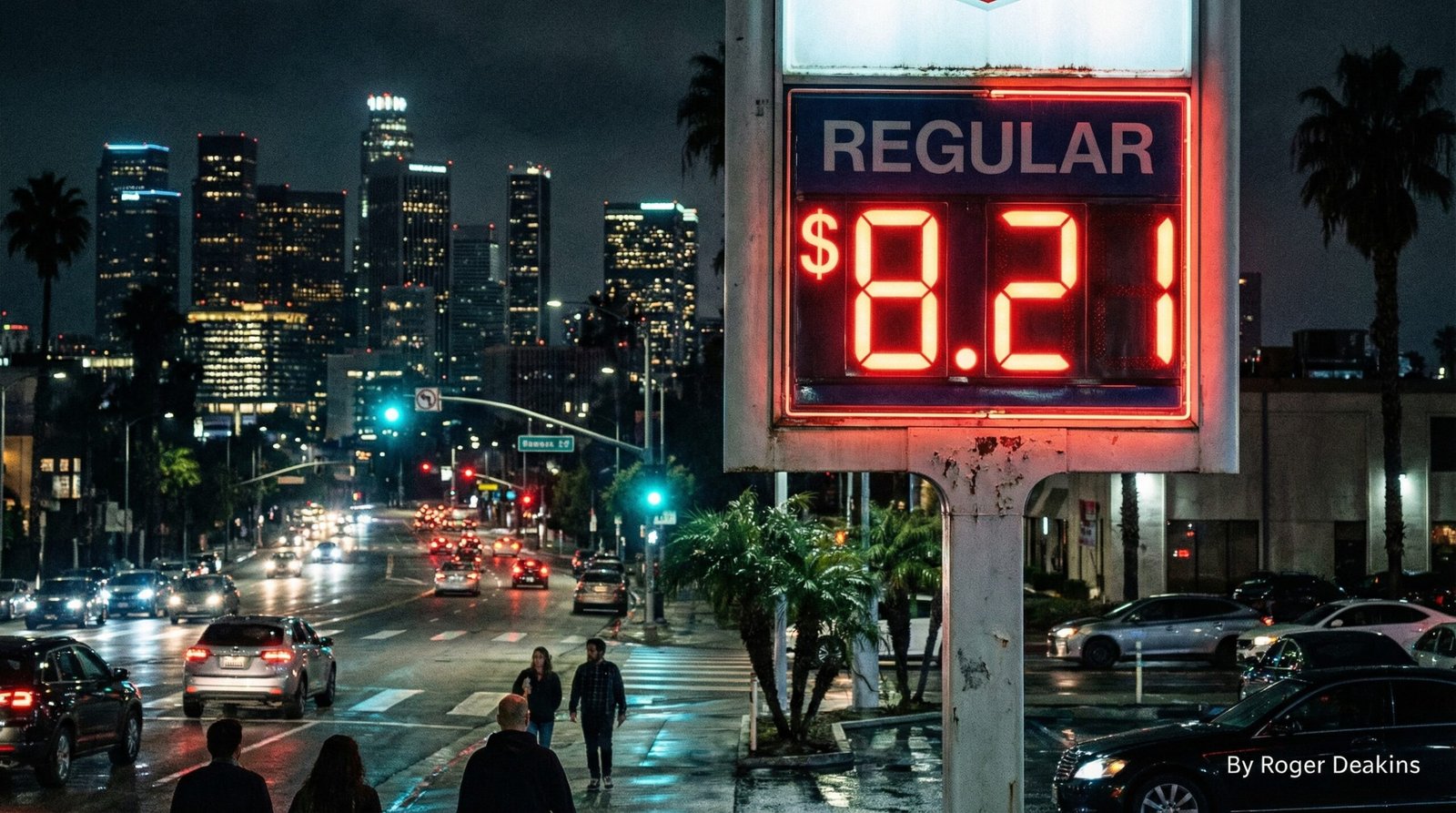
LA gas prices hit $8.21 a gallon at a downtown Los Angeles Chevron this week — while a station in Exposition Park held at just over $4 — as the Iran war drove the SoCal county average to $5.17 overnight, the sharpest single-day jump since the 2022 energy spike. The national average has risen nearly 50 cents a gallon in the one week since Operation Epic Fury began. The class divide at the pump has never been more visible: Millennials and Gen Z who rent in transit deserts, drive for Uber, and can’t work from home are getting their budgets incinerated in real time.
Key Takeaways
• LA County average hit $5.17/gal overnight — a 17-cent single-day jump
• One downtown LA Chevron station: $8.21 per gallon
• National average up nearly 50 cents in one week since Operation Epic Fury began
• Kuwait cut crude output; Qatar LNG in force majeure; 150+ tankers anchored outside Hormuz
• Uber drivers, essential workers, and Inland Empire commuters bearing the full cost
• UBS: Brent could top $120/bbl if Hormuz disruption sustained — California average could approach $7 statewide
What the Numbers Say About LA Gas Prices Right Now
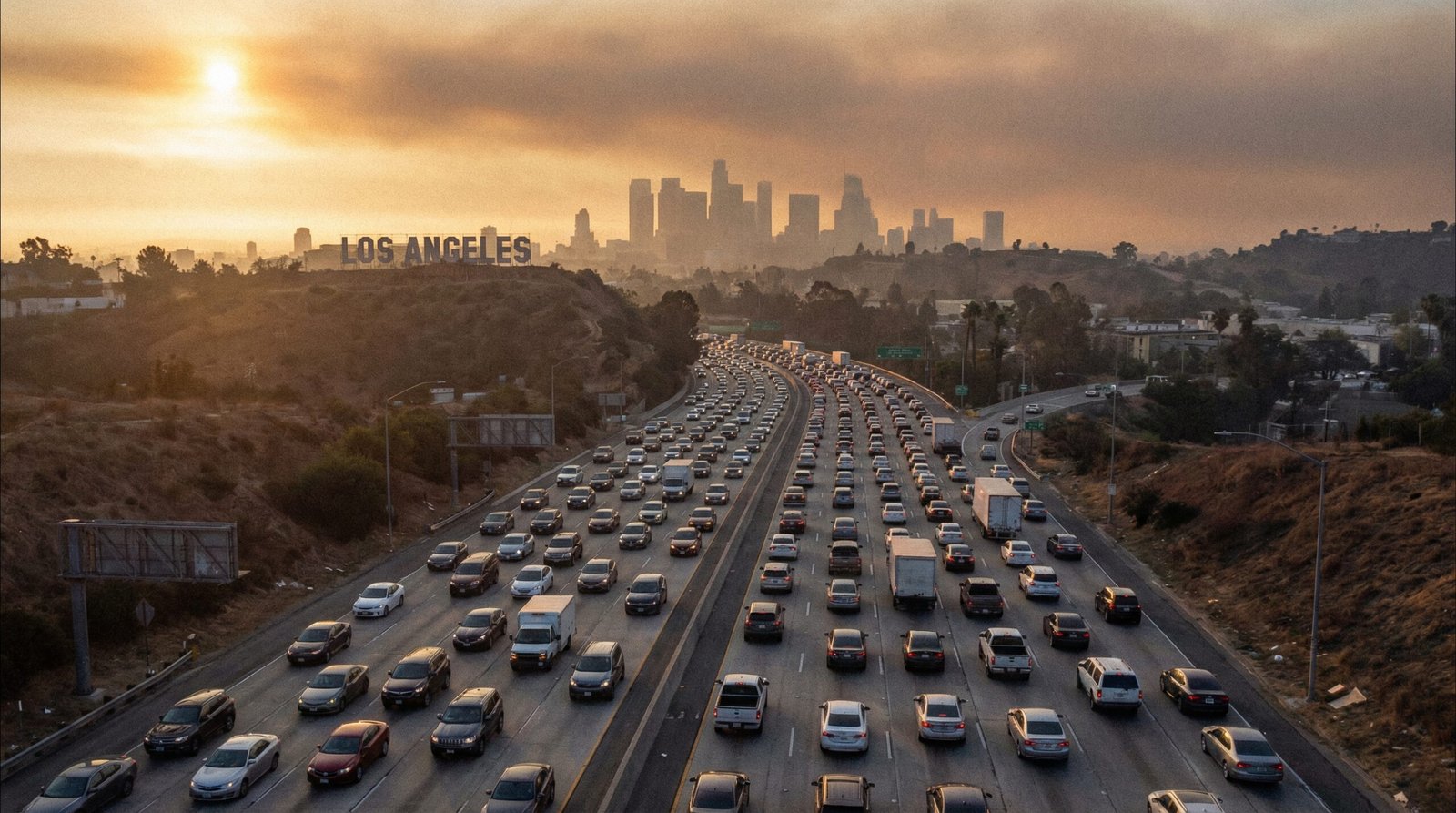
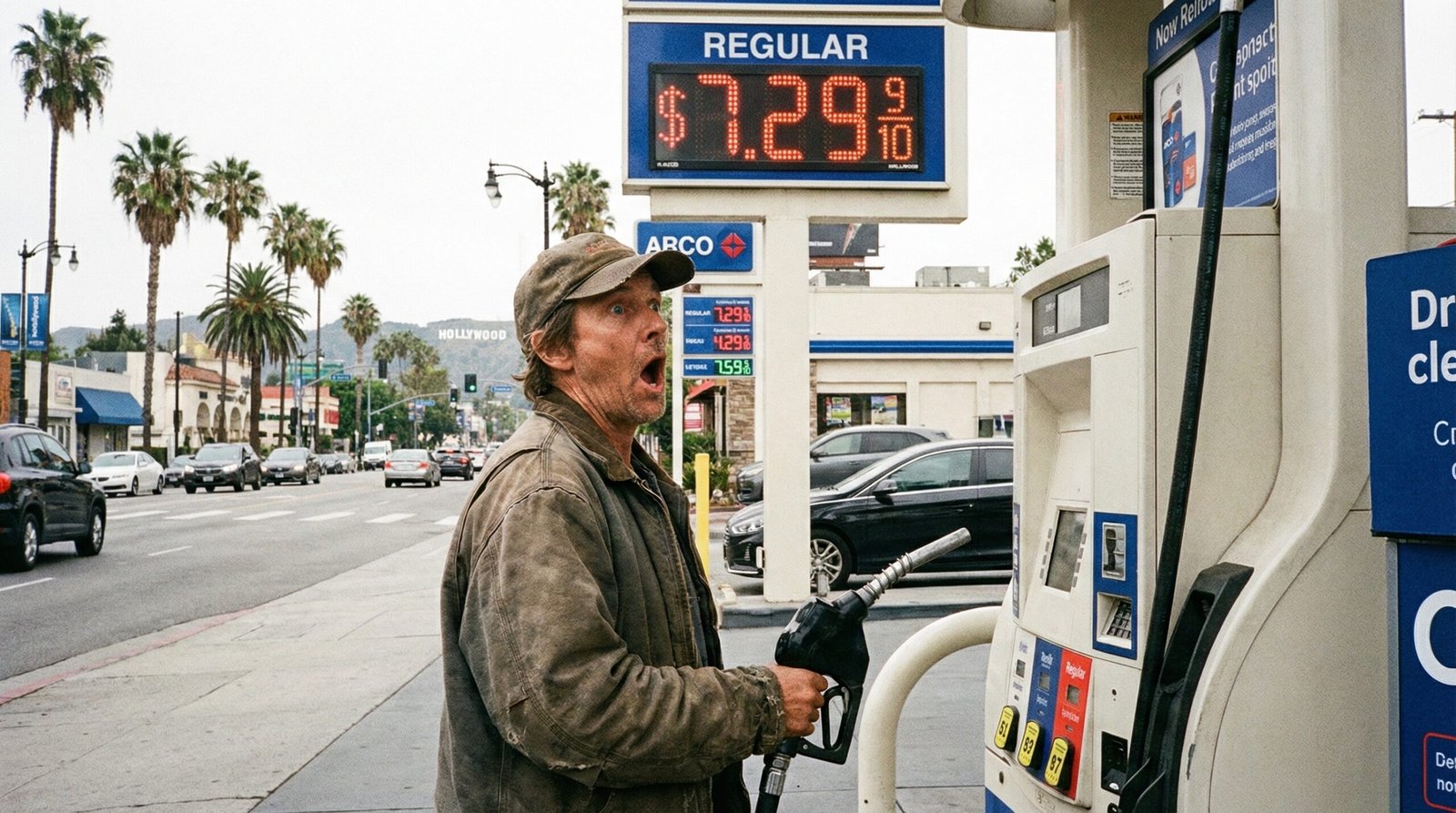
According to AAA, the national average for regular unleaded rose nearly 50 cents per gallon in the week following the launch of U.S.-Israel strikes on Iran — the biggest single-week jump in years. In California, that already-inflated baseline got torched. The statewide average crossed $5 per gallon. Los Angeles County hit $5.17 — a 17-cent overnight jump. Orange County: $5.15. Riverside County: $5.06. And for drivers who didn’t know to avoid the Chevron on Figueroa: $8.21 a gallon.
That $8.21 number isn’t a typo or a kerosene line. It’s regular unleaded. It’s at a major branded chain station in one of the most expensive cities in America. And it’s being paid by people who have no realistic alternative.
This is not a story about the abstract economics of the Iran war’s economic impact. This is what that war costs when it walks into your neighborhood and lights your checking account on fire. The stagflation trap analysts warned about is no longer theoretical — it’s $8.21 on a pump in downtown Los Angeles.
Why Southern California Gets Hit Harder Than Anywhere Else
California already pays a premium before any Middle East crisis. The state uses a cleaner-burning fuel blend that costs more to refine and isn’t interchangeable with the rest of the country’s supply. California’s gas tax is among the highest in the nation. And the state has systematically reduced its own in-state refining capacity over the past two decades — meaning it’s more exposed to global supply shocks than anywhere else.
Layer on top of that: the Hormuz crisis. Roughly one-third of the world’s seaborne crude passes through the Strait of Hormuz. The Hormuz blockade hasn’t been permanent — but just the threat of disruption, combined with Kuwait cutting crude output and Qatar halting LNG production, has been enough to send Brent crude spiking toward $90+. When the feedstock gets more expensive, California’s premium refining costs amplify every cent of that increase.
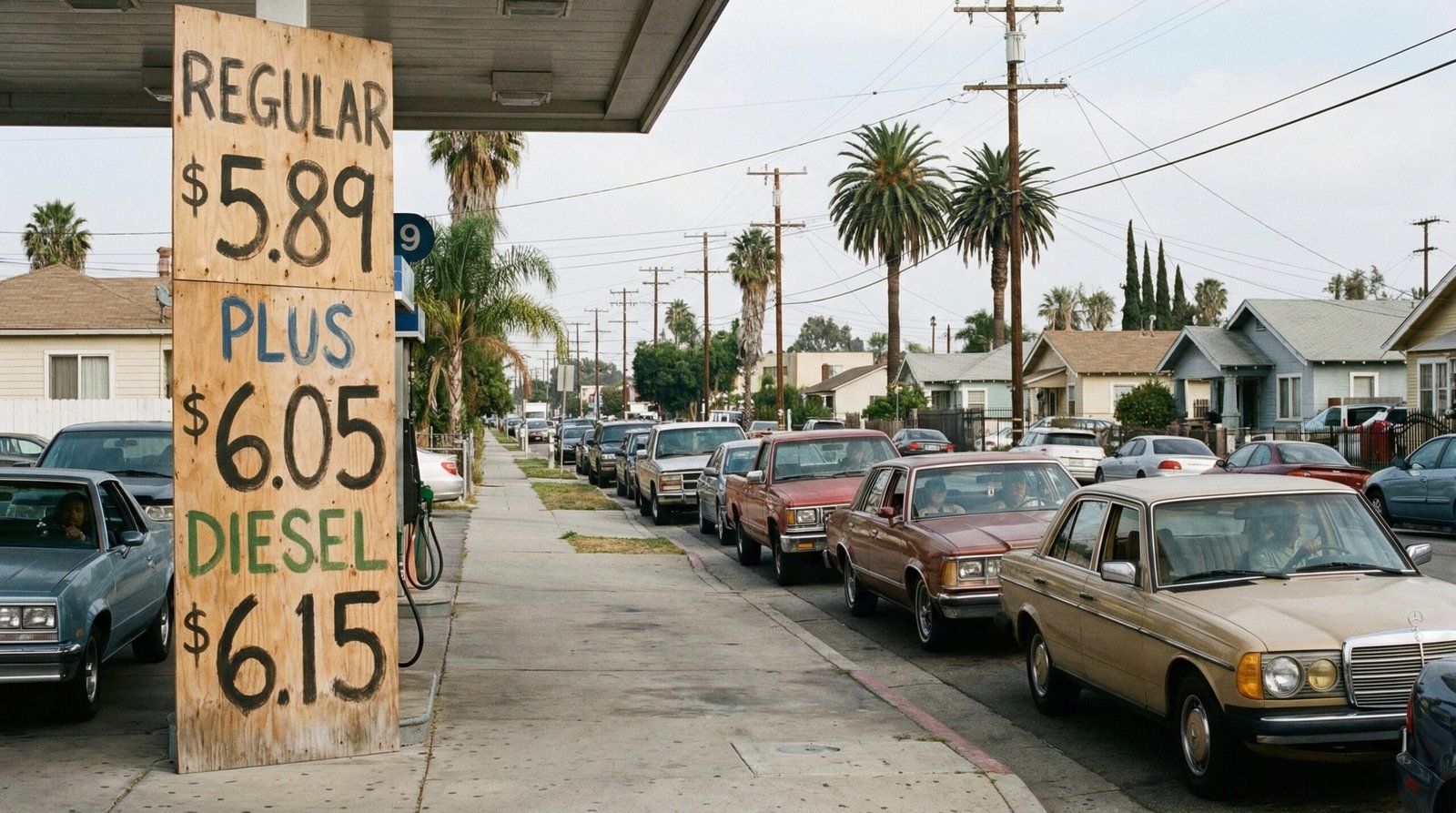
And when prices spike, the branded stations — Chevron, Shell, ARCO’s premium tier — don’t absorb the margin. They pass it. The independent stations in working-class zip codes sometimes hold their pricing longer. That’s how you get a $4 station in Expo Park and an $8 station in downtown LA three miles away. The American energy independence myth meets the reality of a state that offshored its refining capacity and is now paying the price — literally.
Who Is Actually Paying This
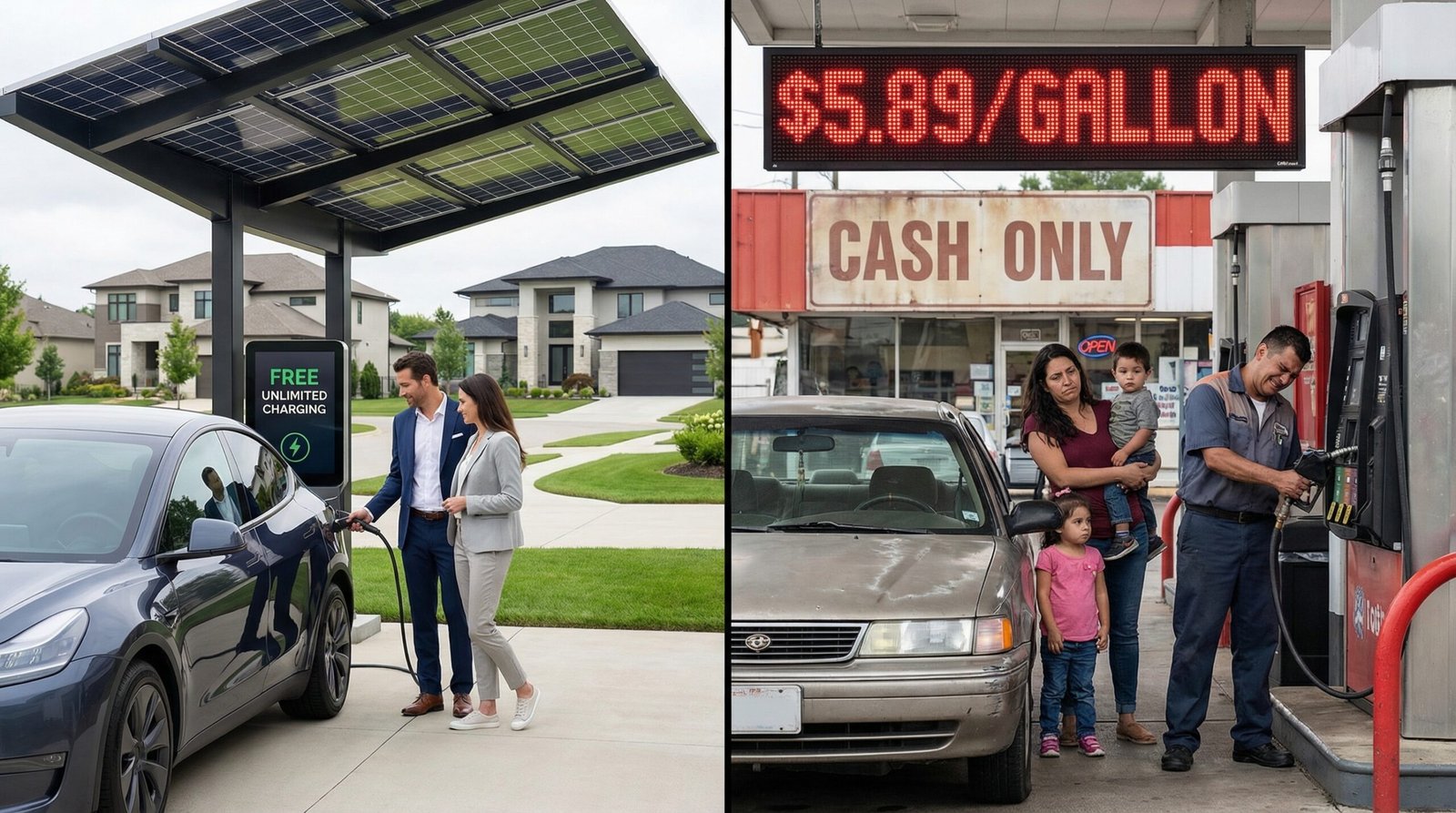
Here’s who doesn’t care about $8 gas: anyone with a company EV or a lease reimbursement. Anyone who works from home. Anyone whose household income is high enough that 3 fill-ups a week is rounding error. In Los Angeles, that describes a significant percentage of the knowledge-economy workers in Silver Lake, Los Feliz, and the Westside.
Here’s who is getting destroyed right now:
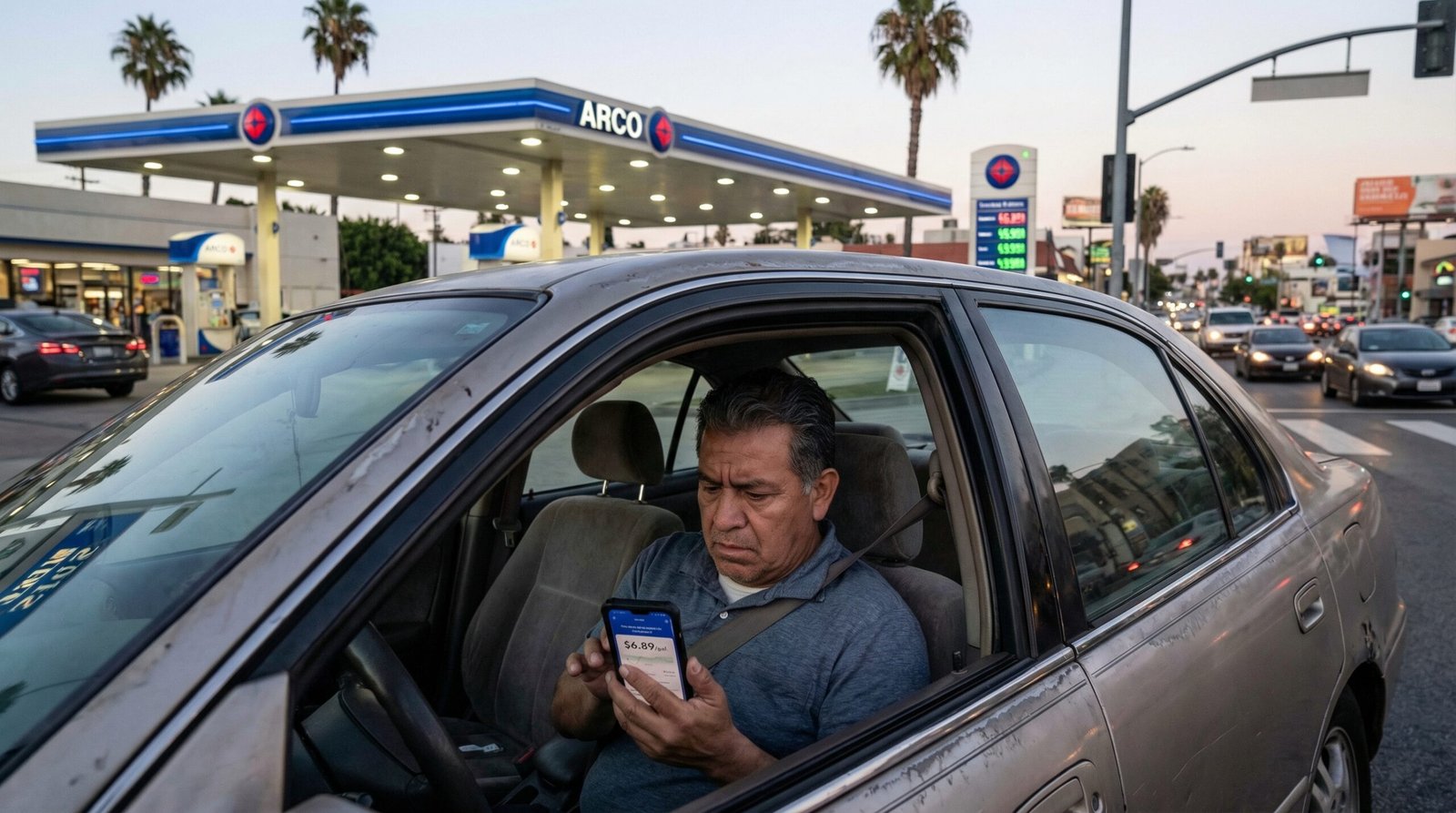
- Gig workers. “I drive Uber and I’m just getting killed right now, and I mean gas prices are just so high … they were high before the war,” one driver told ABC7 Eyewitness News. Uber’s per-mile fuel surcharge doesn’t scale with $8 gas. You absorb the difference. The gig economy trap was designed to make fuel your problem, not the platform’s.
- Essential workers who commute from the Inland Empire. The median house price in the Inland Empire was the only option for families making $60–80K. The tradeoff was a 60–90 minute drive each way. At $5+ per gallon, that commute now costs $400–600 a month in fuel alone.
- Delivery drivers and logistics workers. Independent contractor classification means zero fuel cost coverage. That classification is now a $500/month expense that falls entirely on the driver.
- Anyone in a transit desert. LA’s transit network is famously inadequate outside a narrow corridor. If you live in Pacoima, Compton, or East Pomona, the bus doesn’t go where you work on the schedule you need. You drive. You pay.
The people who benefit from the Iran war — defense contractors up 30–40%, oil companies booking record margins — are not the people paying $8 at the pump. That’s always how this works.
The Generational Math Nobody Wants to Run
Baby Boomers as a cohort are the least exposed generation to this spike. They own homes — often with paid-off mortgages — and statistically are far more likely to be retired or working reduced schedules. The Boomer generation controls 51% of American wealth; a disproportionate share of that wealth is in assets that appreciate during energy shocks: real estate, oil stocks, and defense equities.
Millennials and Gen Z are the cohort drowning in rent burdens, carrying student loan debt, working gig jobs without benefits, and living in the transit-poor zip codes their parents’ homeownership made unaffordable. They are also, statistically, the ones most likely to have gas-dependent jobs and no financial cushion to absorb a $200/month fuel shock.
The median Millennial has essentially zero financial buffer. After rent, student loan minimums, and basic living expenses, the average under-40 Californian has less than $1,000 in liquid savings. A $300/month fuel shock isn’t an inconvenience. It’s a missed payment. The war costs taxpayers an estimated $1 billion per day before the pump prices even moved — and ordinary Angelenos are now paying hundreds more per month on top of that.
How High Can It Go?
Analysts aren’t reassuring. UBS warned that Brent crude could top $120 per barrel if the Hormuz disruption is sustained. Barclays is telling clients “do not buy the dip yet.” Goldman Sachs flagged the oil shock as “very large compared to Russia.” Qatar’s energy minister projected $150/barrel if the Hormuz closure persists for weeks.
At $120 Brent, California’s gas average could approach $7 statewide. At $150 Brent, the math gets ugly fast. The $8 station in downtown LA wouldn’t be an outlier anymore. For context: California already has the most price-sensitive gas market in the country. The Iran war inflation spiral compounds a state that was already running hot on energy costs before a single bomb dropped.
Kuwait has cut crude output. Qatar’s LNG is in force majeure. 150+ tankers are anchored outside the strait. OPEC+’s compensating production increase was immediately deemed “insufficient” by Deutsche Bank. The structural supply picture is worse than 2022, and the political will to de-escalate appears to be approximately zero — Trump said Iran will be “hit very hard” today.
Wait, Didn’t Biden Era Prices Hit $6 in California?
Yes. California hit $6.44 average statewide in June 2022. The difference: that spike was driven primarily by post-COVID refinery maintenance backlogs and European demand competing with U.S. supply after the Russia-Ukraine war. It came down relatively quickly once refineries caught up.
This spike has a different floor. The Hormuz closure isn’t a refinery maintenance problem — it’s a geopolitical chokepoint that could remain disrupted for months. Kuwait has cut production. Qatar’s LNG is in force majeure. 150+ tankers are anchored outside the strait. OPEC+’s compensating production increase was immediately deemed “insufficient” by Deutsche Bank. The structural supply picture is worse, and the political will to de-escalate appears to be approximately zero.
The 2022 spike also didn’t come with a stagflation backdrop of –92,000 jobs in the most recent payroll report. This time the price spike arrives while the job market is already contracting. The February 2026 jobs report confirmed the economy was already shedding jobs before the war’s economic damage fully registers in the data.
FAQ: LA Gas Prices and the Iran War
Why is gas so much more expensive in LA than the national average?
California uses a cleaner-burning fuel blend that costs more to produce, applies among the highest state gas taxes in the country, and has reduced its in-state refining capacity over two decades — making it uniquely exposed to global oil supply shocks. When Brent crude spikes, California prices spike more.
Does the Iran war actually affect California gas prices directly?
Yes. California depends on global oil markets for pricing. The Strait of Hormuz carries about 17–20 million barrels of crude per day. Any credible threat to Hormuz traffic drives Brent crude higher globally, and California prices follow within days.
Why are some LA stations charging $8 while others charge $4?
Branded stations (Chevron, Shell, etc.) charge a significant premium over independents at baseline. During price spikes, they reprice faster and more aggressively. Stations in lower-income neighborhoods often hold prices longer to keep their customer base. That’s how you get a $4 difference within three miles in LA.
Will prices come back down?
If the conflict de-escalates and Hormuz traffic normalizes, some relief is likely within weeks. But most commodity analysts have $5+ California averages through spring and summer 2026 as their base case. The underlying geopolitical disruption is not a short-term problem.
Sources & Methodology
Gas price data from AAA (March 8, 2026) and ABC7 Eyewitness News on-the-ground station pricing in Los Angeles County. Driver quotes from ABC7 field reporting, March 7–8, 2026. Oil market projections from UBS, Barclays, Goldman Sachs, and Deutsche Bank analyst notes. Context on Hormuz supply disruption from our ongoing Hormuz coverage. All external links are dofollow per site policy.