

Manufactured housing predatory lending is a systemic financial trap that has stripped wealth from approximately 22 million Americans who live in mobile homes and manufactured housing communities. The model works like this: a single company—Clayton Homes, owned by Warren Buffett’s Berkshire Hathaway—manufactures the home, finances the purchase at 9–14% interest through a chattel loan (not a real mortgage), sells the land separately under a lease agreement that can be terminated with 30 days notice, and in many states retains the right to repossess the home and evict the family if they miss even one payment. The default rate on these loans runs 15%, compared to 3.6% for conventional mortgages. This isn’t an accident. It’s a business model.
Key Takeaways: • 22 million Americans live in manufactured housing; • Clayton Homes controls 49% of the market and finances 70% of its own sales through captive lenders; • Chattel loans carry 9–14% APR vs. 6.5–7% for conventional mortgages; • Manufactured homes depreciate an average of 3% per year while site-built homes appreciated 7.7% annually 2012–2022; • In at least 26 states, manufactured home owners can be evicted from a land lease community with 30 days notice or less; • Black and Latino borrowers are 2.4x more likely to receive a chattel loan than white borrowers with similar credit profiles; • The Dodd-Frank consumer protections were effectively carved out for manufactured housing lending, leaving buyers with almost no federal protection.
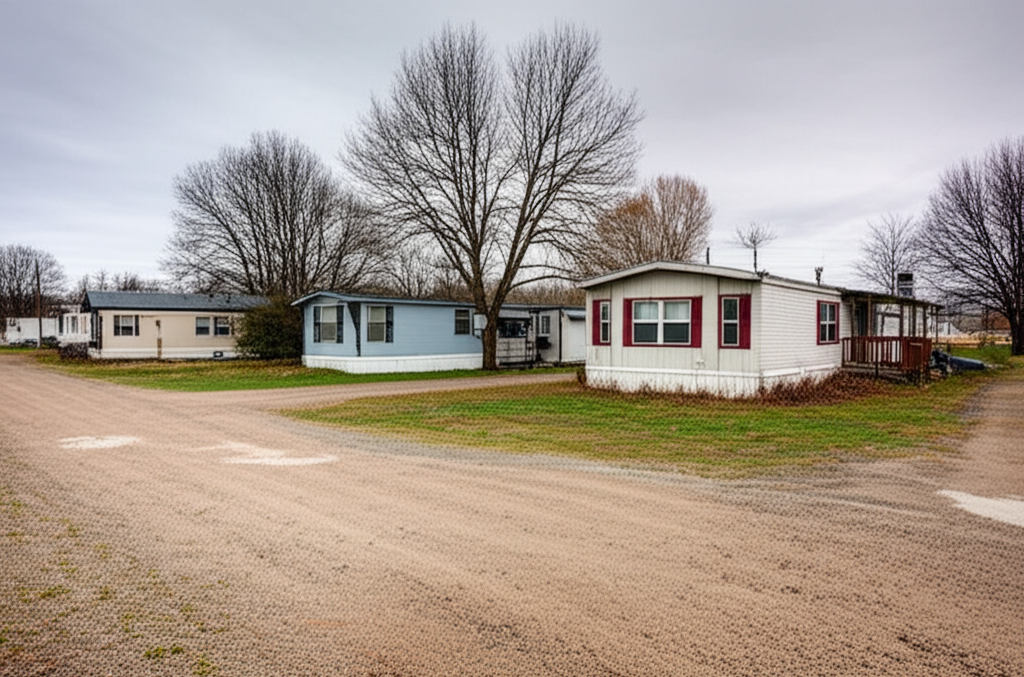
What Is Manufactured Housing Predatory Lending?
Manufactured housing — the federal term for what most people still call mobile homes or trailers — is the largest source of unsubsidized affordable housing in the United States. About 6.7% of the American housing stock is manufactured housing, and the people who live in it skew poor, rural, elderly, and minority. The median income of a manufactured housing resident is $35,000 per year. That’s not a coincidence. Manufactured housing exists precisely because it is the cheapest form of homeownership available — and a specific class of financial products was constructed to extract maximum profit from people who have no better option.
The term “manufactured housing predatory lending” describes a cluster of practices documented by the Consumer Financial Protection Bureau, ProPublica, the Urban Institute, and multiple state attorneys general. These practices include: charging interest rates 3–6 percentage points above conventional mortgage rates on identical risk profiles; using non-mortgage “chattel” loan structures that strip borrowers of consumer protections; placing manufactured home communities on land leased under terms that allow rapid rent increases and eviction; and structuring purchases so that the same corporation that built the home also holds the loan — creating a captive financial relationship with no competitive pressure.
This isn’t a fringe problem. It’s the dominant business model for the segment of the housing market that serves people who can’t afford anything else. Meanwhile, Wall Street has been buying up traditional single-family homes to rent them out, compressing working-class housing options from both directions. Manufactured housing — once a genuine path to homeownership — has been converted into a wealth extraction machine.
The manufactured housing industry is quick to point out that it provides housing to people who couldn’t otherwise afford homeownership. This is true. It’s also true that the terms of that ownership have been engineered to ensure buyers build little to no equity, remain financially vulnerable, and have no practical exit options once locked in. Providing something people need and then exploiting them for needing it is the definition of a trap — and that is what decades of exclusionary zoning and NIMBY land use policy has delivered: a captive market for predatory lenders.

The Clayton Homes Monopoly: How Berkshire Hathaway Cornered the Market
Understanding manufactured housing predatory lending requires understanding Clayton Homes. Clayton is not just a homebuilder. It is the vertically integrated monopolist of the manufactured housing market — manufacturing, selling, financing, and insuring manufactured homes through a single corporate structure that Berkshire Hathaway acquired in 2003 for $1.7 billion.
As of 2026, Clayton Homes controls approximately 49% of the manufactured housing market by shipments, according to the Manufactured Housing Institute. That means nearly 1 in 2 manufactured homes sold in the United States is a Clayton product. The company’s captive lenders — primarily 21st Mortgage Corporation and Vanderbilt Mortgage and Finance, both Berkshire Hathaway subsidiaries — finance roughly 70% of Clayton’s own sales. Clayton builds the home. Clayton’s banks lend the money. Clayton’s insurance arm writes the policy. In many cases, Clayton also owns or manages the community where the home is placed.
This vertical integration is the mechanism of extraction. When a family walks into a Clayton dealership, they are negotiating with a salesperson who works for a company that also controls the financing they’ll need. There is no competing lender shopping for their business. Clayton’s captive lenders are free to charge whatever the market will bear — which turns out to be 9–14% APR, depending on creditworthiness, versus the 6.5–7% available on a conventional home mortgage for a site-built house.
“Clayton Homes’ captive lending structure means that buying a Clayton manufactured home is like borrowing from your landlord’s bank at your landlord’s rate while living on your landlord’s land. There is no competitive check on any component of this arrangement.”
A 2015 Seattle Times and BuzzFeed News investigation found that Clayton Homes was charging minority borrowers significantly higher rates than white borrowers with similar financial profiles, and that its dealers were engaging in the kind of loan steering that was illegal in the traditional mortgage market but not regulated in manufactured housing lending. Clayton denied discriminatory intent. The result, regardless of intent, was a system in which the most financially vulnerable buyers paid the highest rates.
Warren Buffett has defended Clayton’s practices in his annual Berkshire Hathaway shareholder letters, arguing that Clayton provides housing to people who couldn’t otherwise access it and that its default rates reflect the risk profile of its borrowers. What he doesn’t address is why Clayton’s borrowers face interest rates 3–6 points above the market rate for equivalent risk, or why the structural elimination of mortgage title removes protections that every other homebuyer in America receives. Millennial retirement savings are already catastrophically underfunded — manufactured housing chattel loans are one of the structural reasons lower-income households have nothing left to save.
Chattel Loans: The Financial Trap Hidden in Plain Sight
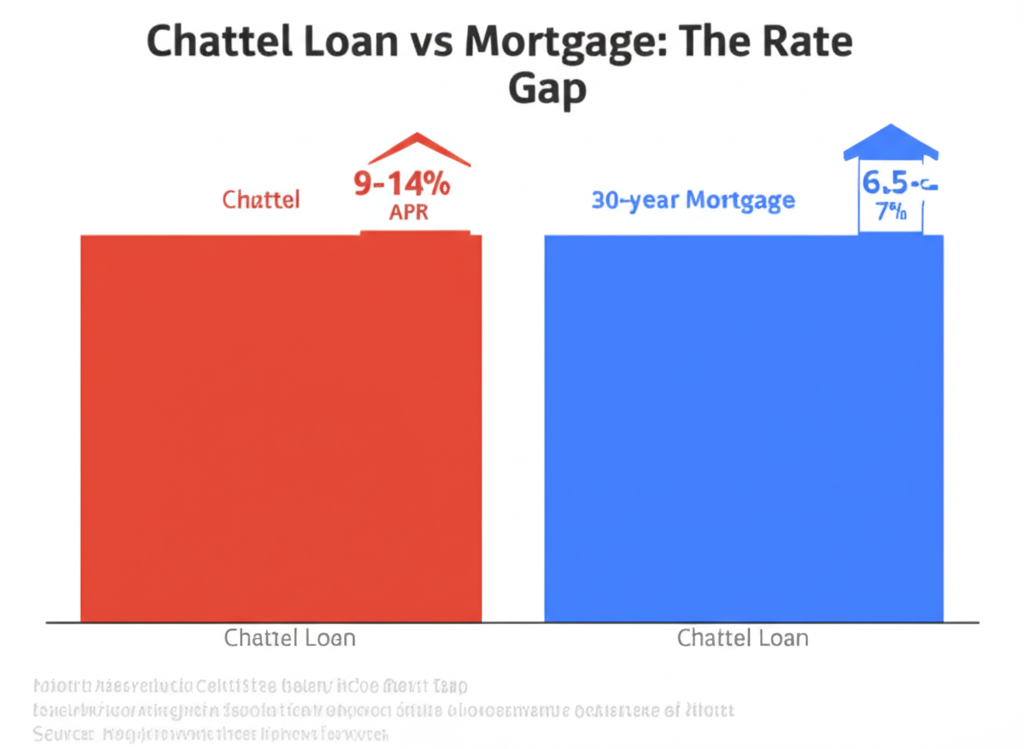
The most important structural feature of manufactured housing predatory lending is the chattel loan — and most buyers have never heard the word. A chattel loan treats the manufactured home as personal property (like a car) rather than real estate. This distinction has enormous financial consequences.
When a home is financed as real property through a conventional mortgage, the borrower receives the full suite of consumer protections established under the Truth in Lending Act, the Real Estate Settlement Procedures Act, the Equal Credit Opportunity Act, and Dodd-Frank. These protections include mandatory loan counseling, three-day rescission rights, limits on prepayment penalties, required disclosure of the loan’s APR and total cost, and access to federal loan modification programs in default. A chattel loan gets none of these.
| Loan Type | Typical APR | Consumer Protections | Foreclosure Process | Down Payment |
|---|---|---|---|---|
| Conventional Mortgage | 6.5–7.0% | TILA, RESPA, ECOA, Dodd-Frank | Judicial (6–12 months) | 3–20% |
| FHA Loan (site-built) | 6.7–7.2% | Full federal protections | Judicial (6–12 months) | 3.5% |
| Chattel Loan (manufactured) | 9–14% | Minimal — UCC personal property rules | Repossession (30–90 days) | 5–20% |
| Vanderbilt Mortgage (Clayton) | 10–14% | Minimal — UCC only | Repossession (30–90 days) | 5–10% |
The repossession timeline is particularly brutal. Under a chattel loan, a manufactured home can be repossessed in as few as 30 to 90 days of missed payments — compared to the 6 to 18 months a borrower in a judicial foreclosure state can remain in a site-built home while contesting the process. This speed advantage is enormously valuable to lenders and enormously harmful to borrowers, who have no time to find alternative housing, sell the home, or restructure their finances.
Approximately 68% of manufactured homes are financed through chattel loans, according to the CFPB. The gutting of the CFPB in 2026 has removed the primary federal agency tasked with monitoring these practices, leaving manufactured housing borrowers more exposed than at any point since the 2008 financial crisis.
“A $90,000 manufactured home financed at 12% APR over 20 years costs $237,000 in total payments. The same home at 6.5% on a conventional mortgage costs $161,000. The rate difference alone extracts $76,000 from a family that chose manufactured housing precisely because they couldn’t afford to overpay.”

Land Lease Traps: When You Own the Home but Not the Ground Under It
Manufactured housing has a second structural vulnerability that compounds the chattel loan problem: in many cases, the homeowner does not own the land their home sits on. Approximately 60% of manufactured homes are placed in land-lease communities — what the industry calls manufactured home communities, and what most Americans call mobile home parks — where residents pay a monthly lot rent to an owner who holds the land.
This creates a form of tenure that has no real equivalent in any other housing sector. The homeowner bears the full risk of homeownership (property taxes, maintenance, loan obligations) while holding none of its most valuable protection: secure tenure on the land. In at least 26 states, the notice period for terminating a land lease and evicting a manufactured home community resident is 30 days or less. That’s how long a family has to move a structure that in many cases cannot practically be moved at all.
Moving a manufactured home typically costs between $3,000 and $15,000, requires specialized transporters, and frequently results in structural damage that renders the home uninhabitable. Most manufactured homes that leave a community end up demolished — which means eviction from a land-lease community is functionally equivalent to losing the home itself, regardless of whether the buyer has made every payment on time.
Private equity has discovered manufactured home communities. Firms including Blackstone, UDR, and Sun Communities REIT have been systematically acquiring manufactured home communities and raising lot rents. Between 2015 and 2023, average monthly lot rents in PE-owned manufactured home communities increased at 3–5x the rate of inflation. Residents, who face the practical impossibility of moving, have no competitive alternative. The Section 8 housing voucher system generally cannot be applied to manufactured housing in land-lease communities, leaving low-income residents without the rental assistance available to renters in other housing types.
The Depreciation Scam: Why Manufactured Homes Lose Value While Everything Else Gains
Site-built homes in America appreciated an average of 7.7% annually between 2012 and 2022. During the same period, manufactured homes treated as personal property on chattel loan terms depreciated at an average rate of approximately 3% per year. A buyer who purchased a $90,000 manufactured home in 2012 with a 10-year chattel loan at 12% APR would have paid down roughly $45,000 in interest by 2022 while their home lost approximately 25% of its original value. Their neighbor who bought a $200,000 site-built home in 2012 would have seen it appreciate to over $400,000.
This is the generational wealth dimension of manufactured housing predatory lending. The great wealth transfer that economists keep predicting will enrich millennials is built almost entirely on the appreciation of real estate owned by Boomers. Manufactured housing buyers are explicitly excluded from that appreciation cycle. The chattel loan classification — treating the home as a car rather than real estate — ensures that buyers accrue no equity through appreciation even if they pay their loans in full and on time.
There is an important nuance here: manufactured homes on owned land that are titled as real property and financed with real mortgages do appreciate — often at rates similar to site-built homes in the same market. The depreciation problem is specifically tied to the chattel loan and land-lease combination. This means the problem is not inherent to manufactured housing as a construction type. It is a financial structure problem, and it is the financial structure that the industry has been allowed to maintain for decades.
The pathway to real property title for manufactured homes exists under the Manufactured Housing Improvement Act of 2000, and state titling laws. But this process requires owning the land, completing state-specific paperwork, and finding a lender willing to write a conventional mortgage — and most conventional lenders still refuse to mortgage manufactured homes regardless of title status.
Who Gets Targeted: Race, Class, and the Geography of Exploitation
Manufactured housing predatory lending is not distributed evenly across the American population. CFPB and HMDA data consistently show significant racial disparities in chattel loan issuance that cannot be explained by creditworthiness alone.
According to a 2023 Urban Institute analysis of HMDA data, Black and Latino borrowers applying for manufactured housing financing were 2.4x more likely to receive a chattel loan than white borrowers with similar income, debt-to-income ratios, and loan-to-value ratios. Black borrowers who did receive manufactured housing mortgages paid an average of 0.8 percentage points more in interest than comparable white borrowers. For a $80,000 loan over 20 years, 0.8 percentage points represents approximately $9,000 in additional total payments.
The geographic concentration of manufactured housing — and its predatory financing — maps almost perfectly onto the geography of rural white poverty and rural minority poverty. The states with the highest concentrations of manufactured housing are South Carolina, West Virginia, New Mexico, Mississippi, and North Carolina. These are states with limited land-use regulation, weak manufactured housing tenant protections, and concentrated poverty in communities with no competitive housing market.
This geographic targeting matters because it is largely invisible to mainstream policy attention. The advocacy ecosystem in Washington focuses on urban housing — the NIMBY zoning battles that shape single-family neighborhoods in Los Angeles and New York. Rural manufactured housing communities, and the millions of working-class and poor Americans trapped in them, generate almost no political attention proportional to the scale of the problem.
The Regulatory Failure That Made This Possible
The regulatory history of manufactured housing is a case study in how the same Congress that was writing consumer protection law carefully excluded the industry most in need of protection. The Manufactured Housing Improvement Act of 2000 — passed during the Clinton administration with bipartisan support — was supposed to modernize manufactured housing standards and improve consumer protections. What it actually did, buried in its 48 pages, was establish a preemption framework that limits state regulation of manufactured housing construction standards while leaving the predatory lending structure entirely intact.
The CFPB, created in 2010 specifically to fill the regulatory gaps exposed by the 2008 mortgage crisis, was the first federal agency with both the authority and the mandate to seriously monitor manufactured housing lending. It published significant research identifying the chattel loan problem, the racial disparities, and the concentration of market power in Clayton Homes. Under the second Trump administration in 2026, the CFPB has been effectively gutted, leaving manufactured housing borrowers more exposed than at any point since before Dodd-Frank.
Fannie Mae and Freddie Mac have run limited manufactured housing mortgage programs (MH Advantage and CHOICEHome) since 2018. These programs theoretically allow manufactured homes meeting certain construction standards to qualify for conventional mortgage financing. In practice, less than 5% of manufactured housing transactions use these programs, because most manufactured homes either predate the specifications or are in land-lease communities where land tenure issues prevent conventional mortgage financing.
The FHA Title I loan program is supposed to provide federally insured chattel loans for manufactured housing at lower rates. In practice, the program issues fewer than 3,000 loans per year in a market of 100,000+ annual sales. The gap between what the program was supposed to do and what it does is the gap that Clayton’s captive lenders fill — at 9–14% APR.
Counter-Argument: Is This Just the Market at Work?
The manufactured housing industry and its defenders make two arguments that deserve serious engagement.
Argument 1: Chattel loans carry higher risk, so higher rates are justified. The default rate on chattel loans is genuinely higher than on conventional mortgages — approximately 15% versus 3.6%. Some of that gap reflects the fact that manufactured housing borrowers are, on average, lower-income and have worse credit histories than site-built home buyers. Risk-based pricing is economically legitimate.
The problem with this argument is that it confuses the symptom for the cause. The chattel loan structure — the absence of real property title, the land-lease tenure risk, the rapid repossession timelines — creates the higher risk as much as it reflects it. A borrower in a land-lease community faces eviction risk that a site-built homeowner never faces. That eviction risk destabilizes employment, schooling, and financial planning in ways that directly increase default probability. The structure that justifies the higher rate is also producing the conditions that cause the higher rate. It’s circular.
Argument 2: Clayton Homes provides housing that no other lender will finance. This is true. Without Clayton’s captive lenders, a significant portion of the manufactured housing market would have no financing at all — because conventional lenders have systematically refused to write manufactured housing mortgages. The problem with this argument is that it treats the absence of competition as a natural condition rather than a market failure created by specific structural choices. Fannie Mae and Freddie Mac could securitize manufactured housing chattel loans at scale; they don’t. FHA Title I could function as designed; it doesn’t. The vacuum that Clayton fills was created by policy choices — many of them influenced by manufactured housing industry lobbying — and Clayton is the primary beneficiary of keeping that vacuum intact.
None of this means Clayton Homes is the unique villain of the story. It means the system is structured to produce these outcomes. The pattern of vertical integration and regulatory capture is identical to what private equity did to the hospital system — and the outcomes for the people at the bottom of that system are equally grim.
Frequently Asked Questions
What is the difference between a chattel loan and a mortgage for a manufactured home?
A chattel loan treats a manufactured home as personal property, while a conventional mortgage treats it as real estate. Chattel loans typically carry interest rates 3–6 percentage points higher than comparable mortgages, offer fewer consumer protections under federal law, and allow lenders to repossess the home in 30–90 days. Most manufactured homes are financed through chattel loans because they sit on leased land and do not qualify for real property mortgage financing.
Can manufactured homes qualify for conventional mortgages?
Yes, but with significant restrictions. Fannie Mae’s MH Advantage program and Freddie Mac’s CHOICEHome program allow manufactured homes meeting specific construction standards to qualify for conventional mortgage financing. However, the home must be on owned land, and fewer than 5% of manufactured housing transactions currently qualify. Most older manufactured homes and nearly all homes in land-lease communities cannot access conventional mortgage financing.
Does Warren Buffett profit from manufactured housing predatory lending?
Berkshire Hathaway owns Clayton Homes, 21st Mortgage Corporation, and Vanderbilt Mortgage and Finance — together the largest manufactured housing manufacturer and lender in the United States. Clayton finances approximately 70% of its own home sales through these captive lenders at rates averaging 3–6 points above conventional mortgages. Berkshire Hathaway has defended these practices as appropriate given the risk profile of borrowers. Critics have documented racial pricing disparities and structurally predatory lending terms in Clayton’s loan portfolio.
What protections do manufactured housing residents have against land lease evictions?
Protections vary widely by state. As of 2026, only 24 states have manufactured housing community tenant rights laws requiring more than 30 days notice before lease termination or eviction. States with the strongest protections include New Hampshire (18 months notice), California (specific relocation assistance requirements), and Minnesota (12 months notice). Many Southern states with high manufactured housing concentration allow community owners to terminate leases with 30 days notice or less.
Sources & Methodology
This article draws on data and reporting from: Consumer Financial Protection Bureau, “Manufactured Housing Finance: New Insights From the Home Mortgage Disclosure Act Data” (2021); Urban Institute Housing Finance Policy Center, “Manufactured Housing: A Sustainable Affordable Homeownership Opportunity” (2023); Seattle Times and BuzzFeed News, “The Mobile-Home Trap” investigation series (2015); Berkshire Hathaway Annual Shareholder Letters (2003–2026); Manufactured Housing Institute, annual shipment data (2026); CFPB Home Mortgage Disclosure Act (HMDA) database, 2022–2024; National Consumer Law Center, “Manufactured Housing Land Lease Protections by State” (2024); Federal Reserve Bank of Chicago, “Manufactured Housing and the Wealth of Low-Income Americans” (2019). Chattel loan rate data reflects reported APR ranges from 21st Mortgage, Vanderbilt Mortgage, and competing manufactured housing lenders as of Q1 2026.


