

The noncompete agreement abuse problem in America is not about protecting trade secrets — it is about trapping 30 million workers in jobs they cannot leave, suppressing wages by an estimated $300 billion annually, and killing the economic mobility that younger generations were promised. Noncompete agreements, originally designed to protect genuinely sensitive corporate information, have been extended so aggressively that they now bind fast-food workers, security guards, and hair stylists to employers who have nothing to protect except their own leverage. The FTC tried to ban them in 2024. A federal judge blocked it. And now the trap is permanent.
Key Takeaways
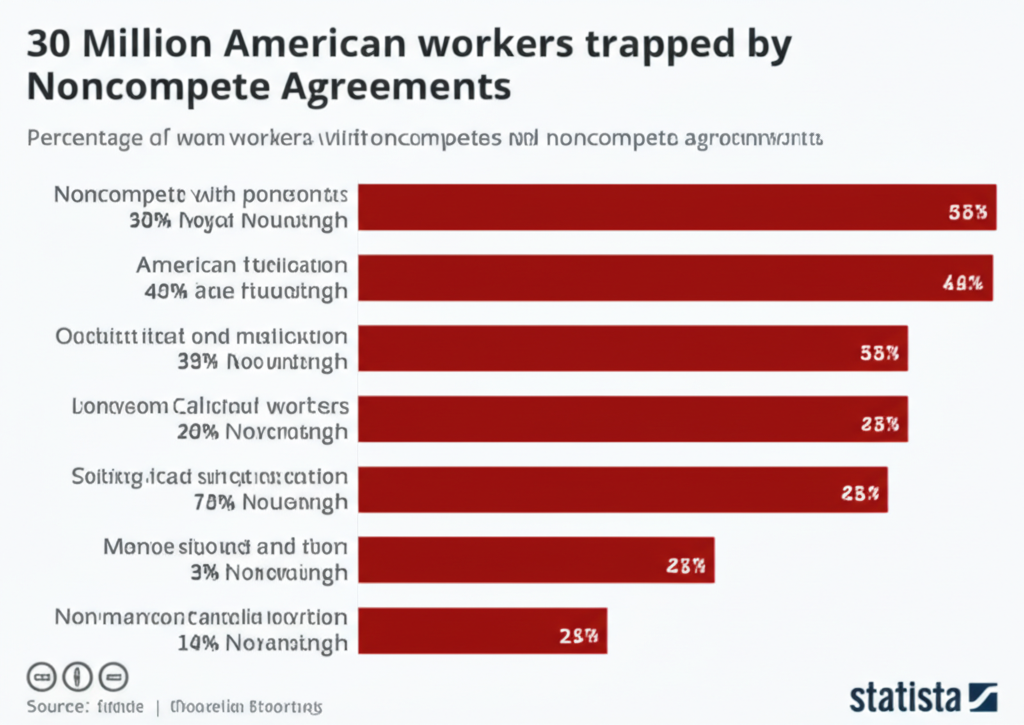
• An estimated 30 million American workers — roughly 1 in 5 — are bound by noncompete agreements
• Noncompetes are used in industries with no trade secrets: fast food, security, home care, hair salons
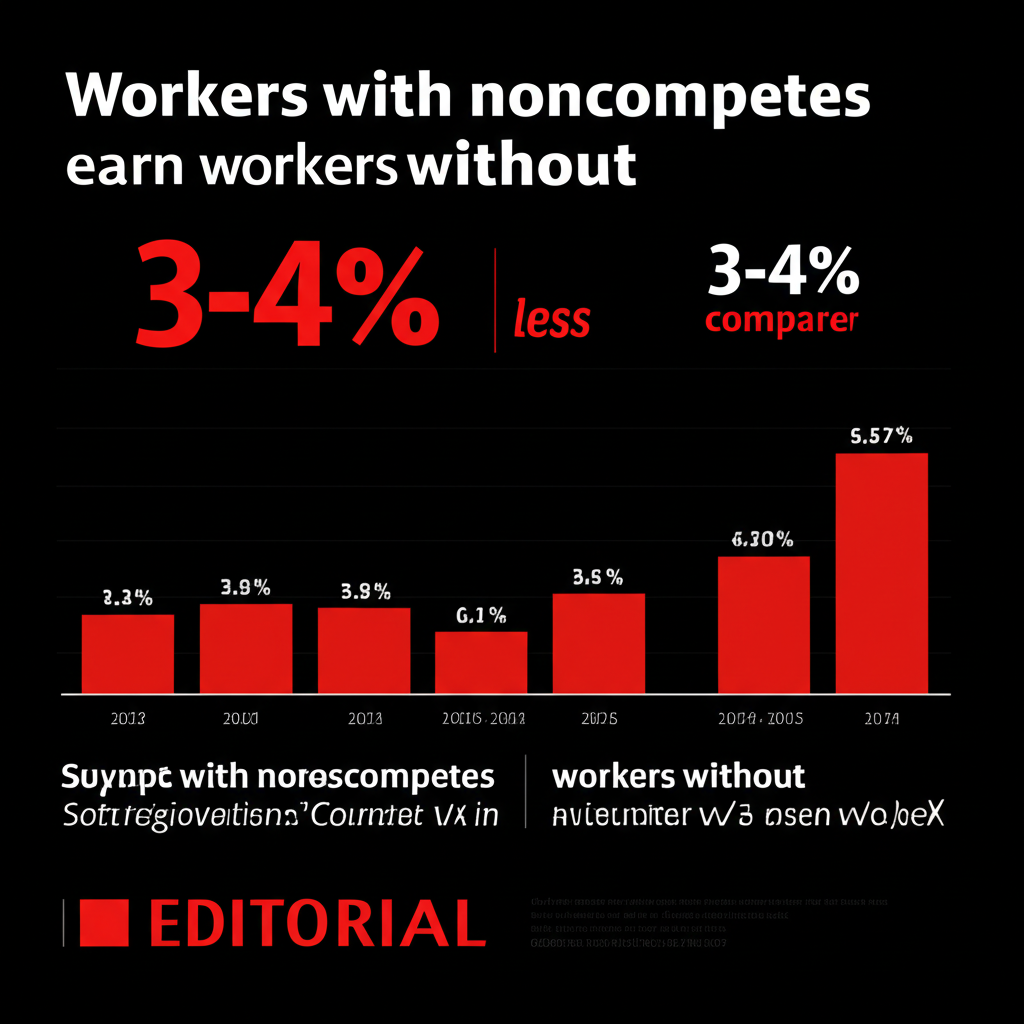
• Workers with noncompetes earn 3–4% less than comparable workers without them
• The FTC’s April 2024 rule banning noncompetes was struck down by a Texas federal court in August 2024
• Only 4 states fully ban noncompete enforcement: California, North Dakota, Oklahoma, and Minnesota
• The suppressed wage cost of noncompete abuse is estimated at $296–$300 billion per year
What Is a Noncompete Agreement and Why Do 30 Million Workers Have One?
A noncompete agreement is a contract clause that prohibits an employee from working for a competitor — or starting a competing business — for a specified period after leaving their employer. In theory, noncompetes exist to prevent a senior engineer from walking out the door on Friday and walking into a rival’s office on Monday with a hard drive full of proprietary algorithms. In practice, they have become a mass noncompete agreement abuse machine that traps tens of millions of workers who have never seen a trade secret in their lives.
The most comprehensive academic data on noncompete prevalence comes from surveys by economists at the University of Michigan and Boston University. Their research, conducted between 2014 and 2022, found that approximately 18–20% of the U.S. workforce — or roughly 30 million workers — are currently bound by a noncompete agreement. An additional 37% report having signed one at some point in their careers. The U.S. Treasury estimated in 2016 that between 12.3% and 18.1% of all private-sector workers were covered by active noncompetes.
For context: the Chamber of Commerce estimates there are 152 million workers in the American labor force. If 20% have a noncompete, that is 30 million people who cannot freely move to another job without risking a lawsuit. Many of those workers are in jobs that pay less than $50,000 a year. A significant share earn minimum wage.
The expansion of noncompetes into the service sector — which accelerated precisely as younger generations entered the workforce — tracks the same pattern as the broader corporate consolidation that has defined 40 years of American economic policy. As industries concentrated into fewer hands, employers gained more leverage to impose terms that workers could not negotiate away. The noncompete was simply the most direct expression of that power asymmetry, written into the employment contract at the point of hire.

The Sandwich Shop Noncompete: How Corporate America Trapped Low-Wage Workers
The most viscerally absurd example of noncompete agreement abuse is also the most widely reported: Jimmy John’s, the sandwich franchise, required its minimum-wage sandwich makers and delivery drivers to sign noncompete agreements prohibiting them from working for any competing business within 3 miles of a Jimmy John’s location for 2 years after leaving. This means a teenager making $8.25 an hour who quit to work at the Subway across the street could, in theory, face a lawsuit.
When the New York Attorney General and the Illinois AG investigated Jimmy John’s in 2016, they found the practice was widespread across the franchise system. Jimmy John’s eventually agreed to stop enforcing the clauses in New York and Illinois. The parent company, which was acquired by private equity firm Roark Capital in 2019, quietly maintained the practice in states with weaker worker protections.
Jimmy John’s was not an outlier. Academic research by Evan Starr, J.J. Prescott, and Norman Bishara published in the Journal of Law, Economics, and Organization documented that noncompetes are used at measurably higher rates among workers earning less than $40,000 per year than among workers earning $150,000 or more. The reason is simple: high-earning knowledge workers have leverage. They can negotiate out of noncompetes. Low-wage workers — who cannot afford lawyers, cannot survive months without income while litigation drags on, and have no union protecting them — are the most compliant and the most exposed.
The industries with the highest rates of low-wage noncompete use read like a map of the modern service economy: food service, hair and beauty salons, home health care, retail, and janitorial services. None of these workers have trade secrets. They have learned skills on the job, and the noncompete exists to prevent them from taking those skills elsewhere for better pay. The gig economy has deepened this trap — app-based platforms have developed exclusive agreements and platform bans that function as noncompetes without ever using the word.
“Noncompete agreements are not protecting trade secrets at Jimmy John’s or the Hair Cuttery or a security guard company. They are protecting employer power. The trade secret is that your employer can make you poorer and less free than you need to be.” — Economic Policy Institute, 2019
How Noncompete Agreements Suppress Wages by $300 Billion a Year
The most damaging effect of noncompete agreement abuse is not the headline lawsuit against a fleeing software engineer. The real damage is the quiet suppression of wages across millions of workers who never try to leave — because they believe the noncompete is enforceable, or because they simply can’t afford to find out.
The economics of this are well-documented. Starr’s 2019 research, published in the American Economic Review, found that workers subject to noncompetes earn 3–4% less than comparable workers in the same occupation and industry who are not bound by a noncompete. The mechanism is straightforward: labor market competition is what forces wages up. If an employer knows that you cannot legally take a job at their competitor, they can pay you less than market rate with reduced fear that you will walk. The threat of “I’ll take the offer from Company B” — the most basic tool workers have in wage negotiation — is neutralized.
When economists aggregate the 3–4% wage penalty across 30 million workers, the total wage suppression estimate is enormous. The Economic Policy Institute’s 2019 analysis estimated the total suppressed wage cost at between $229 billion and $296 billion per year. The FTC’s own economic analysis team, published as part of the April 2024 rulemaking, projected that banning noncompetes would increase total American wages by approximately $298 billion annually — roughly $524 per worker per year.
This connects directly to the wage stagnation vs. productivity gap that has defined the generational economic collapse. Worker productivity has increased 62% since 1979. Hourly compensation has increased 17.5%. Noncompete agreement abuse is one of the structural mechanisms that made all of those other forces more effective at transferring money from workers to shareholders. It is invisible, broadly deployed, and entirely legal.
“The FTC estimates that banning noncompete agreements would increase American wages by $298 billion per year — roughly $524 per worker annually. That is money that has been legally extracted from workers’ paychecks for decades. It is not a natural market outcome. It is an intentional policy choice.” — FTC Economic Analysis, April 2024

The FTC Noncompete Ban: How a Federal Court Killed It in 2024
In April 2024, the Federal Trade Commission voted 3-2 along party lines to issue a final rule banning virtually all noncompete agreements in American employment. The rule would have applied retroactively — invalidating existing noncompetes — and required employers to provide written notice to workers that their noncompetes were no longer enforceable. It was the most significant federal action on worker mobility in decades.
The business community immediately sued. In Ryan LLC v. FTC, filed in federal district court in the Northern District of Texas, Judge Ada Brown issued a nationwide injunction in August 2024, finding that the FTC had exceeded its statutory authority under the major questions doctrine — the same legal theory used to block EPA climate regulations. The Fifth Circuit, the most business-friendly federal appellate court in the country, was the expected destination for appeal. When the Trump administration took office in January 2025, the new FTC chair withdrew the rule entirely. The ban was dead.
The legal mechanism that killed the FTC rule is worth understanding because it is the same mechanism that has gutted the CFPB and other regulatory agencies. The “major questions doctrine” holds that when a federal agency takes an action of “vast economic and political significance,” it must have clear congressional authorization. Articulated by Justice Neil Gorsuch — appointed by a president who lost the popular vote — it has been used with remarkable consistency to protect corporate interests against worker and consumer protection rules. It is not a neutral legal doctrine. It is a structural weapon.
The revolving door between corporate law firms and the federal judiciary ensured that the challenge would be filed in the most sympathetic venue (Northern District of Texas) and that the doctrine most likely to succeed against it was already waiting, pre-loaded in the jurisprudence of the Fifth Circuit. This is not conspiracy — it is the predictable operation of a legal system built over 40 years to prioritize employer power.
Which States Have Banned Noncompete Agreements?
With federal action dead, the battleground for noncompete agreement reform has shifted entirely to the states — and the map is starkly uneven.
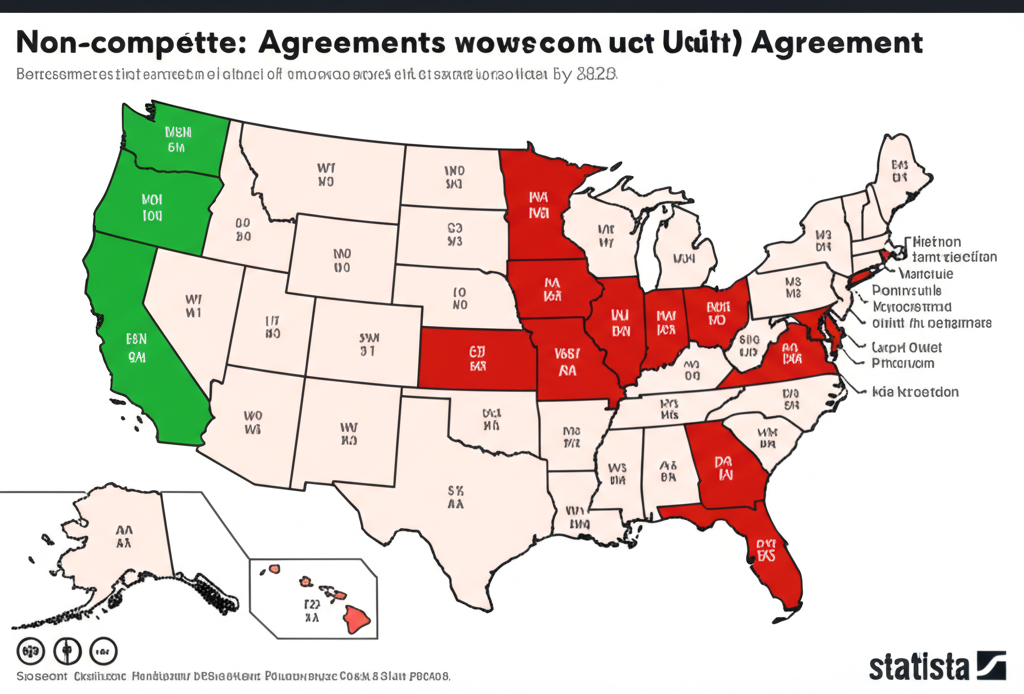
Full ban states (4): California, North Dakota, Oklahoma, and Minnesota (since May 2023) prohibit the enforcement of noncompete agreements in employment contracts. California’s ban dates to the late 19th century and is widely credited as a foundational structural reason for Silicon Valley’s explosive growth — engineers could freely move between companies, creating the talent circulation that built the modern tech industry.
Wage-threshold states: Illinois prohibits noncompetes for workers earning less than $75,000 per year. Massachusetts limits them to workers above a certain threshold and requires advance notice. Washington state has enacted a $100,000 earnings threshold. Colorado, Oregon, and Nevada have enacted similar salary-floor protections.
No meaningful protection: The majority of states, including Texas, Florida, and most of the South and Midwest, allow broad noncompete enforcement with minimal restrictions. In Florida, noncompetes are presumptively enforceable and courts must presume irreparable harm to the employer when considering injunctions. The geographic distribution of protection correlates precisely with states that have also led the push to cut SNAP benefits, opposed minimum wage increases, and enacted right-to-work laws. The absence of noncompete protection is not legal accident. It is deliberate policy.

The Generational Trap: Why Millennials and Gen Z Are Hit Hardest
The noncompete agreement abuse epidemic lands disproportionately on Millennials and Gen Z for reasons that go beyond simple demographics.
First, the sectors where noncompetes have expanded most aggressively are the sectors that dominate younger worker employment: food service, retail, app-based gig work, tech, healthcare, and personal services. Boomers who spent 30 years in manufacturing or union-protected public employment rarely encountered noncompete clauses. The expansion of noncompetes into the service sector — which accelerated precisely as younger generations entered the workforce — means the cohort most impacted is the cohort that could least afford the wage penalty.
Second, the job mobility that defines younger worker career trajectories is directly targeted. The modern career path for a Millennial or Gen Z worker is not one employer for 40 years. It is 12 jobs across 8 years. Every transition is an opportunity for wage negotiation and career advancement. Every noncompete is a toll on that transition — paid either in reduced wages at the current job, in the cost of a lawyer to negotiate release from the clause, or in the geographic displacement required to find a position that doesn’t violate the agreement.
Third, the enforcement asymmetry is fully loaded against younger workers. When a noncompete is violated, the employer has a legal department. The worker has a paycheck that stops the moment they leave. The FTC estimated that the direct litigation costs imposed on workers by noncompete enforcement total approximately $2.6 billion per year. But the indirect cost — workers who comply with unenforceable noncompetes because they can’t afford to find out — is far larger.
The millennial retirement savings crisis is, in part, a noncompete crisis. Workers who are suppressed in their wages for years in their 20s and 30s — the exact period when compound interest on retirement savings would be most powerful — arrive at 40 with less invested than they would have had otherwise. The wage theft from noncompete agreement abuse compounds over time in exactly the same way that legitimate savings compound. It just compounds in the wrong direction.
The Counter-Argument: Do Noncompetes Protect Legitimate Business Interests?
The business community’s defense of noncompetes is not entirely without merit, and intellectual honesty requires acknowledging it.
The strongest version of the pro-noncompete argument focuses on investment in human capital. If a company spends $50,000 training a software engineer in proprietary systems and that engineer can immediately join a competitor, the company will eventually stop providing the training. Several economic studies, including work by Ryan Nunn at the Hamilton Project, found that workers who signed noncompetes and stayed for at least three years earned marginally more than comparable workers without noncompetes — suggesting some wage-sharing associated with high-investment employment relationships.
There is also a legitimate trade secret argument. A senior executive at a pharmaceutical company who leaves to join a direct competitor genuinely poses a different risk than a sandwich maker who quits. Even California allows trade secret claims under the California Uniform Trade Secrets Act and the federal Defend Trade Secrets Act. The difference is that California requires the employer to prove actual trade secret misappropriation, rather than simply invoking a contract clause.
The problem is that these arguments apply to a small fraction of the 30 million workers currently bound by noncompetes. The legitimate business interest in protecting a senior pharma executive’s knowledge does not justify extending the same legal mechanism to a hair stylist who learned to cut hair at SuperCuts. The abuse is not the concept of protecting genuine trade secrets. The abuse is the industrial-scale deployment of a tool designed for one narrow purpose against tens of millions of workers for whom it was never intended.
Frequently Asked Questions About Noncompete Agreements
Are noncompete agreements enforceable?
It depends heavily on your state. Noncompetes are fully unenforceable in California, North Dakota, Oklahoma, and Minnesota. They are restricted to higher-earning workers in Illinois, Massachusetts, Washington, Colorado, and several other states. In the majority of states — including Texas and Florida — noncompetes are broadly enforceable if they are reasonable in duration and geographic scope.
Can my employer really sue me for getting a new job?
Yes. Employers file for temporary restraining orders and injunctions against departing workers regularly, especially in tech, finance, and healthcare. Most workers settle immediately because they cannot afford to fight the injunction. Legal costs of fighting a noncompete enforcement action typically start at $25,000 and can reach $100,000 or more for contested cases.
What happened to the FTC noncompete ban?
The FTC issued a final rule in April 2024 banning virtually all noncompetes. Judge Ada Brown of the Northern District of Texas issued a nationwide injunction blocking it in August 2024. The Trump FTC withdrew the rule in early 2025. There is no current federal law banning noncompetes.
What should I do if I signed a noncompete?
Get a copy of your signed agreement and understand what it says. Consult an employment lawyer in your state before assuming it is enforceable — many noncompetes are overbroad and would not survive judicial review. If you are in California, North Dakota, Oklahoma, or Minnesota, the noncompete is unenforceable regardless of what it says. If you are in a state with a wage threshold, check whether you fall below it.
Sources & Methodology
Key sources: Evan Starr, J.J. Prescott, and Norman Bishara, “Noncompetes in the U.S. Labor Force,” Journal of Law, Economics, and Organization (2019); Federal Trade Commission, “Noncompete Clause Rule: Final Rule,” Federal Register (April 2024); FTC Economic Analysis Team, “The FTC’s Noncompete Clause Rulemaking: Potential Benefits and Costs” (2024); Ryan LLC v. FTC, No. 3:24-cv-00986 (N.D. Tex., Aug. 20, 2024); Economic Policy Institute, “Noncompete Agreements: Analysis of an Evolving Employment Practice” (2019); U.S. Treasury Department, “Non-Compete Contracts: Economic Effects and Policy Implications” (2016); Hamilton Project, “Accounting for the Rise in Non-Compete Agreements,” Ryan Nunn (2016). Wage suppression estimates use FTC economic modeling from the 2024 rulemaking. All figures in 2024 dollars unless noted.


