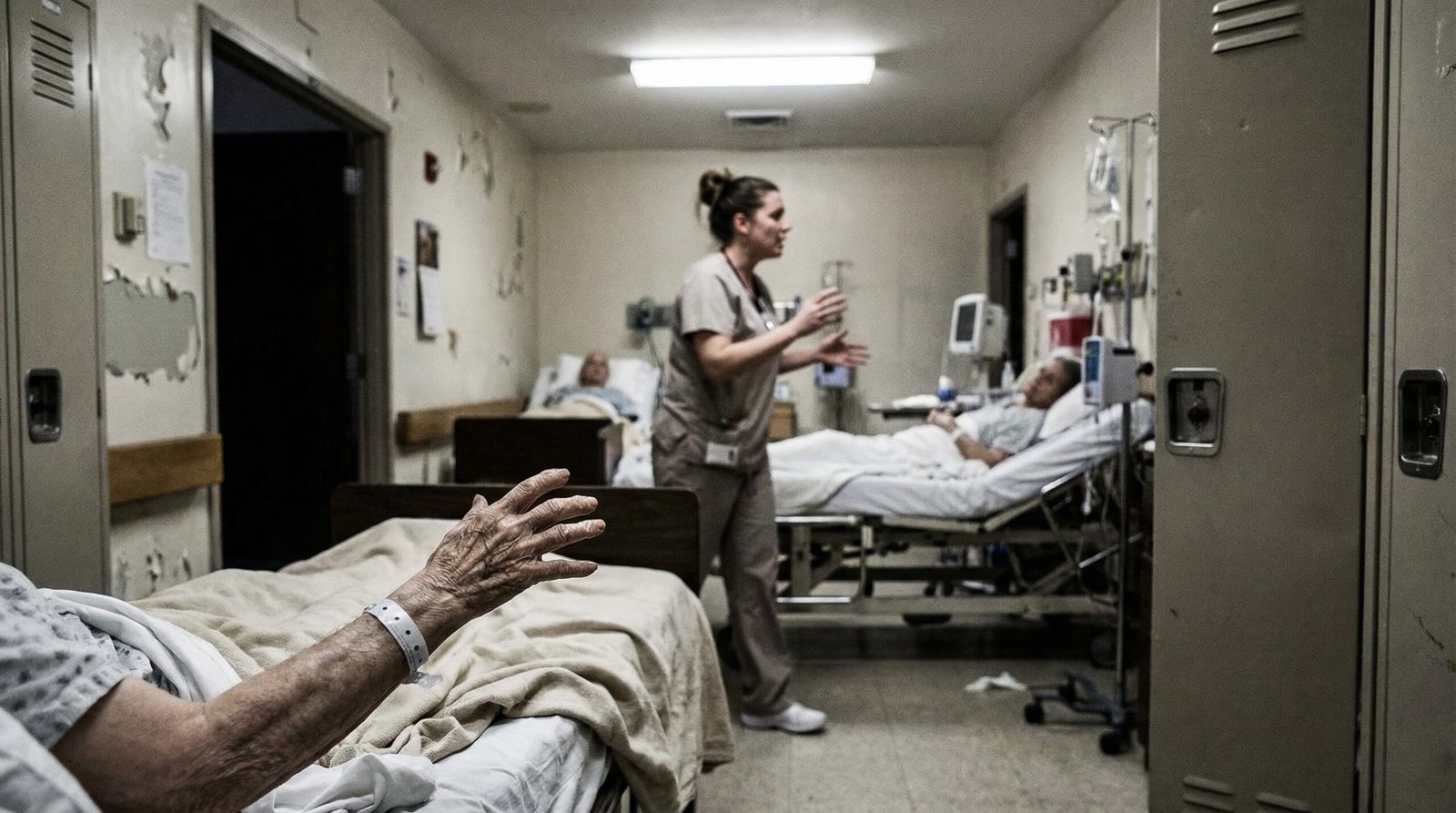

The nursing home staffing crisis is a systemic failure that has left more than 1.2 million Americans in understaffed facilities where the average nursing home operates 25% below adequate staffing levels every single day. Private equity firms, which own between 5% and 13% of U.S. nursing homes, have accelerated the crisis by cutting frontline caregivers after acquisition — with peer-reviewed research linking PE ownership to an 11% increase in resident mortality. The federal minimum staffing mandate that could have fixed it was quietly repealed in late 2025 — while the industry’s lobbying machine pocketed its returns.

Key Takeaways
- 14,742 federally certified nursing homes exist in the U.S. — and the average one is understaffed by 25% daily.
- Private equity firms own 5–13% of nursing homes and are linked to an 11% increase in resident mortality after acquisition.
- CNA turnover runs at ~50% annually; average pay is $17.90/hour — less than many fast food managers.
- The CMS staffing mandate passed in 2024 was repealed in late 2025 before it ever took effect.
- Nursing home costs hit $115,000/year for a semi-private room in 2025 — a bill Medicaid increasingly can’t cover after the 2025 reconciliation law’s cuts.
- PE-owned homes are 41% more profitable than their peers — while delivering worse care and higher Medicare costs.

What Is the Nursing Home Staffing Crisis?
As of July 2025, there are 14,742 federally certified nursing facilities in the United States, housing more than 1.2 million residents. The average facility provides 3.85 hours of nursing care per resident per day — which sounds fine until you realize the federal government’s own research says adequate care requires more, and that only 19% of nursing homes met the minimum staffing standards set in the 2024 CMS rule at the time of its passing.
RN staffing hours declined 19% between 2015 and 2025. Nurse aide hours dropped 7% in the same period. Roughly 50% of nursing homes have waiting lists and are turning residents away due to labor shortages, while 21% are actively downsizing and 24% have closed units entirely. This isn’t a pandemic hangover — it’s a decade-long structural collapse accelerated by financialization and starved Medicaid reimbursement rates.
The human math is brutal. A 20% increase in the proportion of days a facility is understaffed is associated with a 1.05-fold increase in resident mortality risk. In April 2020 alone — when facilities were understaffed AND overwhelmed by COVID — there were 1,000 additional deaths per day among Medicare nursing home beneficiaries compared to April 2019. Deaths have remained above pre-pandemic norms through at least mid-2023. The 2025 Medicaid cuts now threatening long-term care funding suggest the crisis is about to get significantly worse.

How Did Private Equity Gut Elder Care?
The PE playbook in nursing homes is identical to every other sector it has touched: buy the facility using leveraged debt, separate the real estate from the operations (so the operating company pays rent to a REIT owned by the same investors), slash frontline staffing, extract management fees, and — if the returns disappoint — file bankruptcy, wipe out the debt, and leave the residents to someone else’s problem.
The GAO estimates at least 5% of nursing homes had PE ownership in 2022 — but explicitly warns that figure is an undercount due to CMS’s inability to pierce the shell company structures PE firms use to obscure ownership. Independent researchers put the number between 5% and 13%. The Roosevelt Institute estimates 9%. In Iowa alone, a single Cascade Capital affiliate — Legacy Healthcare — controls 7% of the state’s nursing homes.
The real estate separation structure is key. Healthcare REITs like Welltower, Sabra Health Care REIT, and CareTrust REIT hold the physical buildings; PE-backed operators run the care. The REIT collects rent regardless of care quality. When the operator fails — as Genesis HealthCare did in July 2025, filing Chapter 11 with 175 facilities and $2.2 billion in debt — the residents are stranded, the PE firm walks away, and the REIT restructures to find a new tenant. The same model destroyed community hospitals. It’s now eating elder care.
Certified nursing assistants — the frontline workers who do the actual bathing, feeding, and repositioning of residents — average $17.90/hour nationally as of March 2026. Annual turnover runs at approximately 50%. More than 70% of SNFs have offered pay raises and bonuses to attract staff. It hasn’t worked, because the underlying business model doesn’t allow for the margins to pay people enough to stay.

What Happens When PE Buys a Nursing Home?
The research on PE nursing home outcomes is unusually consistent for a field where industry lobbying has historically muddied the data. The National Bureau of Economic Research’s landmark study found PE acquisition leads to a 1.4% reduction in overall staffing, a 3% decrease in paid hours, and an 11% increase in mortality rates. That’s not a rounding error — that’s roughly one additional preventable death per facility per year, multiplied across hundreds of PE-owned facilities.
A separate analysis found PE-owned nursing homes generate 11.1% more ambulatory care-sensitive emergency department visits and 8.7% more ACS hospitalizations after acquisition — the fingerprint of inadequate preventive care. When residents don’t get turned regularly, they develop pressure ulcers; when they’re not monitored for dehydration, they end up in the ER. PE homes cost Medicare an estimated $1,081 more per resident per year than comparable non-PE facilities.
Despite worse outcomes, PE-owned nursing homes are 41% more profitable than non-PE peers. That’s not a paradox — it’s the model. The profit comes directly from the gap between what you charge (Medicare/Medicaid reimbursement) and what you spend on actual care (staffing). Cut the staffing, keep the reimbursement, book the spread. The revolving door between regulators and industry ensures the inspections stay manageable. The 2024 deficiency data shows an average of 9.5 deficiencies per facility per survey cycle, with 27% of facilities receiving citations for “actual harm or immediate jeopardy” — but consequences remain rare.
The bankruptcy pipeline is especially telling. PE companies accounted for 44% of the largest healthcare bankruptcies in 2025, per the Private Equity Stakeholder Project. When Genesis HealthCare — once the largest skilled nursing operator in the U.S. — filed for bankruptcy in July 2025, it was attempting to sell itself to insiders in a deal a Texas judge rejected for “irregularities.” The chain has pending settlements for staffing neglect and deaths. Bankruptcy lets PE firms escape those liabilities while the residents lose continuity of care.

Why Did the Federal Staffing Mandate Get Killed?
In April 2024, the Biden administration’s CMS issued a long-overdue federal minimum staffing rule: nursing homes must provide 3.48 hours of direct care per resident per day, including 0.55 hours for registered nurses, 2.45 hours for nurse aides, and a 24/7 on-site RN. The rule was the first federal staffing floor in the history of nursing home regulation. Industry groups immediately sued. A Texas federal judge overturned key elements in May 2025. Then the 2025 reconciliation law — the same bill that gutted SNAP and ACA subsidies — delayed all remaining provisions until October 2034.
CMS formally repealed the remaining staffing mandate in December 2025, returning nursing homes to the pre-2024 standard: just 8 consecutive hours of nurse presence per day. That’s it. Eight hours. The other 16 hours, your grandmother can wait.
The industry’s lobbying argument was cost: meeting the standard would require hiring hundreds of thousands of new CNAs in an already-tight labor market, at a cost the industry said was impossible. What the industry didn’t mention: PE-owned facilities are already generating 41% more profit than their peers. The money exists. It’s just flowing upward to carry fees, management fees, and REIT rent payments instead of into wages for the people turning your mother every two hours so she doesn’t develop a stage-four bedsore.
Five states — California, Florida, Massachusetts, New York, and Rhode Island — have enacted their own tougher staffing standards. A KFF analysis found that even in those states, many nursing homes operate below mandated levels with minimal enforcement. In Rhode Island, one facility ran with 25% fewer nurses and aides than state minimums required — and faced no enforcement action. The governor had halted enforcement citing “industry financial constraints.”

What Does This Actually Cost?
The national median daily rate for a semi-private nursing home room rose 2% in 2025 to $315 per day — $114,975 per year. A private room runs $355/day ($129,575/year). In states like Michigan, the median hits $135,050 annually. The average American 65-year-old has less than $200,000 in total retirement savings. The millennial retirement savings picture is catastrophically worse. Two years in a nursing home — the average stay — wipes out most families entirely.
Medicaid is supposed to be the backstop. It pays for roughly two-thirds of nursing home resident-days in the U.S. But Medicaid reimbursement rates are chronically below the actual cost of care — which is itself one reason facilities cut staffing. And now the 2025 reconciliation law has made Medicaid cuts structural: the same legislative package that slashed food stamps also imposed new per-capita caps and work requirements that will squeeze state Medicaid budgets for nursing home reimbursement starting in FY2028.
Long-term care insurance was supposed to solve this. It didn’t. The LTC insurance market has effectively collapsed — fewer than a dozen carriers remain, premiums have increased 200–400% for existing policyholders, and millions of Boomers who bought policies in the 1990s are discovering the coverage isn’t what they were promised. The gap between what nursing home care actually costs and what any combination of savings, insurance, and Medicaid will cover is being absorbed by — you guessed it — the next generation.

Wait — Isn’t This Boomers’ Problem?
The nursing home industry’s defenders — and there are some — argue the real villain isn’t PE, it’s chronic Medicaid underfunding. They’re partly right: state Medicaid programs have systematically reimbursed nursing homes below cost for decades, which created the financial pressure that made facilities attractive to PE firms seeking turnaround plays. The American Health Care Association, which represents for-profit nursing homes, points out that only 4.7% of facilities are PE-owned and argues that blaming PE distracts from the reimbursement problem.
Fair point, wrong conclusion. Medicaid underfunding is real — and it’s the product of the same political choices that have underfunded public pensions, neglected infrastructure, and starved every public system that serves people who aren’t politically powerful in the moment. The solution to Medicaid underfunding is not to invite leveraged-buyout firms to extract profit from the gap — it’s to adequately fund the system. PE didn’t cause the underfunding; it weaponized it.
And yes, this is primarily a Boomer problem right now — they’re the ones in these facilities. But the generational angle runs deeper than that. The Boomer-era political coalition that defunded Medicaid, blocked universal long-term care insurance, and deregulated the healthcare sector created the conditions for this crisis. The same generation that benefited from defined-benefit pensions, free state universities, and affordable housing is now discovering that the public systems they voted to defund over 40 years don’t work very well. The irony would be darkly funny if it weren’t Millennials and Gen Z who will spend the next 20 years paying the Medicaid bills, covering the family caregiving gap, and eventually entering these same facilities themselves — to find them staffed at 75% of what’s needed and owned by whoever bought the previous PE firm’s bankruptcy estate.
FAQ
How many nursing homes in the US are understaffed?
The average nursing home is understaffed by approximately 25% on a daily basis, per federal data. Only 19% of facilities met the minimum staffing standards set in the 2024 CMS rule. Of the 14,742 CMS-certified nursing homes, 27% received deficiency citations for actual harm or immediate jeopardy to residents in the most recent survey cycle.
Does private equity ownership make nursing home care worse?
Multiple peer-reviewed studies say yes. The most cited research, from the National Bureau of Economic Research, links PE acquisition to an 11% increase in resident mortality, a 1.4% reduction in staffing, and a 3% decrease in paid care hours. PE-owned homes are also associated with 11% more preventable ER visits and 8.7% more hospitalizations than comparable non-PE facilities. PE-owned homes cost Medicare an estimated $1,081 more per resident per year. Some studies show mixed results for REIT investment specifically, though newer PMC research shows REIT ownership is associated with reduced RN staffing and worse deficiency scores.
What happened to the federal nursing home staffing mandate?
CMS issued a minimum staffing rule in April 2024 requiring 3.48 hours of direct care per resident per day and 24/7 on-site RN coverage. A Texas federal court overturned key provisions in May 2025. The 2025 reconciliation law then delayed all remaining requirements until October 2034. CMS formally repealed the mandate in December 2025, returning to a pre-2024 standard of just 8 consecutive hours of nurse presence daily.
How much does a nursing home cost in 2025?
The national median in 2025 is $315/day ($114,975/year) for a semi-private room and $355/day ($129,575/year) for a private room, per the CareScout 2025 Cost of Care Survey. Costs vary significantly by state — Michigan’s median semi-private room runs $135,050 annually. Medicaid covers roughly two-thirds of nursing home resident-days but reimburses below actual cost in most states, creating a chronic funding gap.
Sources & Methodology
This article draws on peer-reviewed research, federal agency data, and investigative reporting. Key sources include: U.S. GAO, “Nursing Homes: Limitations of Using CMS Data to Identify Private Equity Ownership” (2023); NBER Digest, “How Patients Fare When Private Equity Funds Acquire Nursing Homes” (2021); JAMA Network Open, “Association of Private Equity Investment in US Nursing Homes With the Quality and Cost of Care” (2022); CareScout 2025 Cost of Care Survey; KFF, “A Look at Nursing Facility Characteristics” (2025); Private Equity Stakeholder Project, nursing home PE report (2025); Nurse Education Today, nurse understaffing and mortality (2023); New York Times, “Nursing Home Staffing Shortages” (2024). Staffing statistics are derived from CMS Care Compare data as processed by the American Health Care Association and KFF. PE ownership percentages vary by methodology and year; we present the range 5–13% per PESP’s updated report and the GAO’s acknowledged undercount caveat.