

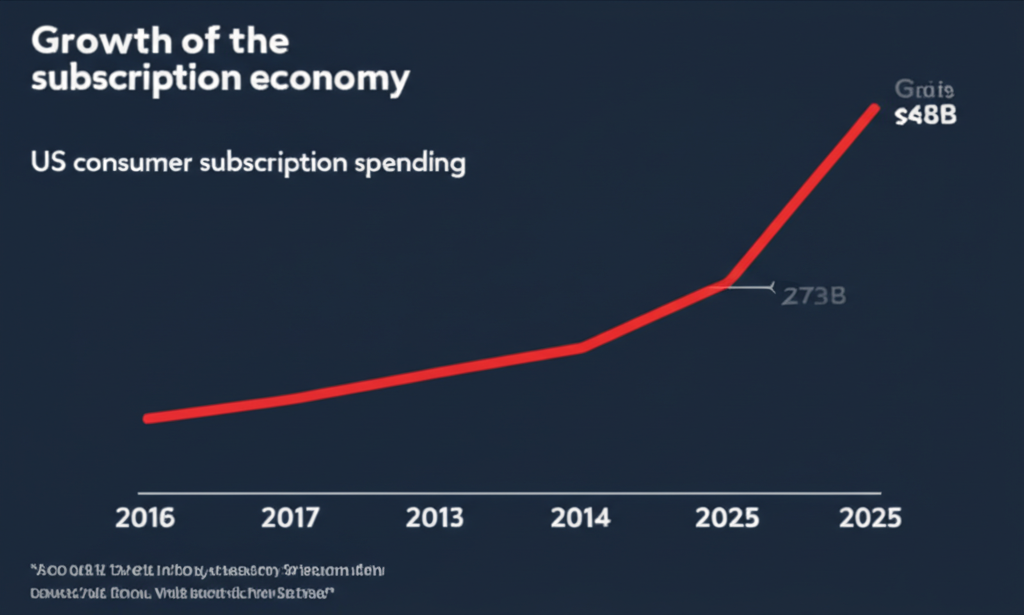
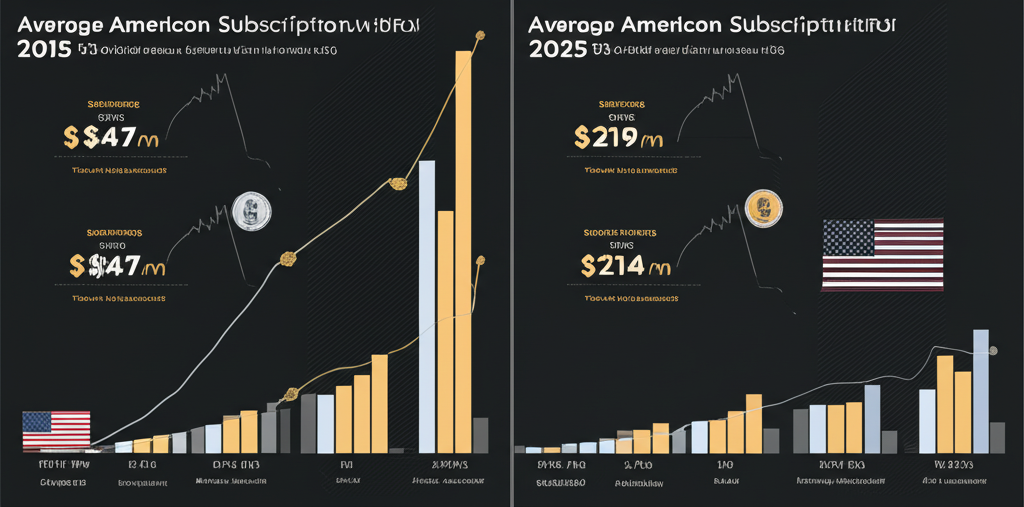
The subscription economy trap has extracted more than $273 billion from American consumers in 2025 alone — not through outright fraud, but through a carefully engineered system of dark patterns, auto-renewal defaults, deliberately confusing cancellation flows, and algorithmically timed price increases designed to maximize the gap between what consumers think they’re paying and what they actually pay. The average American now carries 14 active subscriptions costing $219 per month, up from 3 subscriptions at $47 per month in 2015 — and 42% of consumers are paying for at least one subscription they have completely forgotten about.
Key Takeaways • American consumers spent $273B on subscriptions in 2025 — a 469% increase from $48B in 2015 • The average American carries 14 active subscriptions at $219/month; 42% are paying for forgotten ones • Amazon Prime’s dark enrollment patterns added 14.9M subscribers who wouldn’t have signed up otherwise — per FTC evidence • Adobe’s annual contract trap ensnared 18M customers; FTC settlement reached $540M December 2024 • The FTC click-to-cancel rule was finalized in 2024 but enforcement is limited and penalties remain a cost of business • Gen Z and Millennials carry 38% more active subscriptions than Boomers — and 52% more forgotten charges
What Is the Subscription Economy Trap?
The subscription economy trap is the systematic use of behavioral design, dark patterns, and friction engineering to convert one-time customers into indefinite recurring revenue sources — regardless of whether those customers are still using or deriving value from the product. It is not a bug in the subscription model. It is the model.
The shift from software licenses to subscriptions was sold to consumers as a better deal: lower upfront cost, always-updated software, cancel anytime. The reality that has emerged over the past decade is the opposite: perpetual billing that automatically escalates, cancellation processes engineered to fail, free trials that convert to paid charges without clear consent, and a growing secondary market of subscription management services that exist solely because the problem has become unmanageable without help.
The corporate consolidation driving monopoly pricing across every sector has a specific subscription-economy expression: as platforms achieve dominant market position, they raise prices, remove features from base tiers, and bundle previously free functionality behind premium paywalls. The result is continuous pressure to spend more for the same access to services that have become infrastructure — creative software, cloud storage, streaming, communications tools, security software — with no competitive alternative and no exit that doesn’t involve material disruption.
The economic mechanism is straightforward. Monthly recurring revenue (MRR) is valued by investors at 8–12x annual revenue multiples, versus 2–4x for one-time purchase revenue. This means a company generating $100M/year in subscription revenue is worth three to four times more than a company generating the same revenue through product sales. The entire incentive structure of the software and media industry is now oriented around maximizing subscriber count, minimizing churn, and extracting maximum lifetime value from each account — not maximizing value delivered to users.
The gutting of the CFPB in 2026 has compounded the problem: the one agency most equipped to pursue systemic billing abuse at scale has been defanged at the precise moment the subscription billing ecosystem reached its maximum complexity. The same credit oligopoly dynamics that make it nearly impossible to dispute a credit reporting error apply here: the institutional power is entirely on the side of the biller.
The $273 Billion Dark Pattern Machine: How It Actually Works
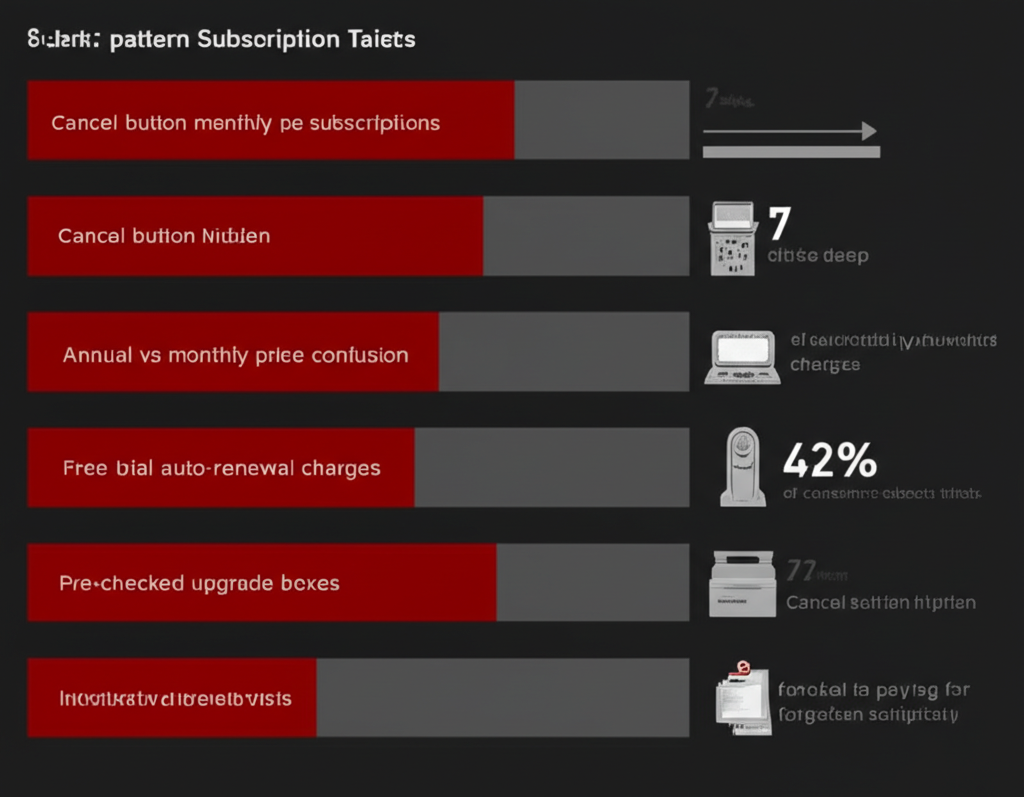
Dark patterns are user interface design choices that deliberately mislead users into taking actions they didn’t intend — or failing to take actions they did intend. In the subscription economy, they are not edge cases. They are standard industry practice, documented across thousands of platforms by the FTC, academic researchers, and state attorneys general.
The most documented dark patterns in subscription billing, with specific examples:
- The Roach Motel — easy in, impossible out. Amazon Prime’s cancellation was documented by the FTC to require navigating 6 screens and 15 individual clicks. Internal Amazon documents showed a single-click cancel button would have cost the company $78 million per year — money that currently flows from consumers who intended to cancel but didn’t complete the process.
- The Confirm-Shaming Exit — cancellation copy designed to make users feel guilty for leaving. Research from Aarhus University found confirm-shaming language reduced cancellation completion rates by 17% on average.
- The Hidden Cost Annual Plan — Adobe’s flagship dark pattern. Users selecting “monthly plan” were enrolled by default in “annual plan, monthly billing” with early termination fees up to 50% of remaining contract value. The FTC settlement reached $540M after 18 million users were trapped.
- The Price-Increase Notification Burial — price increase notices sent in emails with subjects like “Your August statement is ready,” no mention of the price change. By the time consumers notice, multiple billing cycles have passed.
- The Pre-Checked Upgrade — checkout flows where premium tiers or add-ons are selected by default. A 2024 Consumer Reports audit of 200 subscription flows found pre-checked upgrades in 67% of them.
- The Free Trial with Silent Conversion — free trial enrollment requiring payment info, converting automatically to paid at trial end with no pre-conversion notification. Standard practice across thousands of services.
“Amazon had evidence that its dark enrollment patterns added 14.9 million Prime subscribers who would not have signed up if the process had been straightforward. The company’s own A/B testing data, subpoenaed by the FTC, showed that clear disclosure of subscription terms reduced enrollment by 16%. That delta — those 14.9 million people — is the subscription economy trap made quantifiable.” — FTC v. Amazon, complaint filed June 2023
Who Profits and Who Pays: The Generational Breakdown

The subscription economy trap is not generationally neutral. Millennials and Gen Z carry disproportionate subscription burdens because they came of age during the period when the subscription model was first deployed as infrastructure across the tools required for professional and creative work.
A 2025 J.D. Power consumer subscription survey found that consumers aged 25–44 (core Millennials) carry an average of 16.2 active subscriptions at $241/month. Gen Z (18–24) carries 12.8 at $189/month. Baby Boomers (60+) carry 8.3 at $124/month. The generational gap is 38% by subscription count and 52% by forgotten-subscription incidence.
The tools required for Millennial and Gen Z professional work — Adobe Creative Cloud ($660/year), Microsoft 365 ($100/year), Figma ($144/year), Slack ($87.60/year per user), GitHub ($100/year), Notion ($96/year), Zoom ($199.90/year) — are almost entirely subscription-gated in a way they were not for Boomer-era workers, who purchased software licenses once and used them for years. There is no perpetual license version of Photoshop. There is no one-time purchase of Microsoft Office for students. These tools, required for professional participation, have been converted into indefinite rent obligations.
The same consolidation dynamic that killed the corner grocery store has applied to streaming: as Netflix, Disney+, Max, Peacock, Paramount+, and Apple TV+ each raised prices 25–40% since 2022, the monthly cost of maintaining access to the same programming available for $13.99 on Netflix alone in 2019 now requires $75–95/month across multiple platforms. The content is identical. The price is five times higher. The same fee-extraction machine that strips $50 billion annually from retirement accounts operates through the subscription economy at the consumer spending level.
The FTC’s Click-to-Cancel Rule: A Paper Tiger
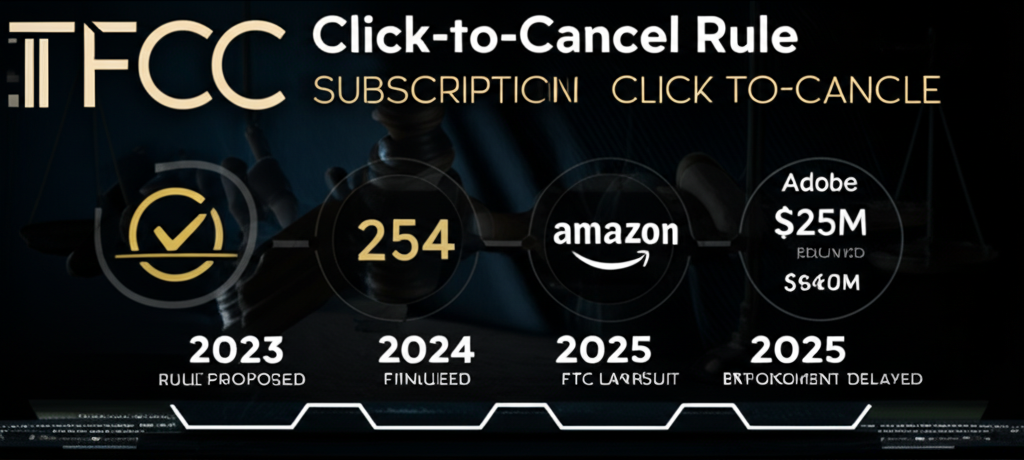
The FTC’s “click-to-cancel” rule — officially the Negative Option Rule amendments, finalized October 2024 — was the most significant federal consumer protection action targeting the subscription economy trap in decades. The rule requires that cancellation must be as easy as enrollment: if you can sign up in one click, you must be able to cancel in one click.
The rule was immediately challenged in court. The Chamber of Commerce, NCTA, and the Interactive Advertising Bureau filed for an emergency stay in the Fifth Circuit in November 2024. The Fifth Circuit granted a partial stay in January 2025, exempting platforms with under $10M in annual subscription revenue from immediate compliance, and delaying enforcement of the “simple mechanism” requirements pending full appellate review.
The enforcement record, even where the rule applies, is thin:
| Company | Violation | Settlement/Fine | Outcome |
|---|---|---|---|
| Amazon | Dark enrollment patterns, Roach Motel cancellation | $25M civil penalty | No structural change to enrollment flow required |
| Adobe | Hidden annual contract terms, ETF trap | $540M restitution fund | Plan description changed; ETF structure unchanged |
| SiriusXM | 7-step cancellation process, retention scripting | $3.5M fine | New cancellation flow; phone option still required |
| Moviepass (defunct) | Auto-renewal without disclosure | $2.6M + restitution | Company bankrupt; no consumer recovery |
| ABCmouse/Age of Learning | Children’s subscriptions without parental consent | $10M | Compliance monitoring only |
The pattern is the same in every case: fines representing a fraction of the revenue generated by the dark pattern, no structural injunction, no individual accountability for executives who approved the design. The revolving door between FTC staff and the industries it regulates is part of the structural explanation for why enforcement stays calibrated to inconvenience rather than deterrence.
“The FTC click-to-cancel rule is a speed bump, not a wall. The fines are priced in — they’re a cost of doing business, not a consequence that changes the calculus. Until the penalty for a dark pattern equals the revenue that dark pattern generated, the math still points toward keeping it.” — Consumer Reports, January 2025
The Subscription Doom Loop: How One Charge Becomes Permanent

The subscription doom loop is the compound effect of multiple practices operating simultaneously: auto-renewal, notification burial, escalating cancellation friction, and price-increase normalization. Each element alone is manageable. Together they create a system where subscription charges become structurally permanent regardless of whether the product is being used.
The mechanism: a consumer signs up with genuine intention to use the service and genuine intention to cancel if they stop. Three months later they’ve stopped using it but haven’t cancelled because the cancellation process requires 20 minutes they haven’t had. Twelve months later, the price has increased from $9.99 to $13.99 in a notification they missed. The charge is now $167.88/year for a service unused for nine months.
C+R Research’s 2025 subscription spending audit (n=2,500) found:
- 42% of respondents were paying for at least one subscription they no longer used and had forgotten about
- The average value of forgotten subscriptions was $39.80/month per affected consumer
- 62% had attempted to cancel a subscription and failed to complete the process on the first attempt
- 29% had abandoned a cancellation attempt entirely because the process was too complicated
- Subscription spending exceeds estimated amounts by an average of $133/month per household
The subscription management app industry — Rocket Money (acquired by Rocket Companies for $1.275 billion in 2023), Trim, Truebill, and DoNotPay — now represents a $2.4 billion secondary market that exists entirely because the primary market has been designed to be unmanageable. A billion-dollar industry dedicated to helping people escape subscriptions they didn’t intend to keep is the clearest possible evidence that the subscription economy trap is structural, not incidental.
The Counterargument: ‘You Agreed to the Terms’
The standard industry defense of subscription dark patterns is that consumers agree to the terms at enrollment, that the terms are disclosed in the EULA or checkout copy, and that adult consumers bear responsibility for monitoring their own financial obligations. This argument fails on three grounds.
First, empirically: disclosure does not equal informed consent when the disclosure is buried in a 40,000-word terms of service document, presented at the end of a multi-step checkout flow at the moment of maximum commitment, in 9pt font against a gray background. The FTC’s own research found that 94% of participants failed to identify material subscription terms even when told to look for them.
Second, legally: the entire premise of consumer protection law since the FTC Act of 1914 is that procedurally fair disclosure does not immunize sellers from deceptive practices. The fact that Adobe buried its early termination fee in annual plan terms did not prevent the FTC from finding the practice deceptive — because deception is evaluated from the perspective of a reasonable consumer, not a lawyer reviewing a contract with a highlighter.
Third, the competitive market failure argument: “just cancel” presupposes a competitive market with genuine exit options. For infrastructure-level tools — Creative Cloud for designers, Microsoft 365 for office workers, cloud storage ecosystems — the exit cost is prohibitive. Switching from Adobe Creative Cloud means converting thousands of proprietary files, retraining years of muscle memory, and finding functional equivalents for specialized workflows. The “you agreed to it and you can leave” argument assumes conditions that don’t exist in the markets being discussed.
How to Audit and Escape the Subscription Trap
The practical counteroffensive requires treating subscription management as a recurring financial hygiene task — not a one-time fix — because the ecosystem is designed to regenerate the problem through price increases, service changes, and the natural accumulation of new subscriptions over time.
- Run a full subscription audit quarterly — not annually. Export 90 days of bank transactions, sort by merchant, and flag every recurring charge you cannot immediately justify.
- Use a subscription tracker app for the initial audit only — Rocket Money or Trim will surface charges you’ve genuinely forgotten. Run it once for discovery; cancel manually thereafter rather than paying for ongoing management.
- Create a dedicated subscription payment card — a virtual card number from Privacy.com, used only for subscriptions. Single view of all recurring charges, and the nuclear option of canceling the card to stop platforms that make direct cancellation impossible.
- Set calendar reminders for every free trial on enrollment day — no exceptions. The trial end date is the evaluation date. Waiting to cancel “when I have time” is exactly the mechanism the trial was designed to exploit.
- Always cancel before the renewal date, not after — most platforms process renewals 24–48 hours before the stated date. Requesting a refund after renewal succeeds only about 40% of the time.
- Use the magic words in writing — “I would like to cancel my account. Please confirm my cancellation request.” Documented via email or chat screenshot. If a platform refuses cancellation in writing, that is a potential FTC complaint.
- File FTC complaints for dark patterns — reportfraud.ftc.gov. The FTC’s enforcement priorities are directly influenced by complaint volume by company. Adobe’s $540M settlement came after consumer complaints reached critical mass.
Frequently Asked Questions
What is a subscription economy dark pattern?
A subscription economy dark pattern is a user interface or communication design choice that deliberately makes it harder for consumers to avoid enrolling in, understand the terms of, or cancel a subscription. The FTC has identified dark patterns as a primary mechanism of deceptive billing under Section 5 of the FTC Act, with the most common forms including hidden cancellation buttons, pre-selected plan upgrades, free-trial silent conversion, and price increase notices buried in billing emails.
Is the FTC click-to-cancel rule now in effect?
The FTC’s Negative Option Rule amendments were finalized in October 2024 and are technically in effect, but enforcement has been limited. A Fifth Circuit partial stay granted in January 2025 exempted smaller platforms from immediate compliance, and full appellate review is pending. The rule requires cancellation to be as easy as enrollment, but fines have been too small relative to the revenue dark patterns generate to change industry behavior at scale.
How many subscriptions does the average American have in 2025?
According to J.D. Power’s 2025 consumer subscription survey, the average American carries 14 active subscriptions at approximately $219 per month — up from 3 subscriptions at $47/month in 2015. Millennials (25–44) average 16.2 active subscriptions at $241/month. 42% of consumers are paying for at least one forgotten subscription, with an average forgotten-subscription cost of $39.80/month.
What is the best way to cancel subscriptions that make it hard to cancel?
For platforms with obstructive cancellation: (1) document the attempt with screenshots; (2) contact customer service via chat using the exact phrase “I would like to cancel my account, please confirm in writing”; (3) if the platform charges an undisclosed fee, dispute the charge with your bank as unauthorized and file an FTC complaint at reportfraud.ftc.gov; (4) use a virtual card number for future subscriptions so you can force-stop billing without the platform’s cooperation.
Sources and Methodology
Data in this article draws from: C+R Research 2025 Subscription Spending Audit (n=2,500, January 2025); J.D. Power 2025 U.S. Subscription Commerce Satisfaction Study; FTC v. Amazon.com Inc., Case No. 2:23-cv-00932, Complaint filed June 2023; FTC v. Adobe Inc., Consent Order December 2024; FTC Negative Option Rule Final Rule, 89 Fed. Reg. 90476 (November 2024); FTC “Bringing Dark Patterns to Light” staff report, September 2022; Consumer Reports “Subscription Cancellation Audit,” January 2025 (n=200 platforms); Aarhus University “Confirm-Shaming and Conversion Rates in E-Commerce,” 2024; IBISWorld Subscription Management App Market Report Q1 2025; Parks Associates “Subscription Commerce: Consumer Behavior and Market Dynamics,” 2025.


