The VA cuts 2026 have gutted 14,400 healthcare positions — including 1,500+ physician roles and 4,900 nursing slots — at the exact moment the United States has deployed active-duty troops to fight the Iran war, six of whom have already come home in flag-draped coffins. The Department of Veterans Affairs serves roughly 9 million former service members. The administration that ordered them into combat has simultaneously dismantled the medical infrastructure responsible for keeping them alive when they return.

Key Takeaways
- The VA eliminated 14,400 healthcare positions in early 2026 — 1,500+ physicians, 4,900+ nurses, 1,800+ claims processors.
- Nearly 28,000 total VA employees left in 2025 alone — the largest one-year decline in VA history, representing 577,000 years of collective experience.
- Six US troops killed in the Iran war so far; hundreds more in active combat. Mental health wait times are already 60–90 days.
- The administration sending troops to war is cutting the system responsible for treating them when they return.
- DOGE originally proposed cutting 83,000 VA jobs; scaled back to ~30,000 after public backlash.
- VA Secretary Doug Collins called coverage of the cuts “scary stories.” Veterans groups called it a crisis.
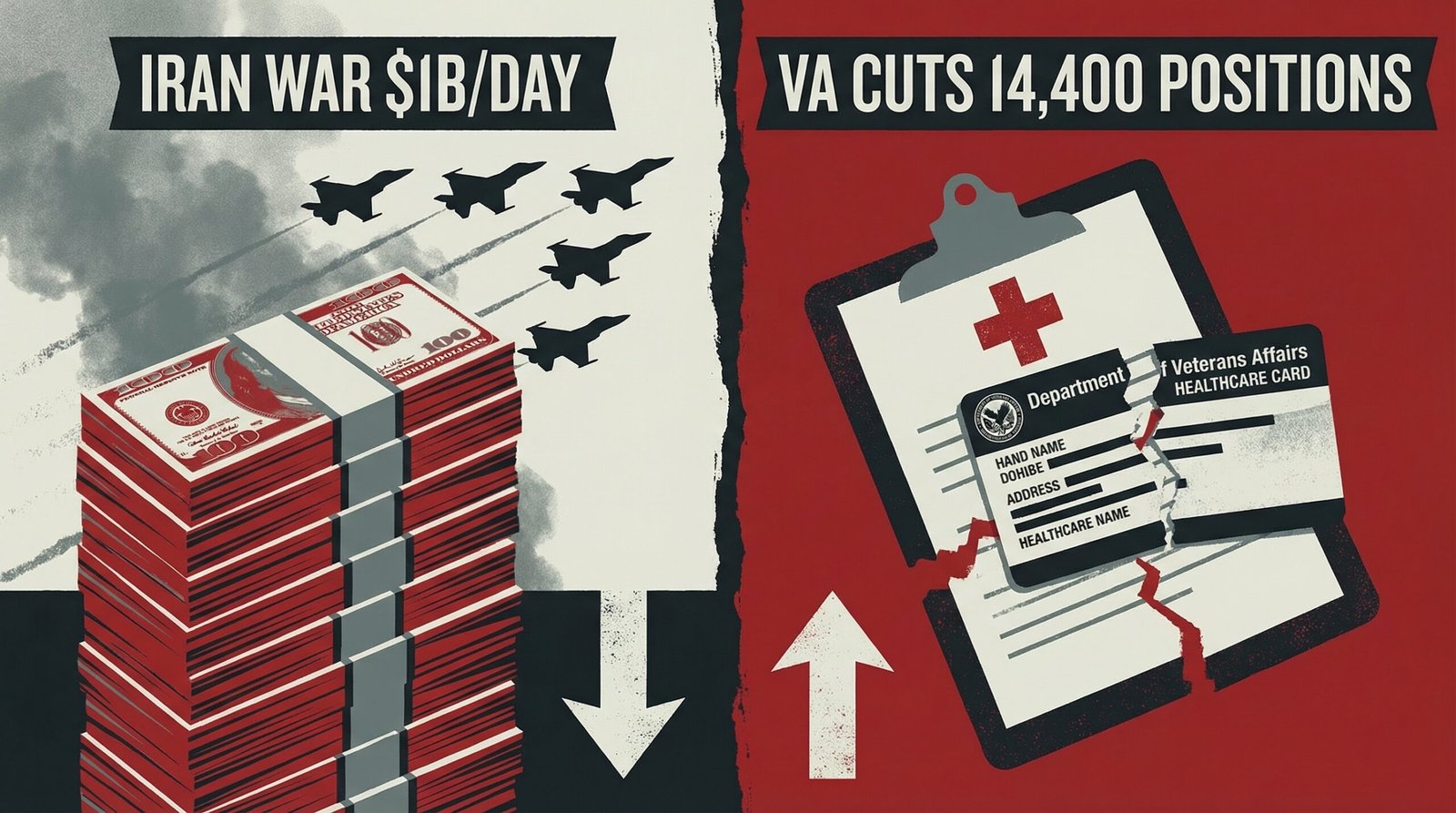
The timing is not ironic. It is policy. While the Iran war costs American taxpayers an estimated $1 billion per day, the government that authorized that spending simultaneously decided it could not afford to fill 4,900 nursing positions at the hospitals that will treat the casualties. This is not a budget shortfall. It is a deliberate sequence of choices — and the people paying for it are the same ones who already paid with their bodies.
How Many VA Positions Were Actually Cut?
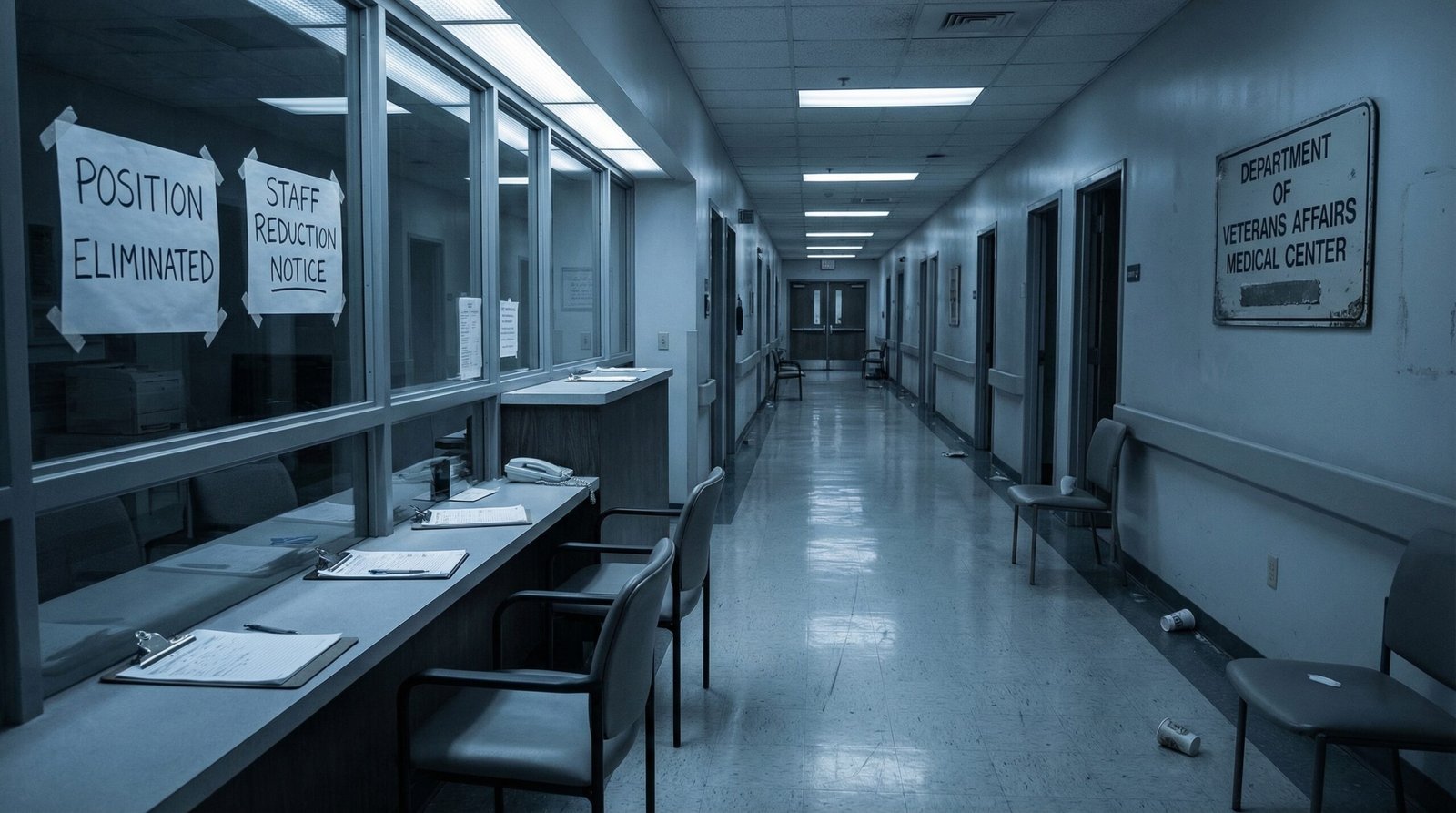
The New York Times obtained internal VA data showing the department eliminated approximately 14,400 healthcare vacancies in early 2026 — positions left open after a wave of resignations and retirements in 2025. The cuts were not layoffs in the traditional sense. The administration simply chose not to refill them. Secretary Doug Collins signed off on eliminating the slots entirely, locking the VA out of hiring those roles in the future.
The breakdown: 1,500+ physician positions eliminated. 4,900+ nursing roles. The remaining 7,700+ positions covered social workers, psychologists, claims processors, and support staff. The Center on Budget and Policy Priorities tracked the broader 2025 departures: nearly 28,000 total VA employees left in a single year — including 2,700+ nurses, 1,000+ medical officers, 1,000+ psychologists, and 1,800+ claims evaluators. Those departures had an average of nearly 11 years of service each, representing 577,000 years of institutional knowledge — 180,000 more years than any previous single-year loss.
Then, in March 2026, rather than backfill those vacancies, Collins closed them permanently. The VA told veterans publicly their care “wouldn’t be affected.” The numbers said otherwise.
There is also the disability rating controversy. In early 2026, the VA quietly proposed a rule to lower disability ratings for veterans whose conditions were being managed by medication — meaning that if your PTSD medication was working, the VA could argue your disability was less severe and cut your monthly compensation. Sen. Tammy Duckworth, an Army veteran who lost both legs in Iraq, called it “disastrous.” After weeks of backlash from veterans’ groups and bipartisan congressional pressure, Collins rescinded the rule. But the fact that it was proposed at all — while troops were actively shipping out to Iran — tells you exactly what this administration values about the people it sends to war.
The VA Cuts Started Before the Iran War — But the War Makes It Catastrophic
The cuts to the VA did not begin with the Iran war. They began the day Elon Musk’s Department of Government Efficiency sent the infamous fork-in-the-road email to federal employees in January 2025. The VA was among the first targets. An internal memo from VA Chief of Staff Christopher Syrek outlined plans to eliminate up to 80,000 jobs. DOGE later scaled back its ambitions to approximately 30,000 after polling showed that gutting veteran healthcare tested worse with every demographic group, including Trump’s core base. But even the “scaled back” version was catastrophic: 28,000 departures in 2025, then 14,400 more positions closed in 2026.
Now layer in the Iran war, which began February 28, 2026. Operation Epic Fury has already killed six US service members and left scores wounded. The Pentagon has confirmed the campaign will last “probably a few weeks” (Sen. Tom Cotton’s estimate) — but wars have a way of outlasting their projected schedules. The daily cost is running at $1 billion. The long-term cost — in disability claims, mental health treatment, physical rehabilitation, and lifelong care — will be orders of magnitude higher and will accrue over decades.
The VA has served every major US combat cohort since World War I. The Iraq and Afghanistan wars alone generated a generation of veterans with traumatic brain injuries, PTSD, limb loss, and burn pit exposure — a burden that fell disproportionately on working-class families who lacked the connections to avoid service or the resources to navigate bureaucratic dysfunction alone. The VA, for all its flaws, is often their only option. Private-sector providers lack the specialized expertise. The Paralyzed Veterans of America testified before Congress in March 2026 that comparable care for spinal cord injuries outside the VA system is “largely nonexistent.”
Sen. Patty Murray put it plainly at a Senate Veterans’ Affairs Committee hearing: Trump was “sending our servicemembers to war while failing to keep his promise to care for them.” It is not a political talking point. It is an operational fact. The system that will receive Iran war casualties is being gutted as those casualties are being created.
What Services Are Being Gutted?
The American Psychological Association’s March 2026 report documented the specific breakdown across VA specialty areas. Mental health services have been hardest hit:
- Mental health wait times: Already 60–90 days at most VA facilities, according to veterans groups. More than 57% of VA medical centers report shortages of psychologists.
- Suicide prevention: Dr. Matthew Miller, executive director of VA Suicide Prevention, departed. Dr. Marsden McGuire, director of Continuum of Care and General Mental Health, departed. The VA’s suicide crisis line now fields calls from veterans who cannot get into the system fast enough to address the underlying trauma.
- TBI and neurology: The national TeleStroke Program, which connected 45 neurologists across the VA system for remote stroke and TBI consults, is compromised by departures. Traumatic brain injury is the signature wound of modern combat.
- Women veterans: Nearly 1 in 3 women veterans reports military sexual trauma (MST), per VA data. Specialized MST counselors have left in significant numbers. Iraq and Afghanistan Veterans of America CEO Dr. Kyleanne Hunter testified in March 2026 that these service gaps are “critical.”
- Geriatric care: Vietnam-era veterans are in their 70s. The VA’s geriatric specialists are leaving at the same time this population hits peak medical complexity.
- Housing and homelessness programs: National housing experts who ran veteran homelessness initiatives have departed. The VA told Congress these roles weren’t critical. Veterans sleeping under bridges tend to disagree.
Meanwhile, veterans waiting for routine appointments report 3-month waits for initial psychiatry visits and 8-week waits for surgery scheduling. VA Secretary Collins, pressed by House Veterans’ Affairs Ranking Member Mark Takano on whether the VA had enough clinical employees, responded that it did not — then defended eliminating the positions anyway, framing it as “modernization.” Takano later asked a room full of veterans’ service organization representatives whether the staffing shortage was negatively affecting their care. Every hand went up.

Who Gets Sent to Fight — and Who Gets the Bill
The six US troops killed in the Iran war so far have been identified as coming from Army sustainment units and specialized operational teams. As this site documented, US combat deaths fall overwhelmingly on working-class and lower-middle-class families — people who enlisted because college wasn’t affordable, the job market was thin, and the military offered structure and a paycheck. The economic profile of the US enlisted force is not the economic profile of the people who authorized the Iran war.
This matters for the VA cuts because it means the people most likely to need VA care — who lack private insurance, financial cushions, or family networks to navigate civilian healthcare — are precisely the people being sent into combat while their safety net is being dismantled. The VA serves roughly 9 million veterans. Approximately 40% rely on it as their primary source of healthcare. For those without other options, the 90-day wait for a mental health appointment is not an inconvenience. It is the difference between getting help and not getting help.
The VA’s own research, published in peer-reviewed journals, shows veterans who receive VA care have significantly lower suicide rates and better outcomes for PTSD and major physical health needs than equivalent veterans treated in the private sector. The VA’s specialized expertise in combat trauma, TBI, and prosthetics is not replicated elsewhere. That expertise is built into the staff — and when the staff leaves, the expertise leaves with them. The 577,000 years of collective experience that walked out the door in 2025 does not come back when you post a job listing. It took decades to build and is being dismantled in a single budget cycle.
The Iran war is costing $1 billion per day. The VA’s total annual discretionary budget is approximately $130 billion. The math is instructive: ten days of the Iran war costs more than one month of the entire VA budget. The administration has no trouble finding money for the war. It is the aftermath — the broken bodies, the shattered minds, the decades of care that follow every conflict — where the accounting suddenly demands austerity.
This pattern is not new. Forty-three presidents have sent Americans to fight in conflicts that Congress never formally declared, accumulating $8 trillion in war debt since 2001. The VA backlog — which peaked at 900,000 pending claims in 2013 after Iraq and Afghanistan — was still running at hundreds of thousands of cases per year before DOGE began eliminating claims processors. The 1,800+ claims evaluators who left in 2025 processed the paperwork that determined whether veterans received disability payments. Their departure means longer backlogs. Longer backlogs mean veterans wait longer to receive the compensation they were legally promised for injuries sustained in service.
The Counterargument: VA Was Already Bloated
The administration’s position — articulated by Secretary Collins and supported by House Veterans’ Affairs Committee Chairman Mike Bost — is that the VA had accumulated unsustainable overhead, that DOGE identified real inefficiencies, and that eliminating unfilled positions does not cut services actually being delivered. Collins argues the VA is “modernizing,” shifting toward telehealth and contracted community care, and that the institutional resistance to reform is bureaucratic self-preservation dressed as compassion.
There is a version of this argument that has merit. The VA does have documented administrative bloat. Wait times were already a problem before DOGE arrived. Community care contracting — allowing veterans to see private providers reimbursed by the VA — has genuinely expanded access in rural areas where VA facilities are sparse.
But the numbers do not support the “nothing was really cut” framing. The NYT’s analysis found that approximately 73% of the 14,400 eliminated positions — roughly 10,500 roles — had been filled at some point during 2025. These were not theoretical vacancies. They were positions that existed, had been filled by real people providing real care, and then sat open after DOGE’s mass resignation campaign triggered an exodus. Collins then closed them permanently rather than refill them. The distinction between “unfilled” and “eliminated” is meaningful: an unfilled position can be hired into; an eliminated one cannot. The VA has now removed the legal authority to hire into roles it acknowledged it needed.
Collins himself told Ranking Member Takano, on the record, that the VA does not have enough clinical employees. He said this and then defended not hiring more. That is not modernization. That is a contradiction that veterans waiting 90 days for mental health appointments are living with in real time.
Frequently Asked Questions
How many VA positions were cut in 2026?
The VA eliminated 14,400 healthcare positions in early 2026 — including 1,500+ physician slots and 4,900+ nursing roles — on top of the roughly 28,000 total VA employees who left in 2025. In total, the department has shed approximately 40,000+ workers since January 2025.
Will Iran war veterans still get VA healthcare?
Legally, yes — combat veterans are entitled to VA care. Practically, the system receiving them is significantly understaffed. Wait times for mental health appointments are already 60–90 days. Specialized care for TBI, spinal cord injury, and PTSD is increasingly compromised by departures of expert clinical staff.
Did DOGE really target veteran healthcare?
Yes. DOGE initially proposed cutting 83,000 VA jobs, scaling back after public backlash. The VA was also among the agencies targeted by DOGE’s mass “deferred resignation” email campaign. Roughly 10,500 of the 14,400 eliminated positions had been actively filled during 2025 before departures created the vacancies now being permanently closed.
What happened to the VA disability rating cut proposal?
The VA proposed a rule in early 2026 to reduce disability ratings for veterans whose conditions were “managed” by medication — potentially cutting monthly compensation for hundreds of thousands of disabled veterans. After significant backlash from veterans’ groups and bipartisan congressional pressure, Secretary Collins rescinded the proposal in February 2026. The proposal was withdrawn, but the fact that it was advanced at all alarmed veterans’ organizations about future policy direction.
Sources & Methodology
Data on VA position eliminations from The New York Times (March 3, 2026) and The Independent/Yahoo News. Workforce departure statistics from the Center on Budget and Policy Priorities (February 20, 2026). Mental health wait times and staff shortages from the American Psychological Association Monitor (March 2026). Congressional testimony from the House Committee on Veterans’ Affairs joint hearing, March 3, 2026. Paralyzed Veterans of America testimony from Stars and Stripes (March 5, 2026). Senator Murray statement from Senate press release. Iran war cost data from prior BBA analysis. All data current as of March 7, 2026.