

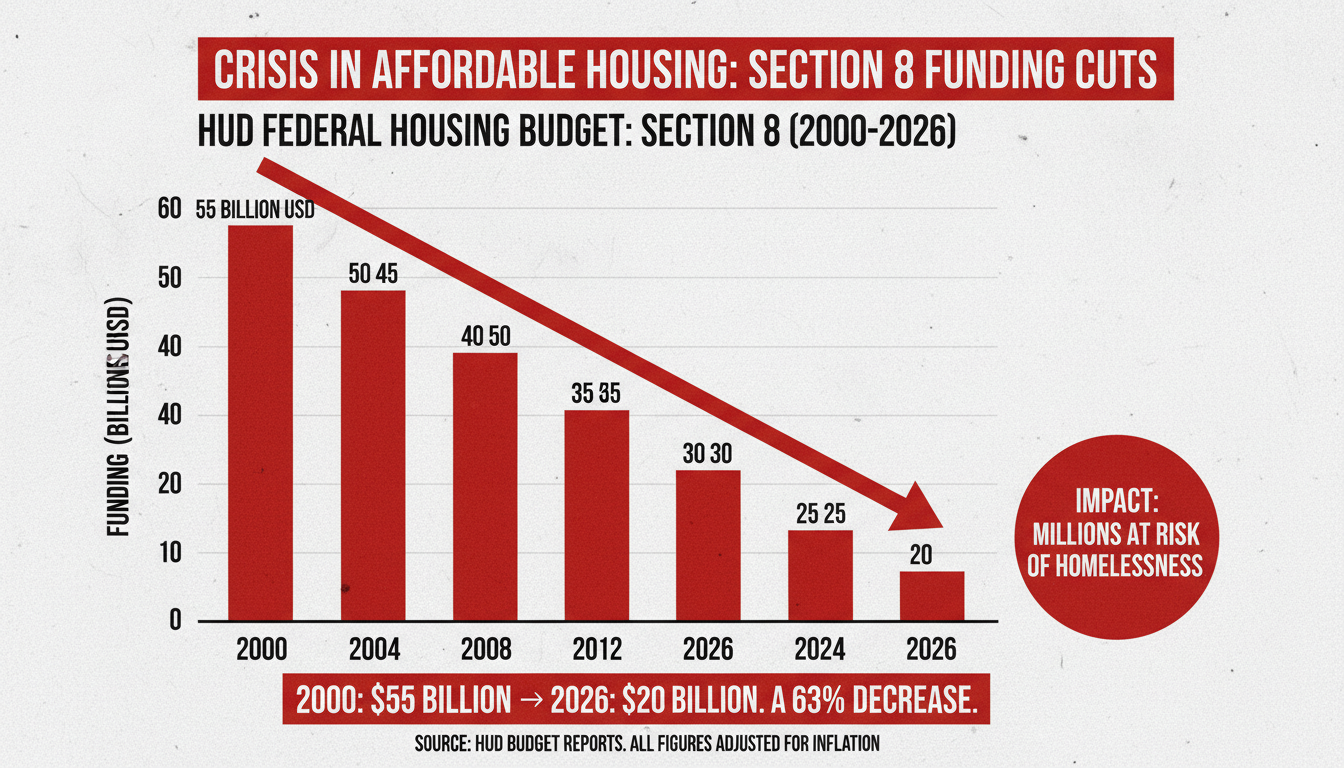
The Section 8 voucher waitlist crisis is one of the most invisible disasters in American housing policy: 2.4 million households are currently sitting on waitlists for a federal housing voucher, with an average wait of seven years before a voucher actually arrives. In some cities — Los Angeles, New York, Miami — the wait stretches past 10 years, and hundreds of thousands of low-income families have given up and removed themselves from lists that haven’t moved in years. Meanwhile, the Trump administration’s 2026 HUD budget proposal would cut rental assistance funding by $26 billion — the largest single-year cut to federal housing aid in American history.
Key Takeaways: 2.4 million households are on Section 8 voucher waitlists. The average wait is 7 years; in major cities, 10+ years. HUD closed 1,800 waitlists in 2025 — not because demand dropped, but because budgets ran out. Landlord refusal rates of 50%+ in major metros mean vouchers that are issued still can’t be used. The 2026 budget proposal cuts $26 billion from rental assistance. This is not an accident — it’s the direct result of 40 years of deliberate underfunding.
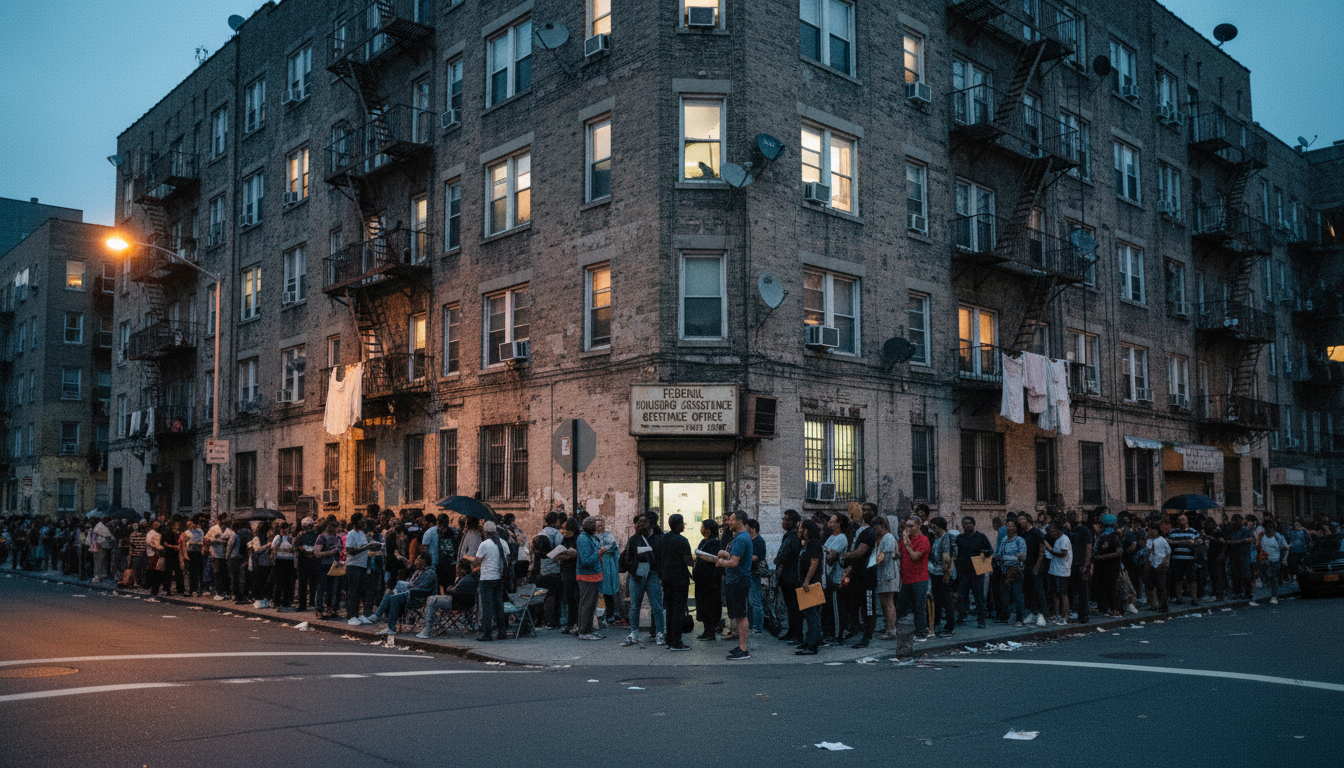
What Is the Section 8 Voucher Program?
The Housing Choice Voucher Program — universally known as Section 8 — is the federal government’s primary mechanism for providing rental assistance to low-income Americans. Administered by HUD and distributed through roughly 2,200 local Public Housing Authorities (PHAs), the program provides monthly subsidies that cover the difference between what a low-income household can afford (typically 30% of their income) and the actual market rent for a private unit.
In theory, it’s an elegant solution: instead of government-owned housing projects, voucher recipients choose their own apartments in the private market. The government pays most of the rent. Landlords get guaranteed monthly payments. Tenants get housing stability. Everyone wins.
In practice, the program serves roughly 2.3 million households out of the 17 million renter households who qualify based on income — meaning the program covers about one in eight eligible families. The other seven are on a waiting list — or they’ve given up and are one bad month away from eviction.
To qualify for a voucher, a household must generally earn below 50% of the area median income, though 75% of new vouchers are required by law to go to households earning below 30% AMI — the very poorest families. Priority is given to the homeless, people fleeing domestic violence, and those living in substandard housing. The voucher is portable: recipients can use it anywhere a landlord accepts it, which is where the second crisis begins.
The 7-Year Wait: How Bad Is the Section 8 Waitlist?
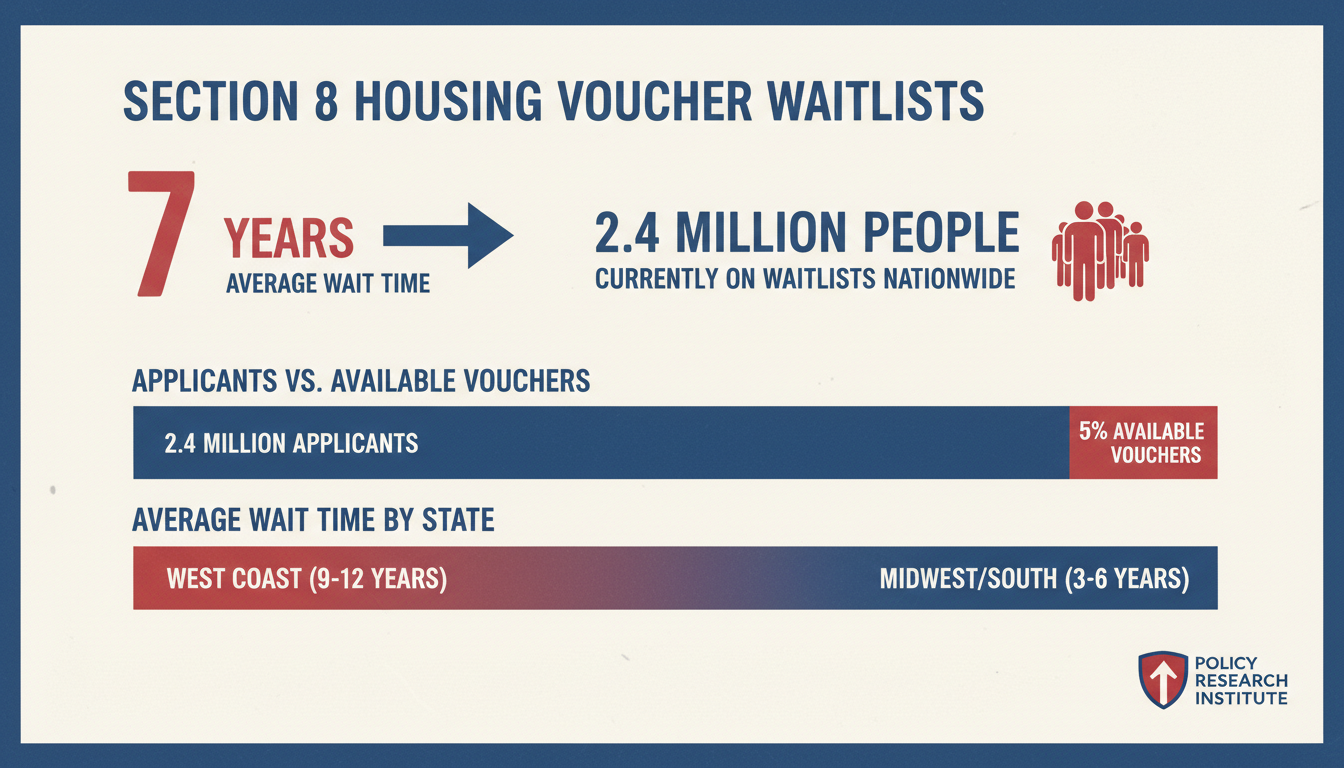
The phrase “Section 8 waitlist” conjures an image of bureaucratic delay — a line that moves slowly but surely toward housing security. The reality is more brutal: for most of the 2.4 million households currently on waitlists, the list is effectively frozen.
| City / Region | Estimated Wait | Waitlist Status (2026) |
|---|---|---|
| Los Angeles, CA | 10-13 years | Closed to new applicants |
| New York City, NY | 7-10 years | Closed (opened briefly 2022) |
| Miami, FL | 10+ years | Closed to new applicants |
| Chicago, IL | 8-12 years | Closed |
| Houston, TX | 4-6 years | Open (limited) |
| Phoenix, AZ | 5-7 years | Open (limited) |
| Atlanta, GA | 8-10 years | Closed |
| National Average | ~7 years | 1,800 waitlists closed 2025 |
According to a 2025 National Low Income Housing Coalition analysis, HUD reported that 1,800 local Public Housing Authority waitlists were closed in 2025 — not because the housing crisis eased, but because PHAs ran out of budget authority to issue new vouchers. There is literally no point in being on a waitlist if the agency has been told it cannot issue vouchers regardless of how many slots open up.
“In Baltimore, we have 25,000 families on the Section 8 waiting list. We issued 400 vouchers last year. At that pace, it would take 62 years to clear the current backlog — and new applicants are added every week.” — Baltimore Housing Commissioner, Senate testimony, September 2025
The scale of unmet need is staggering. The Joint Center for Housing Studies at Harvard estimates that the U.S. needs approximately 7.3 million additional rental units affordable to extremely low-income renters. The voucher program covers a fraction of the gap. As Wall Street continues buying up affordable rental stock at scale, the private market is moving in exactly the opposite direction of what voucher holders need.
The Funding Freeze That Made It Worse
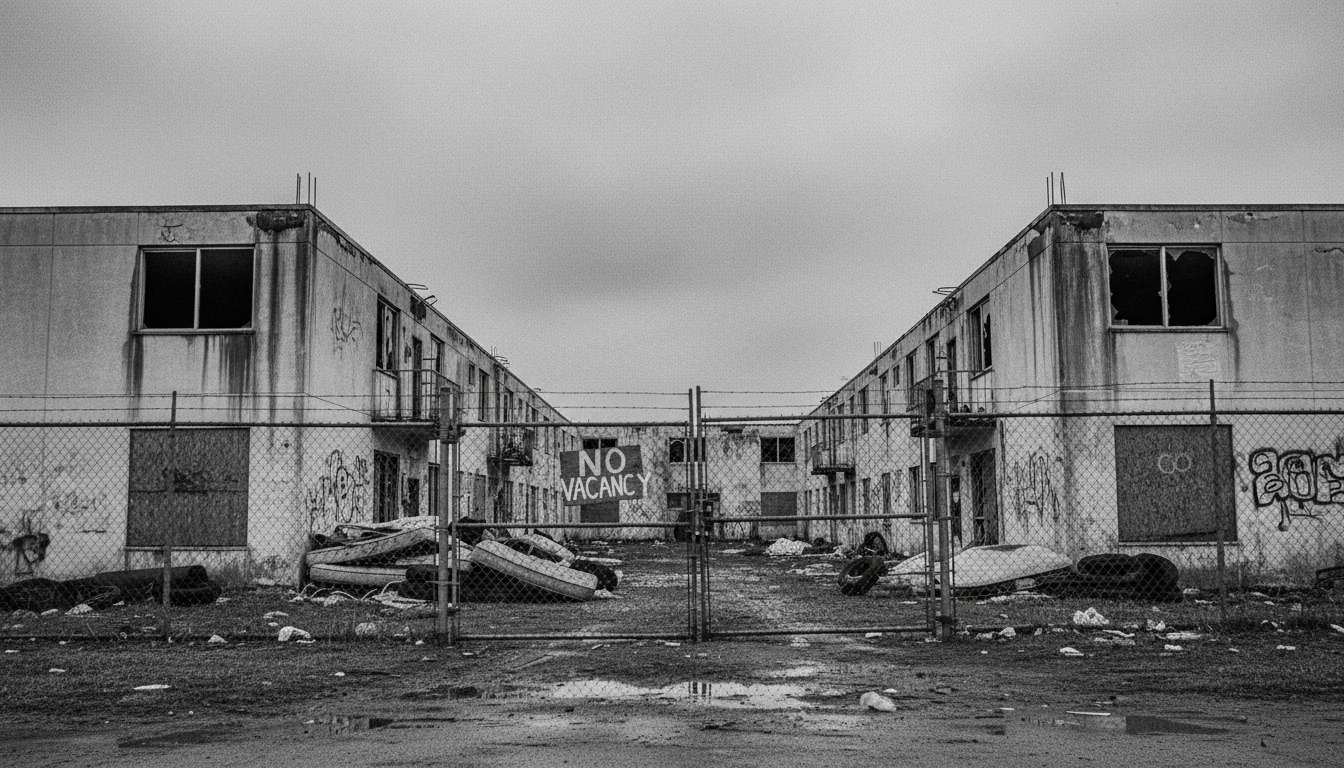
The immediate cause of the 2025-2026 Section 8 collapse is straightforward: Congress has repeatedly failed to appropriate enough money to renew existing vouchers, let alone fund new ones. In fiscal year 2025, HUD’s Housing Choice Voucher budget was cut by $4.1 billion below the amount needed to maintain all existing vouchers at current fair market rents. PHAs were forced to make impossible choices: issue fewer vouchers, drop families mid-tenancy, or impose waiting periods on renewals.
The 2026 Trump budget proposal escalates this into a structural catastrophe. The proposal calls for a $26 billion reduction in HUD’s rental assistance programs — roughly 40% of the total housing assistance budget. According to the Center on Budget and Policy Priorities, this would eliminate vouchers for approximately 800,000 households who currently have them, on top of the 2.4 million already waiting.
For context: the Iran War costs taxpayers approximately $1 billion per day. The entire annual HUD voucher budget is about $32 billion. Congress is proposing to gut the primary housing safety net for poor Americans while running a war that the Pentagon acknowledged is costing more per month than the entire Section 8 program spends in a year.
This isn’t happening in isolation. SNAP food assistance just lost $300 billion under H.R. 1. Medicaid faces multi-billion-dollar cuts. Childcare subsidies collapsed in 2024. The simultaneous gutting of every major low-income support program is not a series of unrelated budget decisions — it is a coherent policy agenda.
Who Is Actually On the Waitlist?

The political framing of Section 8 has always leaned on stereotypes. The actual data tells a different story.
| Household Type | Share of Section 8 Recipients (2025) |
|---|---|
| Elderly households (head 62+) | 23% |
| Households with disabilities | 31% |
| Working households (employed head) | 30% |
| Single-parent families with children | 47% |
| Households earning below 30% AMI | 74% |
| Black households | 44% |
| Hispanic households | 21% |
| White households | 31% |
Nearly a third of current voucher holders are working — they simply earn too little to afford market rent without assistance. Another third have documented disabilities. Almost a quarter are elderly Americans on fixed incomes. The demographic profile of the waitlist looks almost identical.
The racial composition is a function of history. Decades of redlining, discriminatory lending, and exclusionary zoning — policies championed by the Boomer political generation’s NIMBYism — systematically denied Black and Hispanic families access to homeownership and the generational wealth that comes with it.
Why Landlords Reject Section 8 Vouchers
Getting on the waitlist is step one. Getting a voucher issued is step two — potentially seven years later. But even receiving a voucher doesn’t guarantee housing. In 2025, the Urban Institute estimated that roughly 55% of issued vouchers go unused — not because recipients don’t want housing, but because they cannot find a landlord who will accept them.
Landlord refusal of Section 8 vouchers is legal in 27 states. The reasons cited by landlords who refuse:
- HUD inspections — Section 8 requires housing units to pass quality inspections. Many landlords refuse because they don’t want their properties scrutinized.
- Paperwork and payment delays — PHAs are chronically understaffed. HUD subsidy payments are sometimes delayed 60-90 days. Smaller landlords can’t absorb that lag.
- Source of income discrimination — In 27 states with no source-of-income protection, landlords can reject applicants simply for using vouchers.
- Market conditions — In tight rental markets, landlords have 20 applications from market-rate tenants for every unit. They don’t need to accept vouchers.
- Regulatory risk aversion — Landlords fear that accepting one voucher holder will trigger ongoing HUD oversight of their entire property.
The practical result: a family that waited seven years for a voucher now has 60 days to find a landlord who accepts Section 8 in a unit that passes HUD inspection at a rent within the local payment standard. If they can’t find one, the voucher expires and they return to the end of a closed waitlist.
How the Voucher Cliff Sets Families Up to Fail
Even families who successfully land housing with a voucher face a structural trap: the “voucher cliff.” HUD’s payment standards are designed to cover the 40th percentile rent in a given market — meaning 60% of available units already cost more than the voucher will cover. In cities like San Francisco, Boston, and Seattle, voucher holders are functionally priced out of the entire market.
The Section 8 voucher was designed in a housing market that no longer exists. In 1974, it was theoretically possible to find decent housing at the 40th percentile rent in most American cities. Today, the 40th percentile rent in Los Angeles County is $2,400/month for a two-bedroom. The Section 8 payment standard for the same unit is $1,850. The program is funding a gap that closed 20 years ago.
The Manufactured Housing Trap
As conventional rental housing becomes inaccessible, low-income families are increasingly pushed into the manufactured housing market — which has become a predatory lending system of its own. Clayton Homes, owned by Warren Buffett’s Berkshire Hathaway, controls roughly 50% of the manufactured housing market. Clayton both builds homes and provides financing through its subsidiary Vanderbilt Mortgage. Buyers who can’t qualify for traditional mortgages must take “chattel loans” — personal loans at rates averaging 7-15% in 2026, secured by the depreciating mobile home rather than any land.
The default rate on chattel loans is approximately 15% — three times the rate on conventional mortgages. When a resident defaults, they lose not just the home but the cost of all improvements, because the home typically sits on rented lot land. Private equity has moved aggressively into manufactured housing community ownership, imposing rent increases of 20-40% annually on lot fees.
What Boomers’ Housing Politics Built
The Section 8 crisis didn’t emerge from nowhere. It is the direct legacy of housing policy choices made and repeatedly reaffirmed by the Baby Boomer political class from the 1970s onward.
The Housing and Community Development Act of 1974 — the legislation that created Section 8 — was itself a compromise designed to move away from public housing construction after decades of NIMBY resistance. Rather than building enough public housing to meet demand, Congress chose a voucher program that required private landlord cooperation. Boomers who moved to the suburbs and pulled up the drawbridge behind them didn’t want public housing in their communities. A voucher system they couldn’t see was easier to accept.
From 1994 to 2026, the number of Housing Choice Vouchers issued grew from approximately 1.2 million to 2.3 million — a 92% increase over 32 years, during which housing costs increased by over 300%. The program was never funded to match the growth in need because doing so would have required raising taxes on the homeowner class that overwhelmingly controls federal, state, and local politics. The first-time homebuyer age is now 40. Zoning laws that protect existing homeowners’ property values have blocked virtually every attempt to build affordable housing at scale.

The result is a system designed to provide just enough housing assistance to quiet political pressure while ensuring the fundamental supply-demand imbalance that inflates homeowner wealth is never resolved. Section 8 doesn’t fix the housing crisis. It manages the symptoms of a crisis that is enormously profitable for the people who own the housing.
Counter-Argument: Isn’t This Just a Supply Problem?
The standard response to housing voucher critiques is that the fundamental problem is supply — that America simply hasn’t built enough housing, and that no voucher program can solve a supply shortage. This is partially correct and entirely insufficient.
Yes, the U.S. underbuilds housing. Yes, zoning restrictions in high-demand cities are a major cause. Yes, more supply at market rate would eventually relieve price pressure. All of that is true.
What the supply-only argument ignores is timescale and distribution. Supply-side solutions take 10-20 years to materially affect the market even under the best policy conditions. The 2.4 million families on Section 8 waitlists cannot wait 15 years for the market to equilibrate. They need housing now. Market-rate construction almost never produces units affordable to households earning 30% or 50% of AMI — private developers build for the median and above because that’s where the profit is. A robust voucher program, combined with direct public housing investment, is the only mechanism that has ever demonstrably worked at scale in any OECD country.
Frequently Asked Questions
How long is the wait for a Section 8 voucher?
The national average wait for a Housing Choice Voucher is approximately 7 years, but in high-cost cities like Los Angeles, New York, Miami, Chicago, and Atlanta, waitlists have been closed for years. Many families who applied in 2015-2018 are still waiting. In some jurisdictions, waitlists have been effectively frozen for over a decade.
Who qualifies for Section 8 housing assistance?
To qualify, households must generally earn below 50% of the Area Median Income, be U.S. citizens or eligible non-citizens, and pass a background check through their local Public Housing Authority. By law, 75% of new vouchers must go to households earning below 30% AMI. Priority is typically given to households that are currently homeless, are fleeing domestic violence, or are living in substandard conditions.
Why are Section 8 waitlists so long?
Section 8 waitlists are long because Congress has never funded the program at a level commensurate with the number of income-eligible households. Only about 1 in 8 households that qualify for a voucher actually receives one. HUD’s annual budget has failed to keep pace with rising market rents, forcing local PHAs to issue fewer vouchers even when some come available through turnover.
Can landlords refuse to accept Section 8 vouchers?
In 27 U.S. states, it is completely legal for landlords to refuse to rent to tenants with Section 8 vouchers. Only 23 states and Washington D.C. have “source of income” protection laws that prohibit this discrimination. Even in states with these protections, enforcement is inconsistent and the practical refusal rate in tight rental markets remains extremely high — the Urban Institute estimates that roughly 55% of issued vouchers go unused nationwide because recipients cannot find landlords who will accept them.
Sources & Methodology
Data on Section 8 waitlist sizes and wait times: National Low Income Housing Coalition (NLIHC) 2025 Annual Report; HUD Office of Policy Development and Research fiscal year 2025 voucher utilization data. Landlord refusal rates and voucher utilization: Urban Institute, “The Unmet Promise of Section 8 in Major U.S. Markets,” January 2026. HUD budget proposals: Center on Budget and Policy Priorities (CBPP), “FY2026 HUD Budget Analysis,” February 2026. Manufactured housing default rates: Consumer Financial Protection Bureau manufactured housing market report 2025. Demographic composition of voucher holders: HUD Picture of Subsidized Households 2025.


