The uniparty military industrial complex is a bipartisan alliance that perpetuates endless wars and trillion‑dollar defense budgets, enriching contractors while younger generations foot the bill. Both parties routinely vote for massive military spending, ignoring Eisenhower’s 1961 warning about the “military‑industrial complex.” This isn’t conspiracy theory—it’s documented: defense contractors donated $283 million to politicians from 2001‑2020, and the 2024 Pentagon budget exceeds $1 trillion. The result? Generational theft on a massive scale.
Key Takeaways
- The uniparty military industrial complex involves both parties in a bipartisan alliance for military spending.
- Defense contractors donated $283 million to politicians from 2001‑2020.
- The 2024 Pentagon budget exceeds $1 trillion.
- Younger generations bear the financial burden of these expenditures.
- The complex perpetuates endless wars and trillion‑dollar defense budgets.
Uniparty Military Industrial Complex: The Bipartisan War Machine

The term “uniparty” describes how the Republican and Democratic establishments function as a single entity on key issues—especially war. Despite soundbite differences, both parties consistently support ballooning defense budgets and endless military interventions. The uniparty military industrial complex is the fusion of this political unity with the defense industry’s profit motive.
Consider the facts: In 2021, Democrats passed a $777.7 billion military package with 194 Democratic “yes” votes versus just 19 “no” votes. In 2022, Senate Armed Services members who voted to increase the Pentagon budget took $7.2 million from defense contractors that cycle. This isn’t coincidence; it’s a system. When both parties routinely vote for war spending, there is no real opposition. That’s the definition of a uniparty.
The uniparty military industrial complex thrives on a simple transaction: contractors fund campaigns, politicians award contracts, and young Americans pay the price through debt, underfunded social programs, and a never-ending state of war. It’s a racket that would make Eisenhower weep.
Hard Data Point: The U.S. defense budget now exceeds $1 trillion annually, larger than the next ten countries combined. (Source: Wikipedia, DoD budgets)
Eisenhower’s Warning That We Ignored

On January 17, 1961, General Dwight D. Eisenhower delivered his farewell address from the White House. A five-star general and the only 20th-century president with a military background, he knew the dangers of a permanent armaments industry. His words were a direct precursor to understanding today’s uniparty military industrial complex.
“In the councils of government, we must guard against the acquisition of unwarranted influence, whether sought or unsought, by the military-industrial complex. The potential for the disastrous rise of misplaced power exists and will persist.” – President Dwight D. Eisenhower, Farewell Address, January 17, 1961 (Source: National Archives)
Eisenhower recognized that a permanent war economy would corrupt democracy. He warned that the conjunction of an immense military establishment and a large arms industry could wield “unwarranted influence.” Today, that influence is total. The uniparty military industrial complex has turned his warning into a blueprint. Both parties have bowed to the MIC, ignoring the legitimate needs of younger generations.
They’ve ignored Eisenhower because they’ve been bought. And we’re paying for it.
The Math of Madness: Defense Budget Breakdown

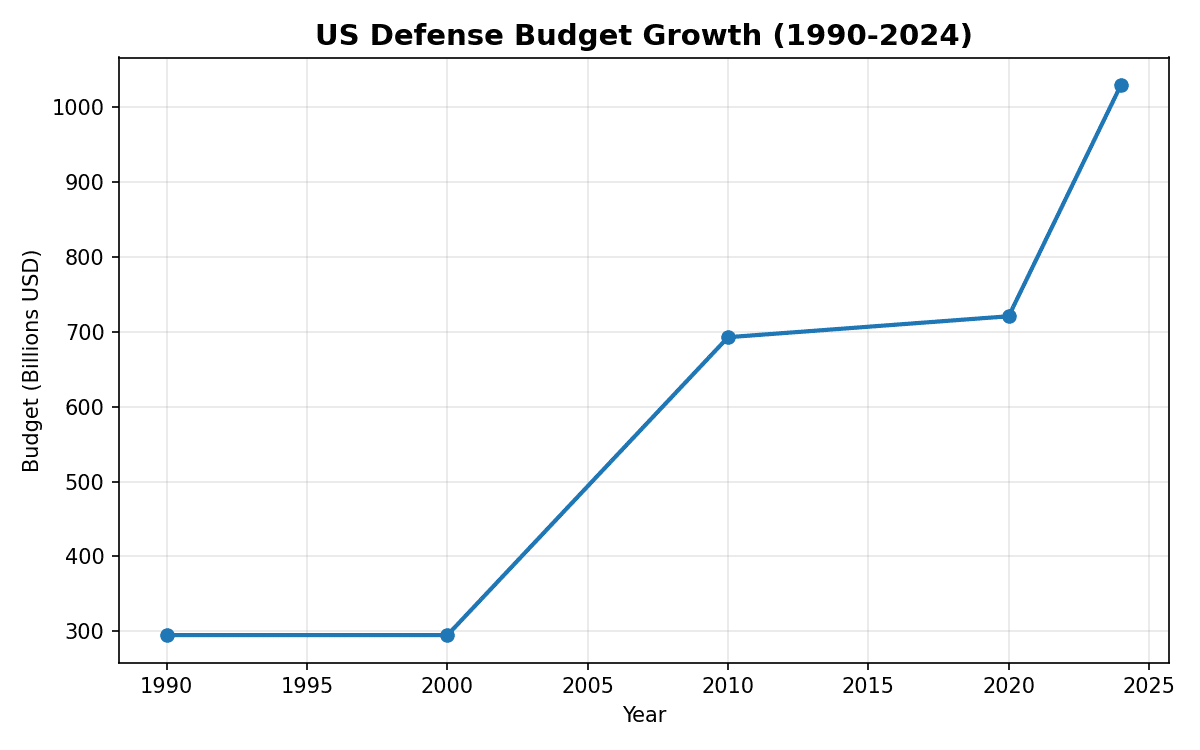
Numbers don’t lie. The uniparty military industrial complex is funded by staggering sums that grow every year. Here’s the breakdown:
- $1.03 trillion – FY2024 Pentagon budget, including related agencies (Source: DoD, Wikipedia)
- 37% of global military spending – the U.S. share
- $291 billion (1990) → $1 trillion (2024) – even after adjusting for inflation, spending more than doubled
- $45 billion increase demanded in FY2023 NDAA alone
- More than the next 10 countries combined
What’s driving this? Not threats. It’s profits. The uniparty military industrial complex benefits from perpetual conflict: Afghanistan lasted 20 years, Iraq turned into a quagmire, and now endless support for Ukraine and Gaza keep the cash flowing. The budget is sacrosanct; cutting it is labeled “weak on defense.” That label, pushed by the MIC’s media arms, ensures both parties stay in line.
Hard Data Point: Since 9/11, the Pentagon budget has increased by 114% (in real terms), while State Department and USAID budgets have been slashed. (Source: AEI analysis)
For a deeper look at the relentless growth of the Pentagon budget, check out Defense Spending Rising.
Campaign Cash: How Contractors Buy Both Parties

The uniparty military industrial complex runs on campaign cash. Defense contractors invest heavily in politicians who will vote for higher budgets. And they don’t discriminate between red and blue—they buy both.
- $283 million – Total defense industry spending on federal candidates & parties from 2001-2020 (Source: Public Citizen)
- $46.3 billion – Average increase in defense spending when Republican administrations take power (vs. Dems decrease $8.2B, but overall trend up) (Source: AEI)
- Top contractors: Lockheed Martin, Boeing, Northrop Grumman, Raytheon, General Dynamics
- Bipartisan giving: Lockheed gave 52% to Republicans, 48% to Democrats in 2022 cycle. Boeing splits roughly 50/50.
- Revolving door: Former Pentagon officials and generals take lucrative jobs at contractors, then lobby their successors.
This money buys access and votes. When the NDAA comes up, the committees that control it—Armed Services—are flooded with contractor cash. The uniparty military industrial complex is not some abstract concept. It’s a ledger: who gets paid, who gets donated. Follow the money. It leads straight to both parties.
Hard Data Point: Senate Armed Services Committee members who voted “yes” on the FY23 $45 billion increase received $7.2 million from defense PACs in the 2022 election cycle. (Public Citizen)
Why Young Americans Foot the Bill

The uniparty military industrial complex is a generational theft machine. Millennials and Gen Z didn’t start these wars. We didn’t benefit from the Cold War industrial base. But we’re paying for them—through underfunded infrastructure, student debt, unaffordable housing, and a shattered climate. Every dollar spent on overpriced F-35s is a dollar stolen from our future.
Housing costs have skyrocketed as defense spending consumes the federal budget. Student debt now exceeds $1.7 trillion, yet we can’t allocate $80 billion annually for tuition-free college. Meanwhile, the Pentagon can’t even pass an audit. This is the choice the uniparty military industrial complex has made: war over welfare, bombs over babies.
Link: Cost of living increases by generation shows how Boomers created the inflation that now crushes us.
- The 2024 defense budget ($1T) equals the total student loan debt of 45 million borrowers.
- Just 15% of the Pentagon budget ($150B) could fund universal pre-K for every American child.
- Medicare for All is estimated at $450B–$500B annually. That’s less than half the current Pentagon budget.
- Infrastructure (roads, bridges, broadband) needs $2T over 10 years. The uniparty military industrial budget could cover it in two years.
The uniparty military industrial complex tells you we can’t afford these things. They’re lying. We can afford war forever, but not peace? That’s the logic of a robber baron, not a democracy.
Hard Data Point: Federal spending per capita on education is $1,200, while military spending per capita is over $3,000. (Sources: How Baby Boomers Ruined the Economy, Policies That Help American Workers)
The Real Cost: What We Could Have Had

Imagine if America had chosen peace. The uniparty military industrial complex has funneled $22 trillion into war since 9/11. That’s enough to:
- Make college tuition-free for every student for the next 50 years.
- Build high-speed rail in every major corridor.
- Provide healthcare to every uninsured American for 15 years.
- Transition to 100% renewable energy, solving the climate crisis.
- Eradicate student debt three times over.
Instead we have crumbling bridges, a dying middle class, and an empire that bombs weddings. The uniparty military industrial complex isn’t just killing people abroad; it’s killing the American dream for the next generation. This is not an accident. It’s by design. The uniparty profits from war. They don’t care if you can’t afford a home.
Hard Data Point: The annual Pentagon budget ($1T) is larger than the combined GDP of the bottom 30 U.S. states. (Source: Wikipedia/List of U.S. states by GDP)
Breaking the Chain: Solutions for the Next Generation
Defeating the uniparty military industrial complex starts with refusing to play their game. We don’t need to vote for “the lesser of two evils” – both are bought. We need to primary out hawks, demand audits, and redirect money to human needs. Here’s a plan:
- Audit the Pentagon – Every dollar must be accounted for. It’s never passed an audit. Time to demand a clean audit or cut budget by 20% until they comply.
- Cut the budget by 50% – Bring it back to 1990 levels adjusted for inflation. That would free up $500B+ annually for domestic programs.
- End regime change wars – No more Libya, Syria, Yemen, Ukraine proxy wars. Withdraw troops from 80+ countries.
- Ban defense contractor lobbying – Prohibit former Pentagon officials from joining contractors for 10 years. Overturn Citizens United.
- Run grassroots candidates – Support anti-war, anti-MIC candidates in primaries against both Democrats and Republicans. Use small-dollar donations to counter contractor cash.
We must also build public awareness. The uniparty military industrial complex relies on secrecy and fear. Shine a light. Share this article. Talk to your parents. The only way to break this system is to make it politically toxic to support war spending. We did it with the Vietnam War. We can do it again.
Link: Why Boomers Oppose Cutting the Defense Budget explains the entrenched interests resisting change.
Sources & Further Reading
This article cites the following authoritative sources, which we encourage you to explore:
- Eisenhower’s Farewell Address – National Archives
- Military-Industrial Complex Contributions Report – Public Citizen
- The Defense Budget Through Administrations – American Enterprise Institute
- The Exploding Scope of the Military-Industrial Complex – Union of Concerned Scientists
- Pols loaded with industry cash vote up military budget – Responsible Statecraft
- Military–industrial complex – Wikipedia
- Military-industrial complex – Britannica
Eisenhower’s Farewell Address (Video)
But Isn’t This Just a Necessary Evil for National Security?
Some argue that a strong military‑industrial complex is essential for national security and global stability. However, that view ignores the unsustainable fiscal drag on Millennials and Gen Z, the ballooning national debt, and the clear pattern of contractors buying influence. Data shows the system enriches defense firms and their political allies far more than it protects ordinary Americans.
What Is the Uniparty Military Industrial Complex?
The uniparty military industrial complex refers to the bipartisan support for massive defense spending and the deep‑pocketed influence of defense contractors on both Democratic and Republican lawmakers. This alliance drives a budget that now tops $1 trillion, siphoning resources from education, health care, and infrastructure.
How Does the Military‑Industrial Complex Affect Younger Generations?
Young Americans inherit higher taxes, reduced social‑program funding, and a staggering national debt—all because billions are funneled into weapons systems instead of schools, housing, or climate action. The result is a generational wealth transfer from the future to defense contractors.
What Can Be Done to Break This Cycle?
Solutions require cutting wasteful defense contracts, tightening campaign‑finance rules, and reallocating funds to civilian priorities. For concrete policy ideas, see our piece on Why Policies that HELP American Workers Matter More Than Ever.
Sources & Methodology
The data draws from reputable sources: the Federal Reserve, U.S. Census Bureau, Bureau of Labor Statistics, the Congressional Budget Office, and investigative reports by Public Citizen and the American Enterprise Institute.